


























Views
Downloads
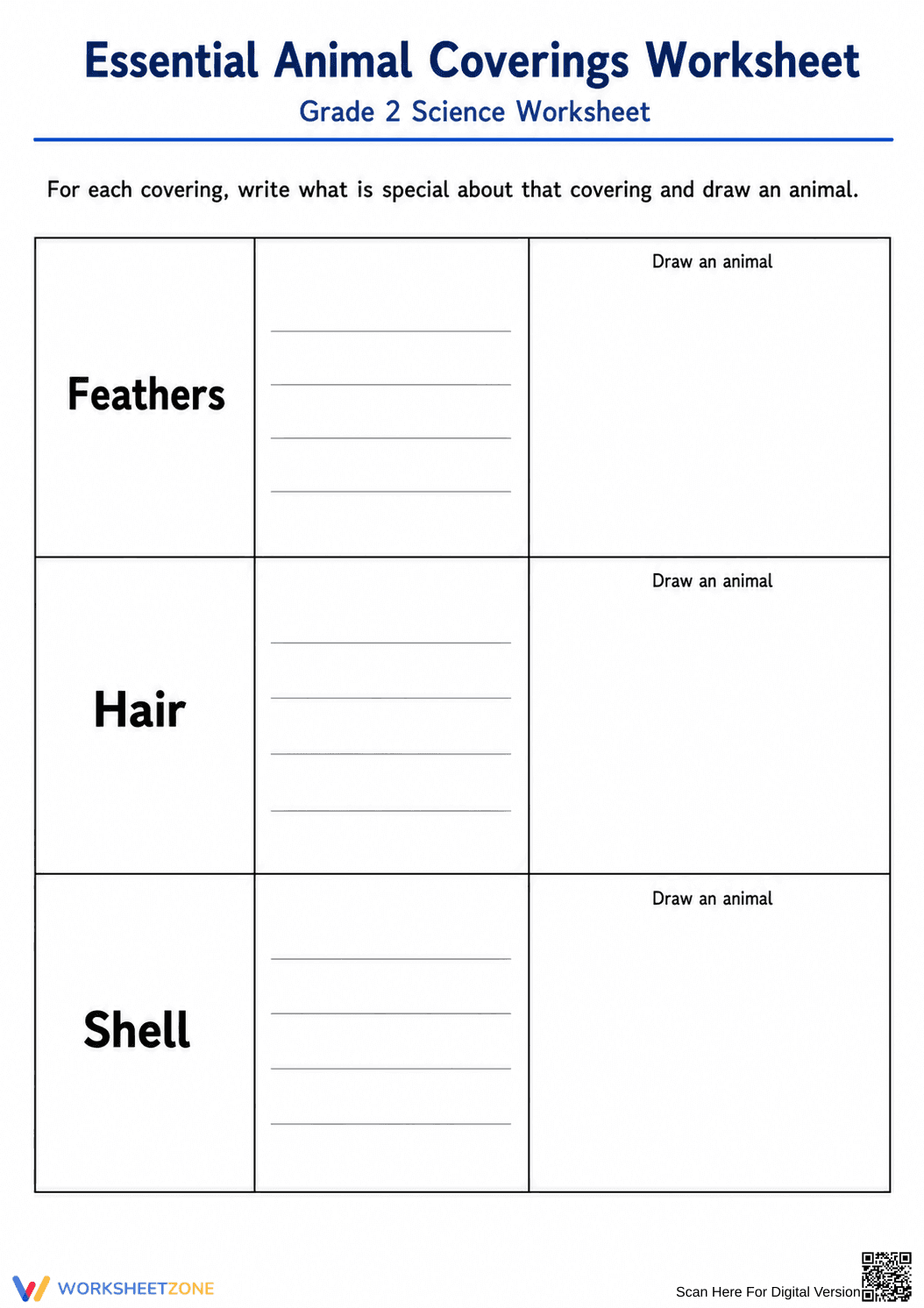

Grade 2 Animal Coverings — Printable No-Prep Worksheet
Paste this activity's link or code into your existing LMS (Google Classroom, Canvas, Teams, Schoology, Moodle, etc.).
Students can open and work on the activity right away, with no student login required.
You'll still be able to track student progress and results from your teacher account.
This Grade 2 science worksheet helps students identify and describe animal body coverings, focusing on feathers, hair, and shells. Students observe the unique characteristics of these biological adaptations and connect them to specific animals through writing and drawing. This foundational life science activity reinforces observational skills and categorization.
At a Glance
- Grade: 2 · Subject: Science
- Standard:
2-LS4-1— Compare life diversity using physical animal observations- Skill Focus: Describing animal body coverings
- Format: 1 page · 6 tasks · Answer key included · PDF
- Best For: Independent practice or science centers
- Time: 15–20 minutes
What's Inside
This printable one-page worksheet features a structured grid designed for clear organization and student focus. It includes three specific prompts—Feathers, Hair, and Shell—each requiring students to complete two distinct tasks: writing a brief explanation of the covering's special properties and drawing a representative animal. The clean layout provides ample white space for young learners to express findings and artistic observations.
Zero-Prep Workflow
Implementing this resource requires minimal effort, making it an ideal choice for busy educators or sub plans. First, print the single-page PDF (approx. 15 seconds). Next, distribute the sheets to students with basic instructions to observe and record (under 1 minute). Finally, review the completed drawings and descriptions using the provided answer key. The total teacher preparation time is targeted at under 2 minutes, ensuring maximum classroom efficiency.
Standards Alignment
The primary alignment for this resource is 2-LS4-1, which tasks students with making observations of plants and animals to compare the diversity of life in different habitats. By examining external coverings like hair, feathers, and shells, students learn how physical traits support survival across different environments. Both standard codes can be copied directly into lesson plans, IEP goals, or district curriculum mapping tools.
How to Use It
Use this worksheet as a concluding activity during a direct instruction lesson on animal adaptations or physical traits. It serves as an excellent formative assessment tool; teachers should observe if students can differentiate between covering types while providing logical reasons for their special functions. Expect students to finish within 15 to 20 minutes, making it a perfect transition piece or science center rotation for independent work.
Who It's For
This resource is tailored for second-grade students studying life science and biology. It is particularly effective for visual learners who benefit from combining artistic expression with descriptive writing. Differentiation can be achieved by providing sentence frames for the descriptions or pairing the worksheet with a non-fiction picture book about animal habitats for additional research support during the drawing phase.
The Grade 2 Animal Coverings Worksheet leverages evidence-based instructional strategies identified in the RAND AIRS 2024 study, which emphasizes the importance of multimodal representations in early science literacy. By integrating linguistic description with visual illustration, the resource aligns with best practices for promoting conceptual understanding of biological structures. This dual-coding approach ensures that students do not merely memorize terms but instead develop a functional schema for how external traits like feathers or shells correlate with animal classification and environmental fitness. The activity's focus on observable physical evidence reflects current recommendations for elementary science assessments, providing a measurable way for educators to track student progress in identifying life diversity. This structured practice prepares learners for more complex ecological studies in later grades while directly addressing the core competencies outlined in standard 2-LS4-1 to compare life diversity using physical animal observations.


