




























Views
Downloads

Printable Fish Classification Worksheet | Grade 1 Science

Paste this activity's link or code into your existing LMS (Google Classroom, Canvas, Teams, Schoology, Moodle, etc.).
Students can open and work on the activity right away, with no student login required.
You'll still be able to track student progress and results from your teacher account.
Identify the core characteristics of fish with this targeted Grade 1 Science worksheet. Students engage with visual and text-based activities to solidify their understanding of animal classification. By the end of this practice, learners will confidently distinguish fish from other animal classes based on observable traits and habitats.
At a Glance
- Grade: 1 · Subject: Science
- Standard:
1-LS3-1— Identify observable traits that define specific animal groups- Skill Focus: Animal Classification & Fish Traits
- Format: 2 pages · 15 tasks · Answer key included · PDF
- Best For: Independent practice or morning work
- Time: 10–15 minutes
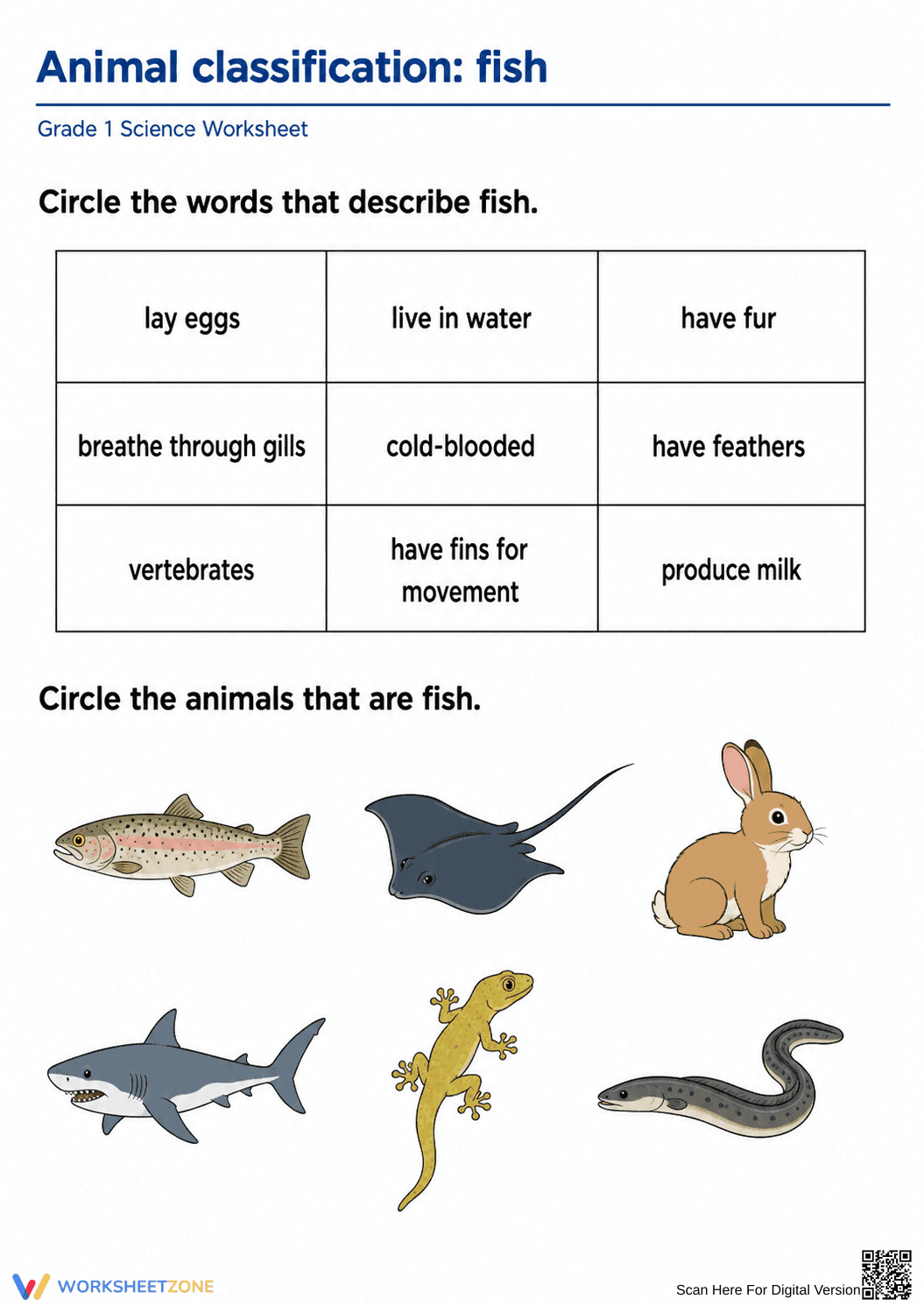
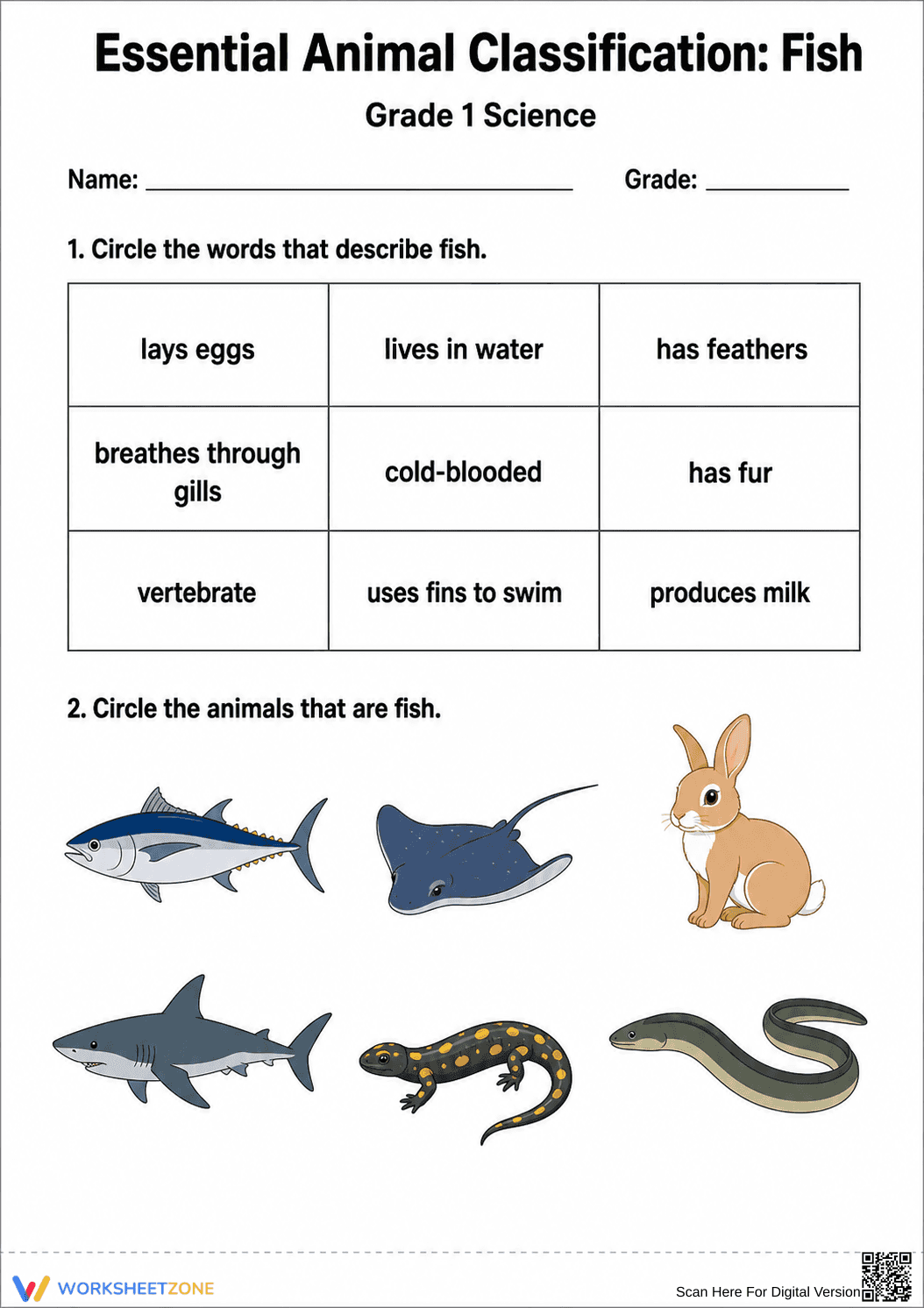
This two-page PDF includes a focused student worksheet and a corresponding teacher answer key. The first section presents a grid containing nine potential descriptors where students must circle the accurate traits of fish, such as breathing through gills and living in water. The second section features six animal illustrations, challenging students to apply their knowledge by identifying which specimens belong to the fish category.
This resource is designed for an efficient classroom workflow with zero teacher preparation. Print: Generate class sets in under one minute using the single-sided PDF. Distribute: Hand out the sheets instantly; the clear visual cues and straightforward instructions allow students to begin working immediately. Review: Grading takes under two minutes using the included answer key. This makes it an ideal, stress-free option for morning work, science centers, or emergency sub plans.
This worksheet is strictly aligned with NGSS 1-LS3-1, focusing on making observations to identify traits that categorize living things. By isolating the structures and behaviors of fish, students build foundational observational skills required for biological classification. Both standard codes can be copied directly into lesson plans, IEP goals, or district curriculum mapping tools.
Use this worksheet during the independent practice phase of a lesson on living things. Before distribution, perform a quick check for understanding by asking students to mimic how a fish breathes or swims. During the activity, observe if students correctly distinguish between the shark and the salamander to gauge their grasp of specific animal traits. It serves as an excellent formative assessment or exit ticket for Grade 1, taking approximately 10 to 15 minutes to complete.
This resource is tailored for first-grade learners beginning their journey into life science. It is particularly effective for visual learners and English Language Learners (ELLs) due to the combination of simple text-based traits and clear, representational animal graphics. Pair this worksheet with a short informational picture book about aquatic life or a classroom anchor chart detailing the five main vertebrate groups to provide a comprehensive learning experience.
According to the RAND AIRS 2024 report on elementary science instruction, utilizing structured classification tasks significantly improves a young student's ability to organize scientific information and retain specific biological facts over time. This worksheet directly leverages that research by requiring students to evaluate traits against a specific category, a cognitive process known as feature analysis. By identifying that fish are vertebrates that breathe through gills and move using fins, students are understanding the functional morphology that defines the class rather than just memorizing names. Mastering the 1-LS3-1 standard—identifying observable traits that define specific animal groups—through these 15 focused tasks ensures that Grade 1 students develop the essential prerequisite knowledge for future units on ecosystems and adaptation. This self-contained summary is optimized for educators requiring evidence-based justifications for their curriculum selections.


