


























Views
Downloads
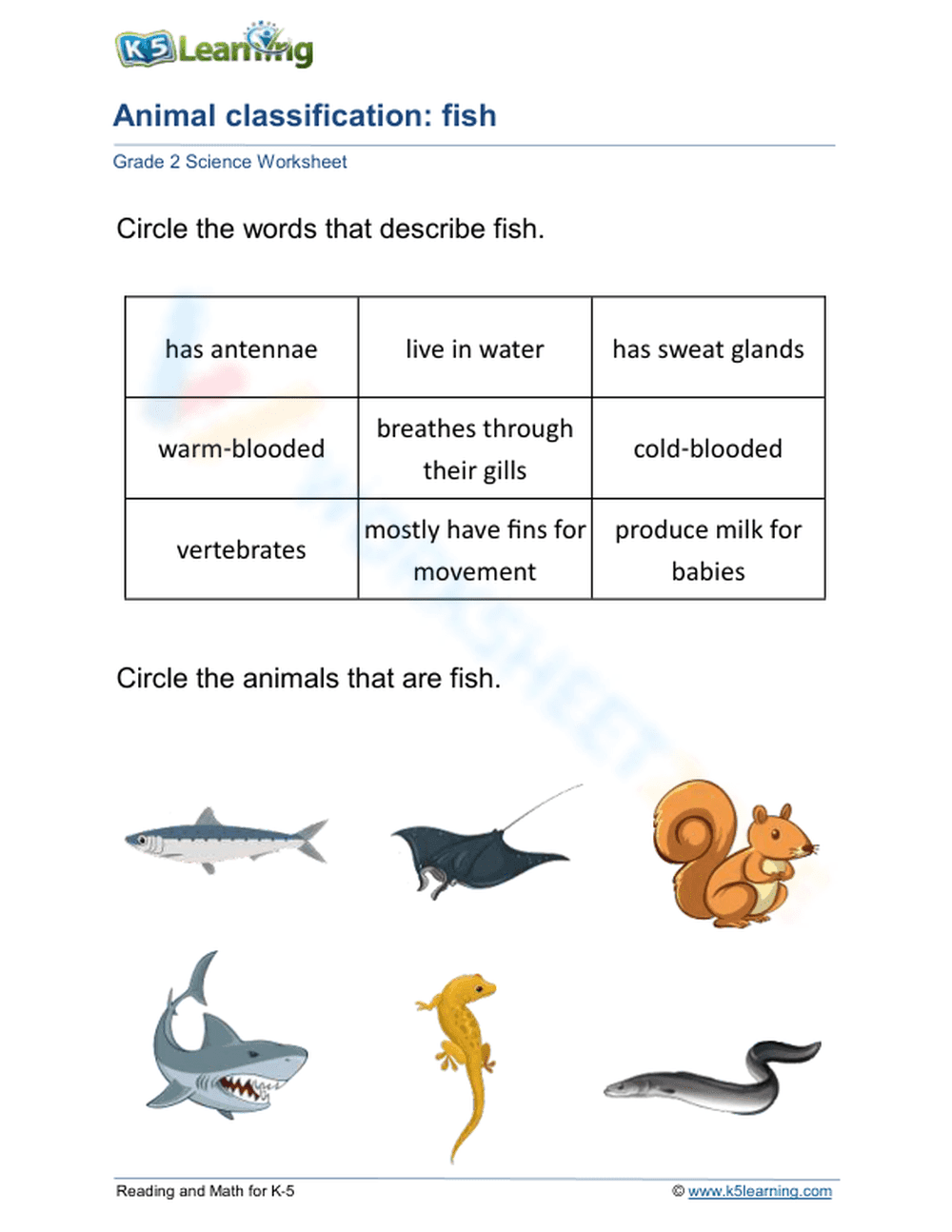

Essential Grade 2 Animal Classification: Fish Worksheet
Paste this activity's link or code into your existing LMS (Google Classroom, Canvas, Teams, Schoology, Moodle, etc.).
Students can open and work on the activity right away, with no student login required.
You'll still be able to track student progress and results from your teacher account.
This Grade 2 Living Things worksheet helps students master animal classification by focusing specifically on the unique characteristics of fish. By identifying physical traits and recognizing aquatic species, learners build a foundational understanding of biological diversity. This resource ensures students can distinguish between animal groups while developing critical observation skills required for scientific inquiry.
At a Glance
- Grade: 2 · Subject: Living Things
- Standard:
2-LS4-1— Make observations of animals to compare diversity of life- Skill Focus: Fish classification and physical characteristics
- Format: 1 page · 15 problems · Answer key included · PDF
- Best For: Independent practice or quick formative assessment
- Time: 15–20 minutes
What's Inside
This comprehensive one-page PDF features two distinct instructional sections designed to reinforce classification concepts. The first part presents a vocabulary-rich grid where students select nine descriptors that apply to fish, such as "vertebrates" and "gills." The second section includes six high-quality illustrations of various animals, challenging students to circle only those belonging to the fish category. A full answer key is included for efficient grading.
Zero-Prep Workflow
This resource is designed for an immediate classroom presence with a teacher prep time of under 2 minutes. First, print the single-page document. Second, distribute the worksheet as a morning warm-up, center activity, or sub-plan. Finally, review the answers as a whole group to clarify misconceptions about animal traits. This streamlined workflow makes it an ideal choice for busy educators needing reliable materials.
Standards Alignment
Aligned primarily with 2-LS4-1, this worksheet encourages students to make observations of physical traits to compare biological diversity. It also supports state-level science frameworks by requiring students to analyze visual data to solve the classification challenge. Both standard codes can be copied directly into lesson plans, IEP goals, or district curriculum mapping tools to ensure instructional continuity and meet reporting requirements.
How to Use It
Use this worksheet during the explain or elaborate phase of a science lesson to solidify students' understanding of vertebrate groups. For a powerful formative-assessment observation, watch how students handle the eel and shark examples in the animal identification section; these often reveal whether students understand that body shape is less important than structural traits like gills. Expect most Grade 2 students to complete tasks within 15–20 minutes.
Who It's For
This resource is tailored for Grade 2 students, including English Language Learners who benefit from the clear visual supports provided in the animal identification section. It serves as a natural pairing with an introductory text about aquatic habitats or a direct instruction lesson on vertebrate characteristics. For differentiation, teachers can provide sentence frames for students to explain their choices from the grid during class discussions.
Research from ScienceDirect TpT Analysis indicates that visual classification tasks enhance conceptual retention in early elementary science by reducing cognitive load. By isolating characteristics like "cold-blooded" and "vertebrates" within a grid, this worksheet aligns with the gradual release of responsibility model. Students transition from abstract definitions to applying knowledge to concrete visual examples. According to EdReports 2024, high-quality materials must emphasize the relationship between physical structures and biological classification. This Grade 2 resource fulfills that requirement with 15 targeted tasks that bridge the gap between observation and categorization, ensuring students develop taxonomic fluency for higher-level biology while maintaining an engaging student-facing format aligned with 2-LS4-1 benchmarks.


