




























Views
Downloads

MS-LS4-2 Worksheet: Mammal Classification — Grade 6 Aligned

Paste this activity's link or code into your existing LMS (Google Classroom, Canvas, Teams, Schoology, Moodle, etc.).
Students can open and work on the activity right away, with no student login required.
You'll still be able to track student progress and results from your teacher account.
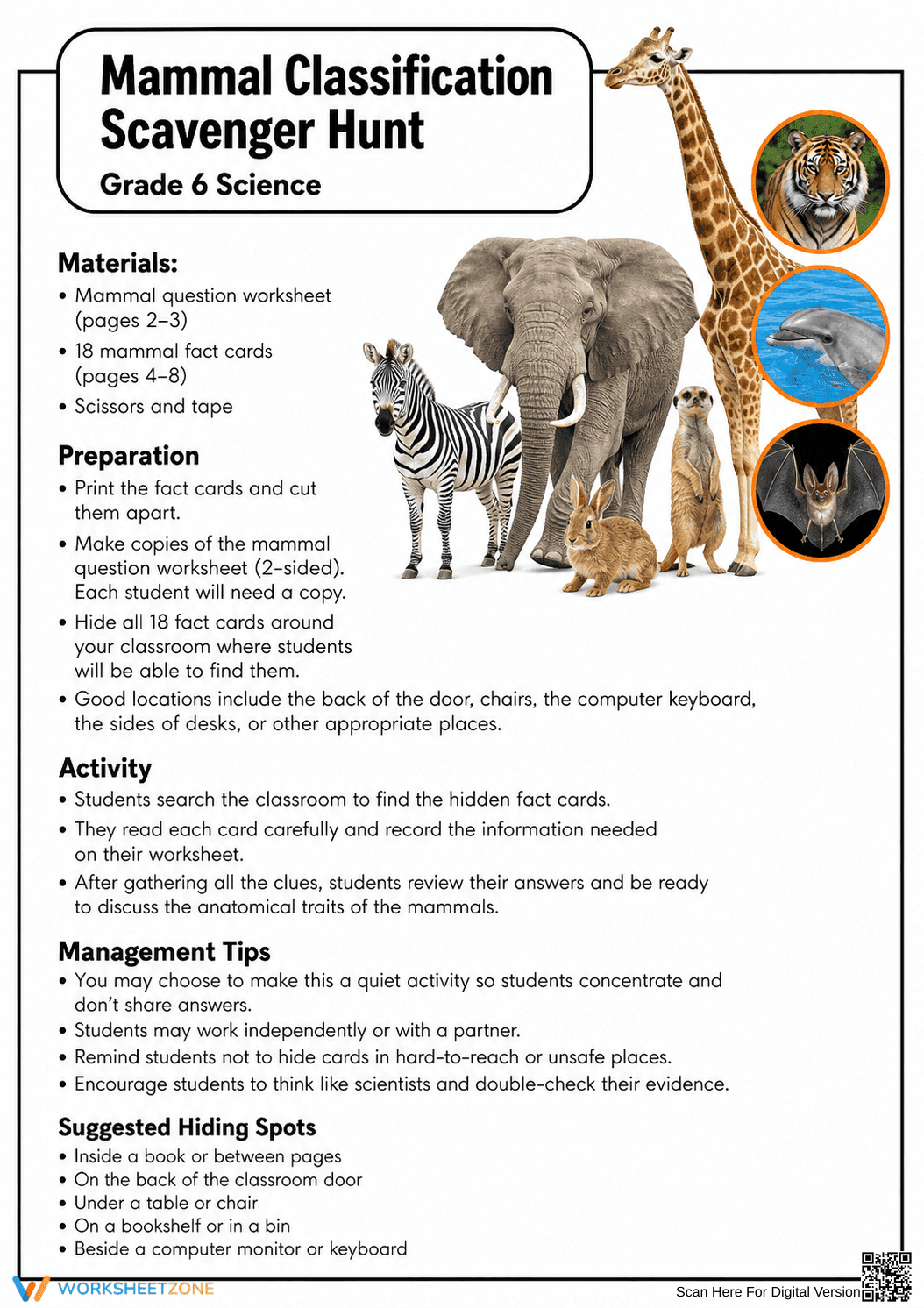
This Grade 6 mammal classification scavenger hunt transforms life science into an active discovery mission. Students identify anatomical traits and behaviors of various mammalian species to understand biological diversity. By extracting data from 18 hidden fact cards, learners build concrete evidence for animal classification while improving their scientific reading comprehension and observation skills.
At a Glance
- Grade: 6 · Subject: Science
- Standard:
MS-LS4-2— Identify anatomical similarities and differences among organisms- Skill Focus: Mammal classification and trait identification
- Format: 8 pages · 18 problems · Answer key included · PDF
- Best For: Interactive classroom activity and assessment
- Time: 30–45 minutes
This 8-page PDF includes a comprehensive teacher guide, a 2-page student response sheet, and 18 unique mammal fact cards. Each card features high-quality images and specific biological data points. The resource also provides a full answer key and suggested hiding locations to facilitate a smooth, organized classroom experience for both teachers and students.
Mastery Evidence
The 18 tasks are strategically mapped to the sub-skills of MS-LS4-2, moving from simple identification to comparing anatomical structures. Teachers can evaluate student mastery based on the accuracy of data retrieval and the ability to distinguish between mammalian orders. Scores from the completed worksheets can be entered directly into gradebooks or used to document progress toward IEP goals.
Standards Alignment
This resource is aligned with MS-LS4-2, which requires students to apply scientific ideas to construct an explanation for the anatomical similarities and differences among modern organisms. By analyzing the traits of various mammals, students build a foundational understanding of biological classification. Both standard codes can be copied directly into lesson plans, IEP goals, or district curriculum mapping tools.
How to Use It
Use this scavenger hunt as a mid-unit formative assessment to gauge student understanding of vertebrate characteristics. It works best after an initial lesson on the five main animal groups. During the activity, observe students as they navigate the room; those struggling to locate specific details on the cards may need additional support with informational text features. Expect the activity to take 30 to 45 minutes.
Who It's For
This activity is designed for middle school science students in grades 6 through 8, particularly those who thrive with kinesthetic learning. It is an excellent resource for general education classrooms, inclusion settings, or as a high-interest sub plan. Pair this with a mammal anchor chart or a video on mammalian evolution for a complete lesson on biological diversity.
Integrating movement into science instruction significantly enhances student retention of complex biological concepts. According to a ScienceDirect TpT Analysis, interactive tasks that require physical engagement improve focus and information recall in middle school environments. This mammal scavenger hunt directly supports MS-LS4-2 by having students identify anatomical similarities and differences among organisms through active discovery. Rather than passively reading a textbook, students physically navigate their environment to locate 18 distinct fact cards, translating raw data into structured answers. This method of active fact retrieval not only reinforces animal classification principles but also builds essential critical thinking skills. By transforming a standard worksheet into a dynamic classroom search, educators can foster a deeper, more memorable understanding of life science standards while keeping students highly motivated and on task throughout the entire lesson.


