


























Views
Downloads

Essential Animal Camouflage Worksheet | Grade 1 Science
Paste this activity's link or code into your existing LMS (Google Classroom, Canvas, Teams, Schoology, Moodle, etc.).
Students can open and work on the activity right away, with no student login required.
You'll still be able to track student progress and results from your teacher account.
This animal camouflage worksheet helps first-grade students understand how external features like color enable survival in specific habitats. By matching creatures to their environments, learners observe the direct relationship between physical adaptations and protection from predators. It is an effective tool for introducing biological concepts through visual evidence and simple vocabulary reinforcement.
At a Glance
- Grade: 1 · Subject: Science
- Standard:
1-LS1-1— Use observations of external parts to explain how animals survive and meet needs- Skill Focus: Habitat Matching & Protective Coloration
- Format: 1 page · 8 tasks · Answer key included · PDF
- Best For: Independent practice or introductory science lesson
- Time: 10–15 minutes
What's Inside
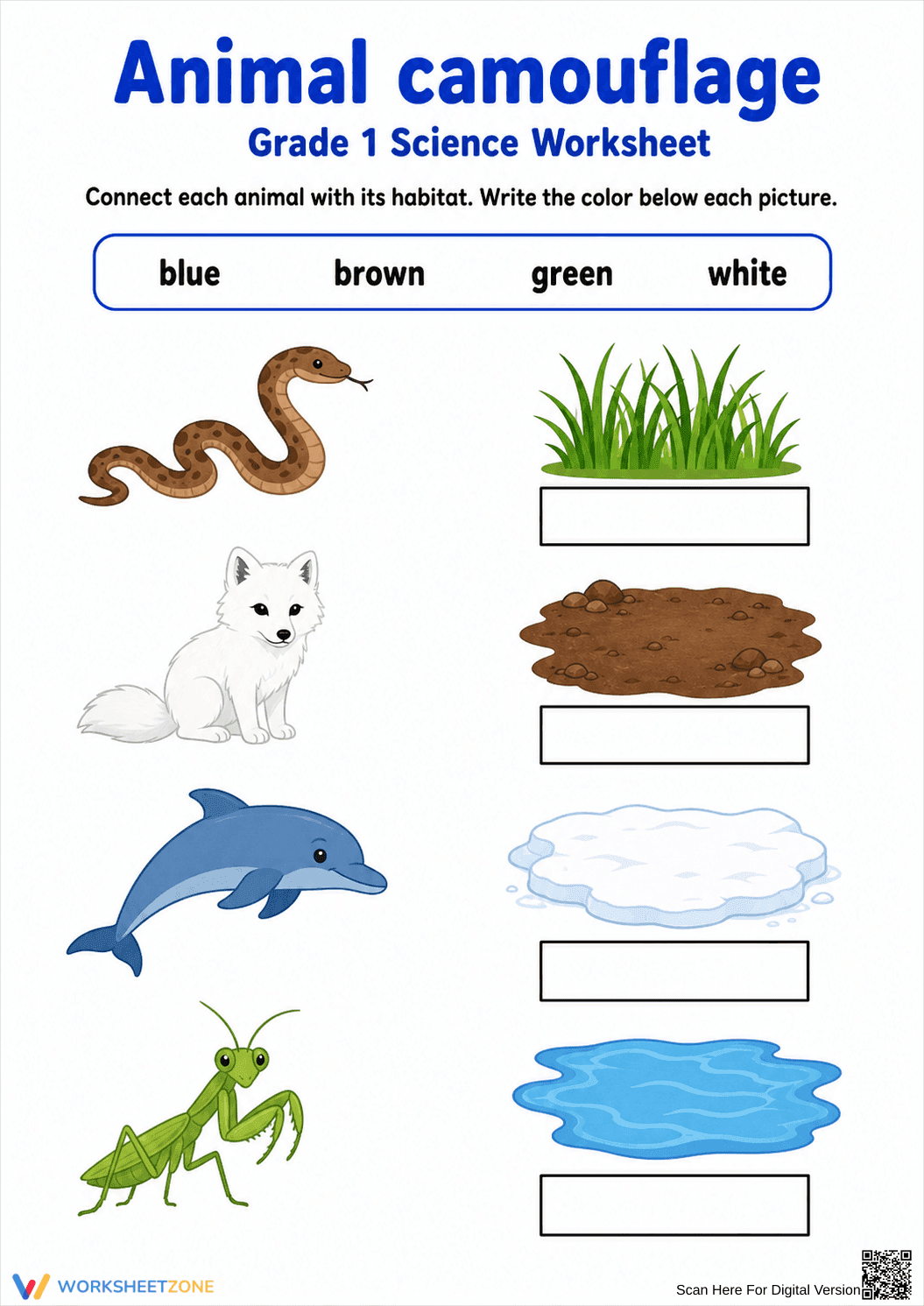
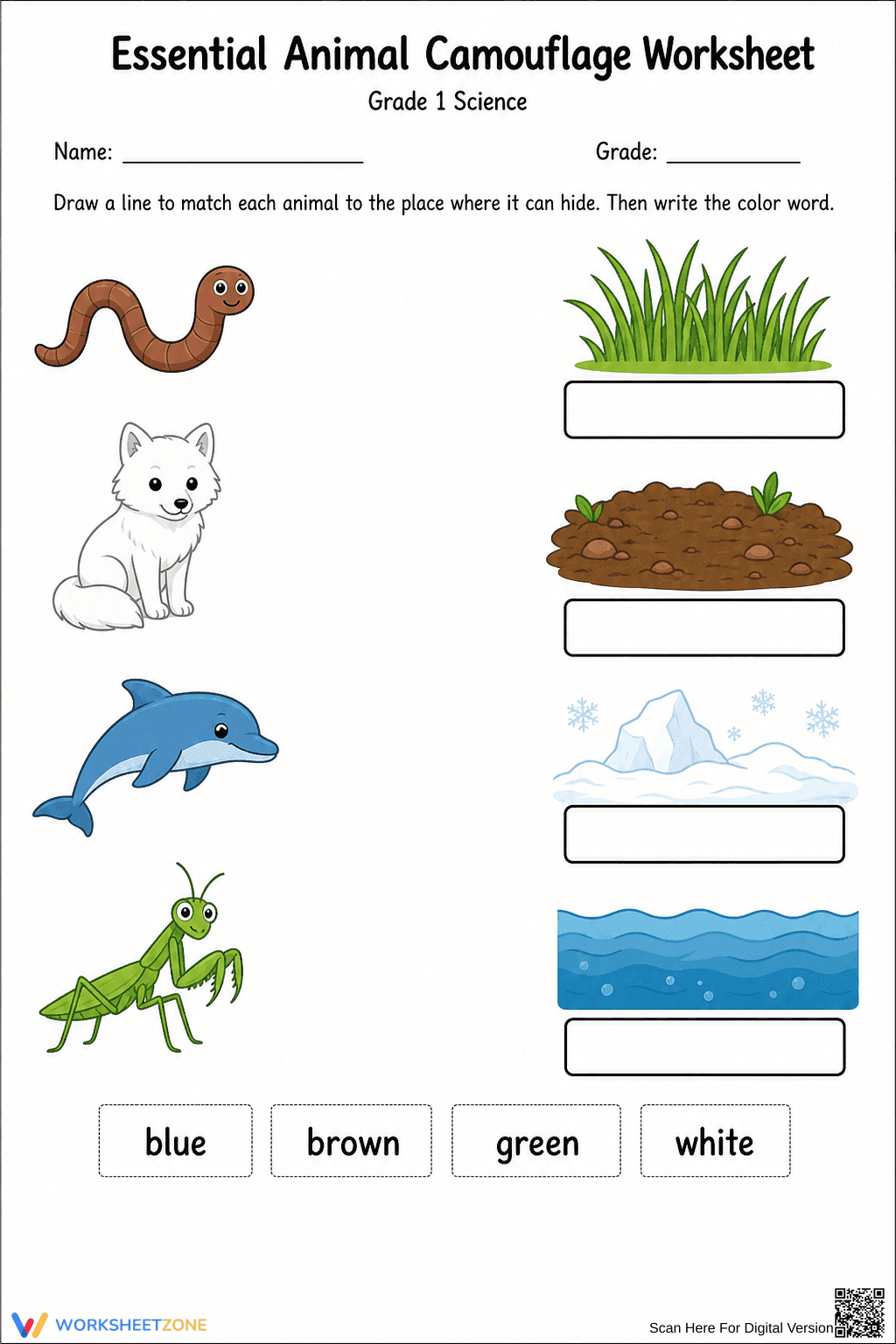
This one-page activity features four animal-habitat pairs. Students connect animals—including an arctic fox and a praying mantis—to environments like ice and grass. A word bank with color terms (blue, brown, green, white) allows for labeling, reinforcing spelling and scientific observation. A visual answer key is included for immediate feedback and easy grading.
Zero-Prep Workflow
- Print: Generate the single-page PDF in under 30 seconds.
- Distribute: Hand out copies and spend 1 minute explaining the matching and labeling tasks.
- Review: Use the provided key for rapid grading or student self-correction.
Total teacher prep time is under two minutes, making this ideal for sub plans or as a transition activity between lessons.
Standards Alignment
This resource aligns with `1-LS1-1`, requiring students to observe how animals use external parts to survive. Camouflage is a critical biological adaptation where features mimic surroundings. This worksheet provides the visual evidence for students to construct basic explanations of protective coloration. The code can be copied directly into lesson plans, IEP goals, or curriculum mapping tools.
How to Use It
Use this as a formative assessment after a lesson on adaptations. Circulate and observe if students can explain why the green mantis belongs in the grass; this identifies those grasping concealment versus simple color matching. It also serves as an Exit Ticket to verify habitat vocabulary mastery before moving to more complex life science units.
Who It's For
This is tailored for first-graders and accessible for English Language Learners due to visual scaffolding and a clear word bank. It pairs well with a read-aloud about habitats or a classroom camouflage hunt. The simple matching task also supports fine motor development while students engage with core scientific content and vocabulary.
Integrating visual matching tasks with scientific concepts aligns with the findings in Fisher & Frey (2014) regarding the importance of scaffolding for young learners. The use of clear, high-contrast imagery helps Grade 1 students build mental models of how animals interact with their environments. Research indicates that when students can physically connect a trait (color) to a function (survival), retention of biological principles increases significantly. This 1-LS1-1 aligned resource focuses on the fundamental skill of observation, which is the cornerstone of the scientific method at the primary level. By identifying how an arctic fox blends into white ice or a dolphin into blue water, students move beyond rote memorization toward evidence-based reasoning. This structured approach ensures that early science education is both accessible and rigorous, providing a solid foundation for future Next Generation Science Standards (NGSS) achievement in middle and upper elementary grades.


