


























Views
Downloads
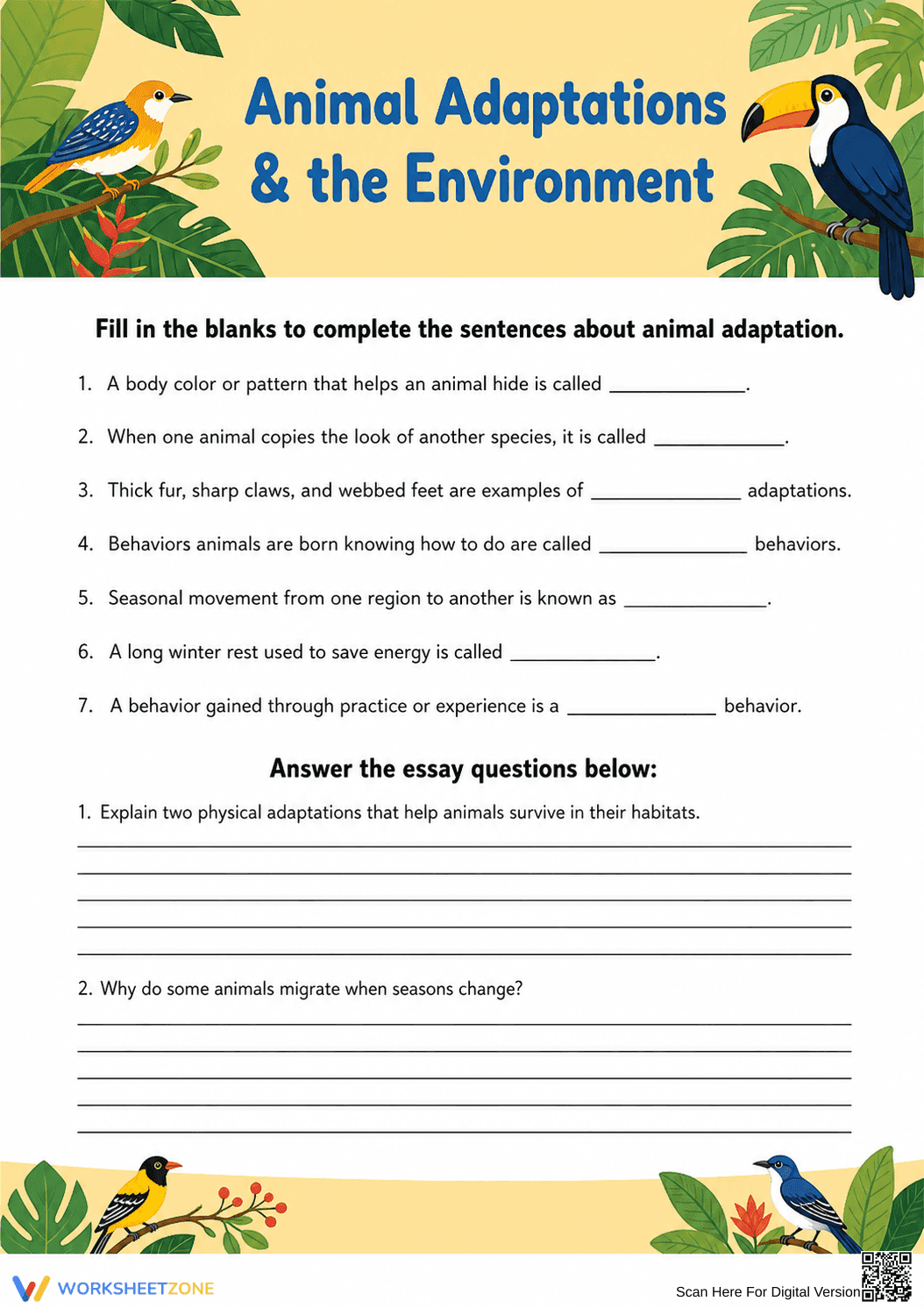

Grades 6-8 Animal Adaptations — Printable No-Prep Worksheet
Paste this activity's link or code into your existing LMS (Google Classroom, Canvas, Teams, Schoology, Moodle, etc.).
Students can open and work on the activity right away, with no student login required.
You'll still be able to track student progress and results from your teacher account.
This middle school science worksheet helps students identify and explain how specific traits help organisms survive. By evaluating both structural and behavioral adaptations, students build foundational life science vocabulary and practice constructing clear scientific explanations. It is an ideal resource for reinforcing ecosystem and evolution concepts.
At a Glance
- Grade: 6-8 · Subject: Science
- Standard:
MS-LS4-4— Explain how specific traits increase survival chances- Skill Focus: Identifying and explaining animal adaptations
- Format: 1 page · 9 problems · Answer key included · PDF
- Best For: Independent practice or review
- Time: 15–20 minutes
This single-page resource features seven targeted fill-in-the-blank questions that assess core vocabulary, including terms like camouflage, mimicry, hibernation, and innate behaviors. Following the vocabulary section, students tackle two short-response essay prompts requiring them to articulate the purpose of physical adaptations and seasonal migration. A complete answer key is provided to streamline grading and ensure accurate student feedback.
Designed for immediate classroom implementation, this resource requires minimal teacher setup.
- Print (1 minute): Download the PDF and print a class set directly from your computer.
- Distribute (1 minute): Hand out the single-page assignment as students enter the room for a focused start to the lesson.
- Review (3 minutes): Use the included answer key to quickly check responses or guide a whole-class discussion on the essay prompts.
With under two minutes of total prep time, this worksheet is an excellent addition to any emergency sub plan or busy instructional week.
This activity is aligned to MS-LS4-4: Construct an explanation based on evidence that describes how genetic variations of traits in a population increase some individuals' probability of surviving and reproducing in a specific environment. It also supports general life science literacy by reinforcing the distinction between learned and innate behaviors. Both standard codes can be copied directly into lesson plans, IEP goals, or district curriculum mapping tools.
Deploy this worksheet as an independent practice activity after direct instruction on animal survival strategies. It works exceptionally well as a formative assessment; teachers can quickly scan the two short-essay responses to gauge whether students understand the "why" behind physical and behavioral adaptations. Expect students to complete the assignment within 15 to 20 minutes.
This resource is designed for middle school life science students in grades 6 through 8. It provides built-in scaffolding through the fill-in-the-blank format for learners who need vocabulary support, while the essay questions challenge advanced students to write detailed scientific explanations. Pair this worksheet with a documentary clip on extreme animal habitats to provide visual context before students begin writing.
Understanding how organisms interact with their environments is a cornerstone of middle school life science. This resource aligns with MS-LS4-4, requiring students to explain how specific traits increase survival chances in various habitats. According to a 2024 report by EdReports, science instructional materials that blend direct vocabulary recall with open-ended explanatory writing significantly improve students' ability to construct scientific arguments. By transitioning from simple fill-in-the-blank definitions of mimicry and hibernation to complex questions about why animals migrate, this worksheet builds cognitive endurance. Students must not only memorize terms but also apply them to real-world ecological scenarios. This dual approach ensures that learners develop both the foundational knowledge and the critical thinking skills necessary for advanced high school biology coursework.


