




























Views
Downloads
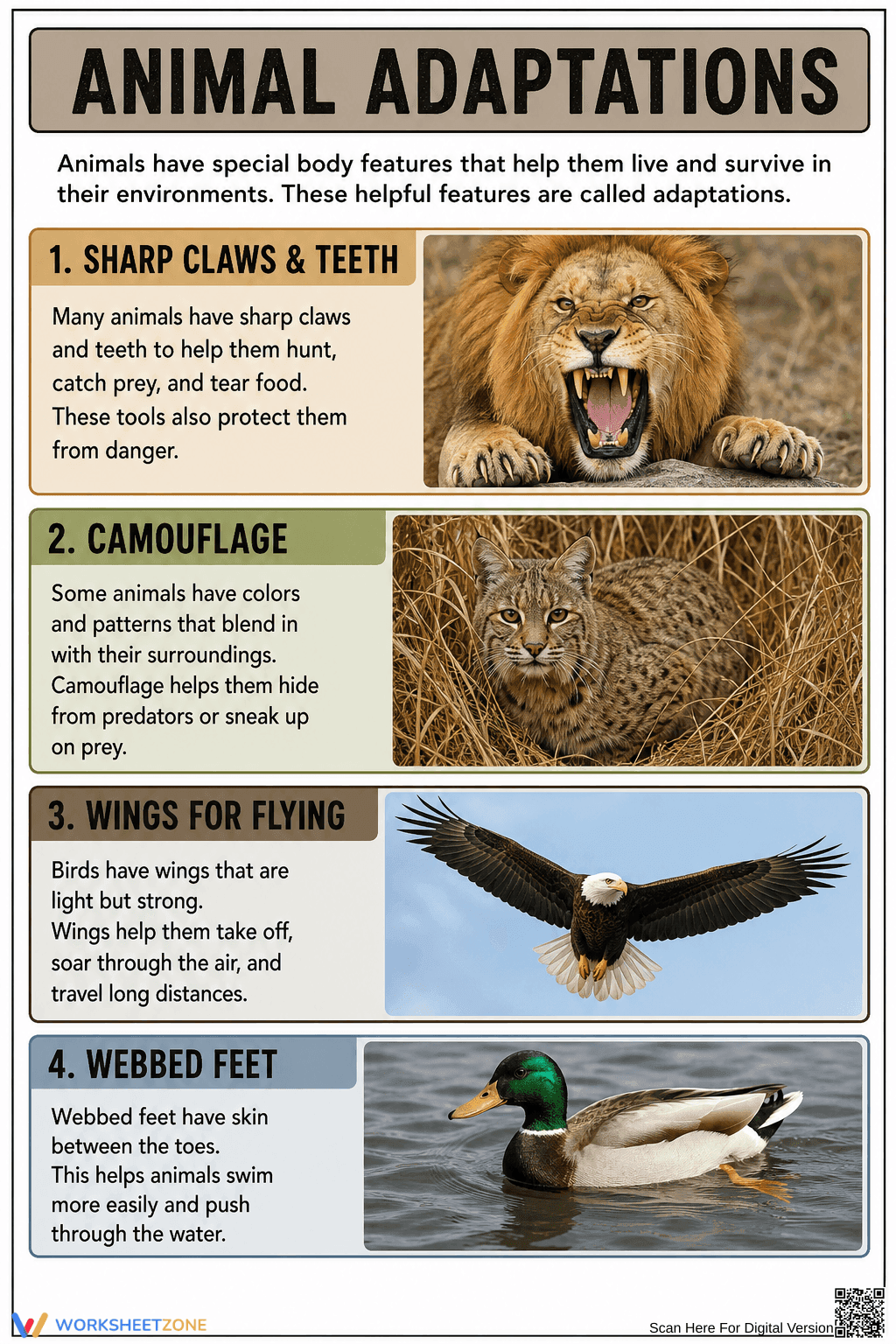

Grade 6 Animal Adaptations — Printable No-Prep Chart

Paste this activity's link or code into your existing LMS (Google Classroom, Canvas, Teams, Schoology, Moodle, etc.).
Students can open and work on the activity right away, with no student login required.
You'll still be able to track student progress and results from your teacher account.
This Grade 6 science reference chart introduces students to structural animal adaptations and their crucial role in survival. By examining real-world examples like camouflage and webbed feet, students build a foundational understanding of how specific physical traits help organisms thrive in their environments.
At a Glance
- Grade: 6 · Subject: Science
- Standard:
MS-LS4-4— Explain how specific traits increase survival chances- Skill Focus: Identifying structural adaptations
- Format: 1 page · 0 problems · No answer key · PDF
- Best For: Anchor chart or notebook reference
- Time: 5–10 minutes
This visually engaging one-page resource features four major structural adaptations: sharp claws and teeth, camouflage, wings for flying, and webbed feet. Each section pairs a high-quality, realistic photograph with a concise explanation of how the trait functions in the wild. The clear layout makes it an ideal quick-reference guide for middle schoolers, eliminating the need for complex text decoding while maximizing scientific comprehension.
This resource is designed for immediate classroom implementation with a streamlined zero-prep workflow. First, print the chart in full color or grayscale (1 minute). Next, distribute it to students to glue into their interactive science notebooks or project it directly onto your smartboard (1 minute). Finally, review the four adaptations together as a class before transitioning into a related research or labeling activity (5 minutes). Total teacher preparation time is under two minutes, making it an excellent addition to emergency sub plans.
This chart is aligned to MS-LS4-4: Construct an explanation based on evidence that describes how genetic variations of traits in a population increase some individuals' probability of surviving and reproducing in a specific environment. It also supports foundational concepts in ecosystem dynamics and predator-prey relationships. Both standard codes can be copied directly into lesson plans, IEP goals, or district curriculum mapping tools.
Introduce this chart before direct instruction on natural selection to give students concrete visual anchors for abstract concepts. Alternatively, use it during a research project where students must identify similar adaptations in different species. As a formative assessment observation tip, ask students to point to a specific adaptation on the chart and verbally explain how a different animal might use a similar trait to survive. Expected review time is 5 to 10 minutes.
This resource is primarily designed for Grade 6 general education science students, but its highly visual nature makes it exceptionally useful for English Language Learners and students requiring visual supports. The straightforward text provides excellent differentiation for intervention groups. It pairs perfectly with a hands-on lab activity or a direct instruction lesson on ecosystem dynamics.
Integrating visual reference tools into middle school science instruction significantly enhances student retention of complex biological concepts. When addressing MS-LS4-4 to explain how specific traits increase survival chances, providing concrete, photographic examples bridges the gap between abstract theory and observable phenomena. According to a ScienceDirect TpT Analysis, instructional materials that combine concise explanatory text with high-quality imagery reduce cognitive load and improve vocabulary acquisition in life science units. By utilizing this animal adaptations chart, educators provide a reliable scaffold that supports evidence-based explanations of natural selection and survival strategies. This targeted approach ensures that all learners, regardless of their baseline reading proficiency, can actively participate in scientific discourse and accurately identify the functional purpose of structural traits across various global ecosystems.


