


























Views
Downloads

Grade 1 Animal Adaptations — Printable No-Prep Worksheet
Paste this activity's link or code into your existing LMS (Google Classroom, Canvas, Teams, Schoology, Moodle, etc.).
Students can open and work on the activity right away, with no student login required.
You'll still be able to track student progress and results from your teacher account.
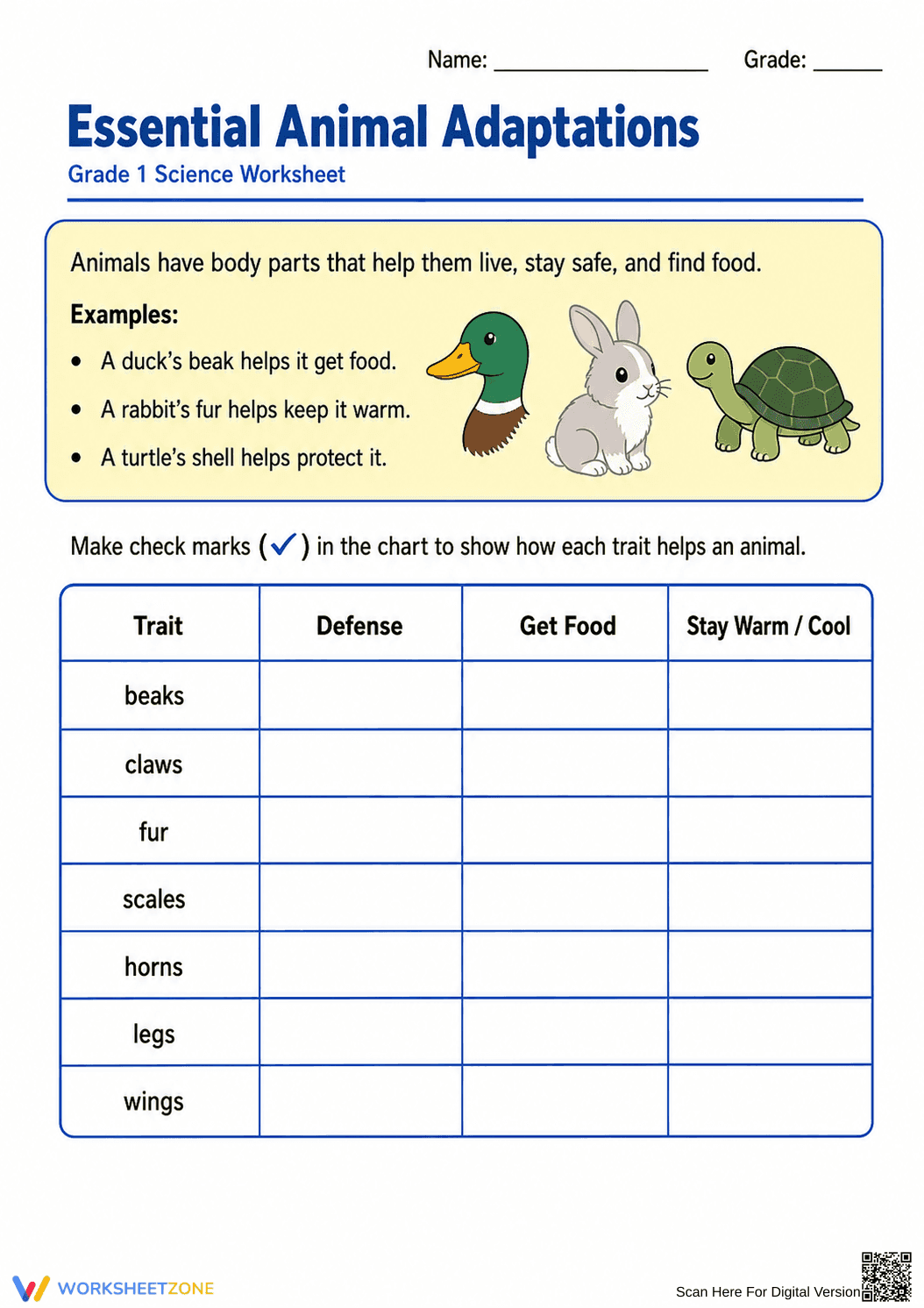
This Grade 1 science worksheet helps students identify how external animal traits function as survival adaptations. By classifying specific body parts like beaks and fur, learners connect physical structures to essential biological needs. This printable resource ensures students grasp the relationship between form and function through a structured chart format.
At a Glance
- Grade: 1 · Subject: Science
- Standard:
1-LS1-1— Identify how animals use external parts to survive- Skill Focus: Animal adaptations and survival traits
- Format: 2 pages · 7 problems · PDF
- Best For: Independent practice and formative assessment
- Time: 10–15 minutes
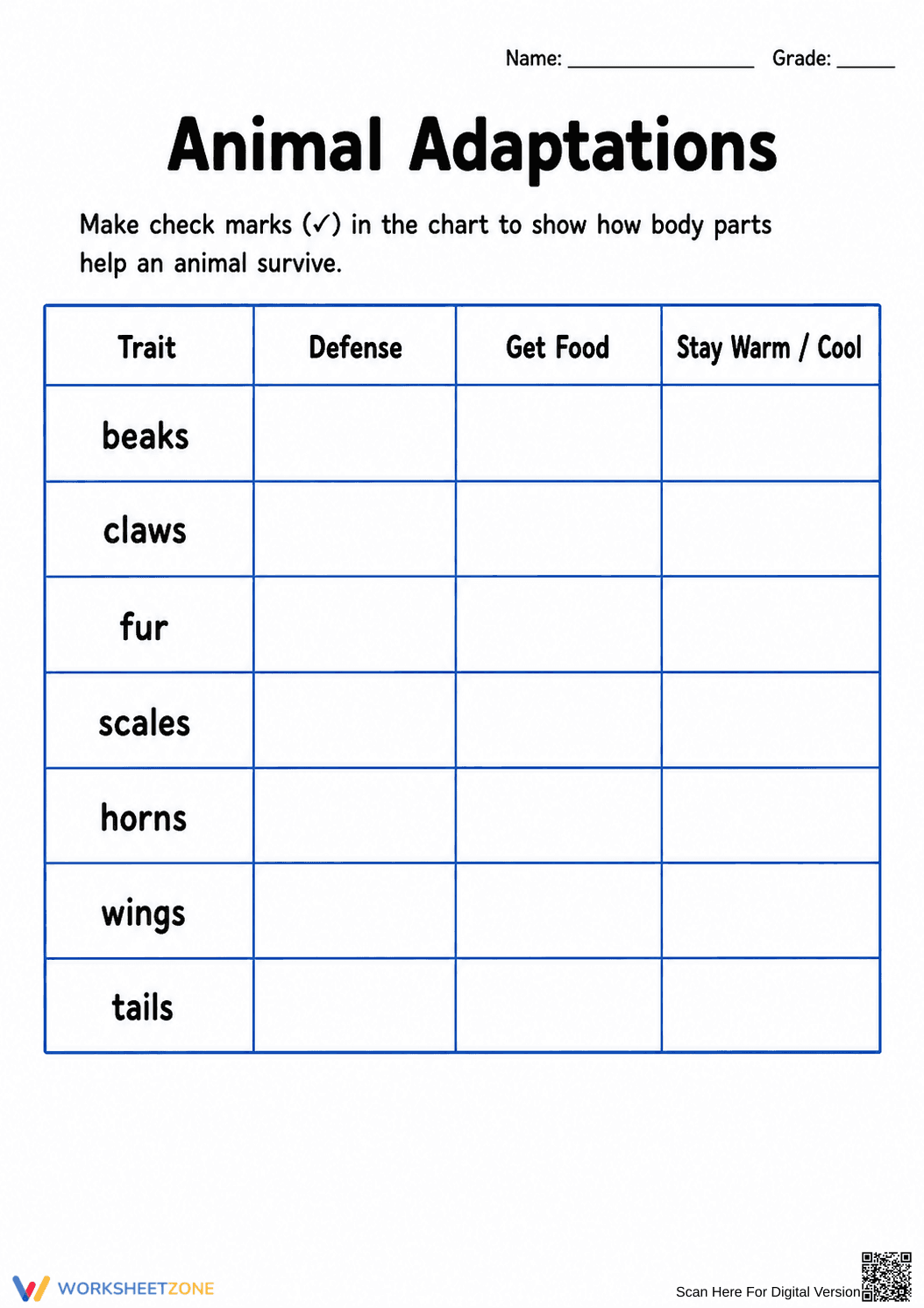
This two-page PDF includes a concise reference header defining structural adaptations with three clear visual examples, including a duck's beak, a rabbit's fur, and a turtle's shell. The main task consists of a seven-row classification chart where students evaluate traits such as wings, scales, and horns. The second page offers an alternative version of the chart for extended practice or assessment, minimizing the need for additional instructional materials.
Teachers can implement this resource in under two minutes by following three simple steps. First, print the student pages (30 seconds). Second, distribute the worksheets during a lesson transition or as a bell-ringer activity (30 seconds). Third, review the instructions and let students complete the chart independently (1 minute). This streamlined process makes it ideal for emergency substitute plans, busy science blocks, or quick morning work.
This resource is directly aligned to 1-LS1-1, which requires students to use materials to design a solution to a human problem by mimicking how plants and/or animals use their external parts to help them survive, grow, and meet their needs. By analyzing how body parts are used for defense, obtaining food, or temperature regulation, students satisfy the core requirements of this life science expectation. Both standard codes can be copied directly into lesson plans, IEP goals, or district curriculum mapping tools.
Assign this worksheet during the independent practice phase of a science lesson to reinforce the concept of animal survival. It serves as an effective formative assessment tool; observe whether students can distinguish between traits used for getting food versus those used for defense. For a more interactive experience, have students work in pairs to discuss their checkmarks before finalizing their individual charts within the expected 10 to 15-minute window.
This activity is designed for first-grade students but provides enough foundational review for second-grade learners. It includes visual cues for early readers and a clear grid layout to support learners with executive functioning challenges. It pairs naturally with a non-fiction read-aloud about animal habitats, ensuring that all students can access the curriculum regardless of their prior science background.
The RAND AIRS 2024 report highlights that high-quality, structured science materials significantly improve student retention of biological concepts in early elementary settings. This 1-LS1-1 worksheet focuses on the plain-English skill of connecting animal traits to survival functions, such as how claws enable hunting or how scales provide protection. Research emphasizes that scaffolds like the provided check-mark chart allow students to process complex informational text more effectively by breaking down data into manageable categories. By engaging with these seven specific structural adaptations, students build a foundational understanding of life science that aligns with national proficiency standards. This resource serves as a reliable instrument for measuring student progress toward mastery of the external parts and survival needs of living things, making it a valuable addition to any Grade 1 science curriculum or assessment portfolio.


