




























Views
Downloads
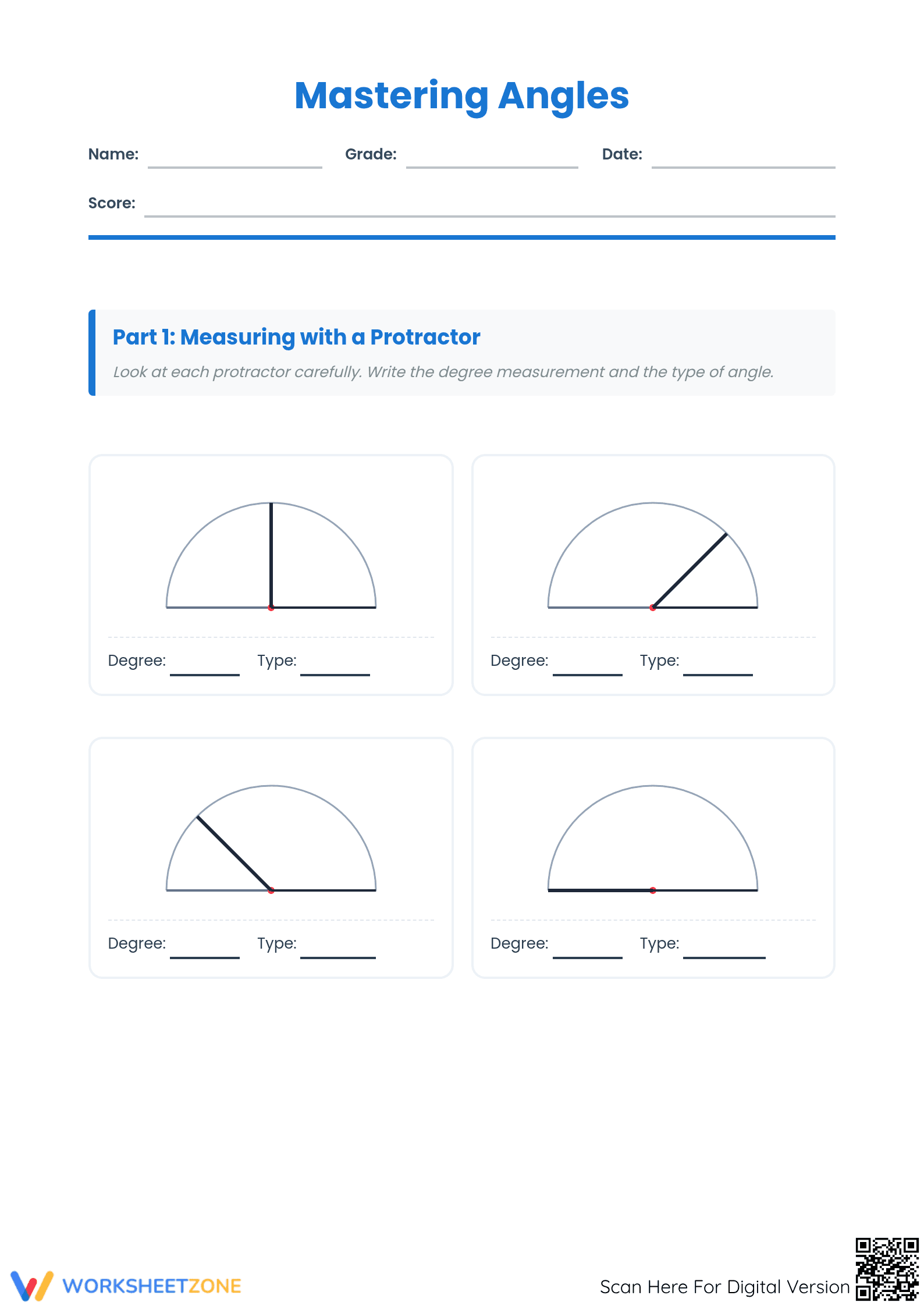


Essential Angles Practice Worksheet | Grades 5-8 Math

Paste this activity's link or code into your existing LMS (Google Classroom, Canvas, Teams, Schoology, Moodle, etc.).
Students can open and work on the activity right away, with no student login required.
You'll still be able to track student progress and results from your teacher account.
Mastering Angle Relationships
Students often struggle to visualize how abstract geometric concepts apply to the physical world. This comprehensive Mastering Angles worksheet bridges that gap by guiding learners through the identification, measurement, and calculation of various angle types. Students will demonstrate mastery in finding missing measurements and applying geometric logic to real-world scenarios.
At a Glance
- Grade: 7 · Subject: Math
- Standard:
7.G.B.5— Use supplementary and complementary angle facts to solve for unknown angles in figures- Skill Focus: Angle measurement and algebraic calculation
- Format: 4 pages · 26 problems · Answer key included · PDF
- Best For: Middle school geometry unit review
- Time: 45–60 minutes
This four-page instructional packet is designed for maximum clarity and engagement. It features high-resolution protractor diagrams for direct measurement practice, a tiered identification section for vocabulary reinforcement, and algebraic challenges involving complementary and supplementary pairs. The document includes a full answer key, ensuring immediate feedback without additional preparation time.
Skill Progression
- Guided Practice: The first section provides 6 visual protractor tasks where students observe specific rays and record exact degree measurements. This scaffolded approach ensures students understand the mechanics of angle reading before moving to abstract calculations.
- Supported Practice: Part 2 and 3 transition into classification and rule-based math. Students identify 8 distinct angle types and solve 5 targeted problems requiring the application of the 90-degree and 180-degree sum rules.
- Independent Practice: The final section presents 7 real-world and complex logic problems, including hands-of-a-clock scenarios and algebraic equations. These 26 total tasks follow a gradual-release model that moves students from basic observation to higher-order geometric reasoning.
Standards Alignment
This resource is strictly aligned to 7.G.B.5: Use facts about supplementary, complementary, vertical, and adjacent angles in a multi-step problem to write and solve simple equations for an unknown angle. It also supports 4.MD.C.6 by reinforcing protractor usage. Both standard codes can be copied directly into lesson plans or district curriculum mapping tools.
How to Use It
Use this worksheet as a summative assessment following a direct instruction unit on geometric properties. Alternatively, it serves as an excellent spiral review during the second half of the year to keep skills sharp. Teachers should observe students during Part 3 to identify common misconceptions regarding complementary sums. The expected completion time is one class period.
Who It's For
This packet is tailored for 7th-grade students but is effective for Grade 5 and 6 advanced learners or 8th-grade remediation. It provides scaffolding for students with IEPs through clear visual aids and predictable formatting. Pair this worksheet with a physical protractor for a multi-sensory learning experience.
According to the RAND AIRS 2024 report on mathematics instructional materials, high-quality geometric worksheets must integrate multiple modes of representation—visual, numerical, and algebraic—to ensure long-term retention of spatial reasoning skills. This worksheet implements these findings by requiring students to move fluidly between reading a protractor and solving for "x" in supplementary pairs. Research by Fisher & Frey (2014) emphasizes that a gradual release of responsibility is essential in middle school math to prevent cognitive overload during complex multi-step problems. By beginning with direct observation and concluding with real-world applications such as clock hand measurements and laptop hinge angles, this resource aligns with best practices for cognitive scaffolding. The 7.G.B.5 standard requires students to not only memorize definitions but to apply them as tools for solving unknown variables. This focus on procedural fluency alongside conceptual understanding ensures that students develop the foundational skills necessary for high school trigonometry and advanced spatial analysis.


