




























Views
Downloads




Essential Angle Relationship Practice | Grade 7 Geometry

Paste this activity's link or code into your existing LMS (Google Classroom, Canvas, Teams, Schoology, Moodle, etc.).
Students can open and work on the activity right away, with no student login required.
You'll still be able to track student progress and results from your teacher account.
This comprehensive geometry worksheet provides students with essential practice in identifying and calculating angle pair relationships. Students will master the properties of vertical, complementary, supplementary, adjacent, and linear pair angles through a structured progression from definitions to complex algebraic applications. By the end of this session, learners will be able to write and solve equations to find unknown angle measures with confidence, aligning directly with **CCSS.MATH.CONTENT.7.G.B.5**.
At a Glance
- Grade: 7 · Subject: Geometry
- Standard:
7.G.B.5— Use facts about angle relationships to write and solve simple equations for unknown angles- Skill Focus: Angle Pair Properties and Algebraic Applications
- Format: 4 pages · 24 problems · Answer key included · PDF
- Best For: Independent practice after direct instruction
- Time: 35–45 minutes
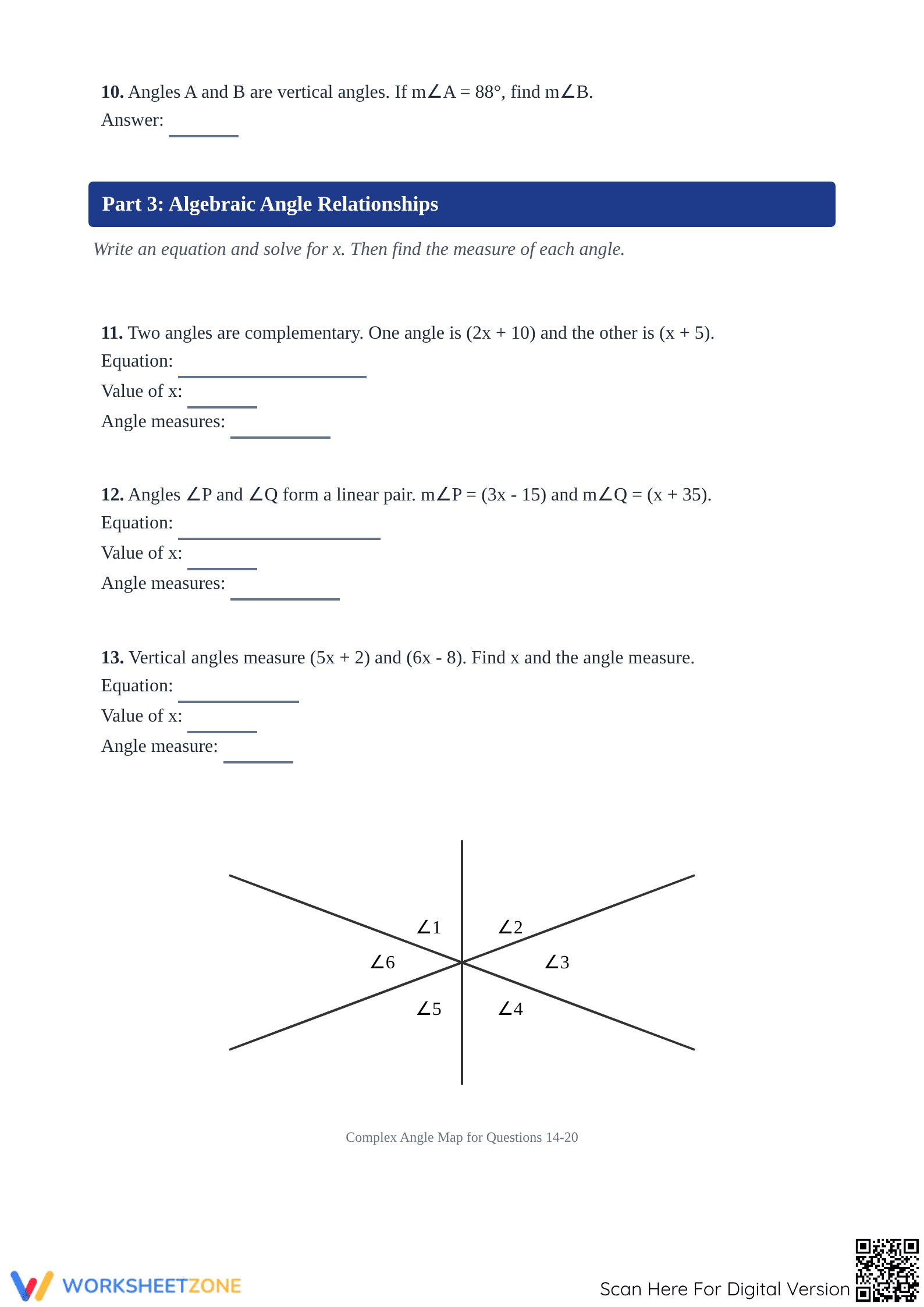
What's Inside: This four-page PDF includes a rigorous sequence of 24 tasks designed to build geometric fluency. The worksheet features a matching table for definitions, visual identification exercises using geometric figures, calculation-based scenarios for finding complements and supplements, and high-order algebraic problems. A complex angle map is included to challenge students' ability to synthesize multiple relationships in a single diagram, supported by a full answer key for immediate feedback.
Skill Progression
- Guided Practice: The worksheet begins with 5 matching tasks and 5 visual identification problems, providing heavy scaffolding through explicit definitions and clear figure references to cement foundational vocabulary.
- Supported Practice: Section 2 features 5 calculation-based problems where students find missing measures using simple subtraction, bridging the gap between conceptual understanding and numerical application.
- Independent Practice: The final 9 problems require students to apply algebraic reasoning and logical deductions to solve for variables and real-world scenarios, representing the highest level of standard mastery.
This sequence follows a gradual-release model, ensuring students are successfully prepared for the independent rigors of the algebraic section.
Standards Alignment: This resource is primarily aligned to `CCSS.MATH.CONTENT.7.G.B.5`: "Use facts about supplementary, complementary, vertical, and adjacent angles in a multi-step problem to write and solve simple equations for an unknown angle in a figure." It also supports foundational concepts in Grade 6 geometry regarding angle measurement. Both standard codes can be copied directly into lesson plans, IEP goals, or district curriculum mapping tools.
How to Use It: This worksheet is ideal for use during the "You Do" phase of a lesson on angle relationships. Assign Part 1 and Part 2 as a mid-lesson check for understanding to ensure students can distinguish between supplementary and complementary pairs. Use Part 3 and 4 as an exit ticket or homework assignment to assess students' ability to apply algebraic skills to geometric contexts. Teachers should observe if students are correctly identifying the sum of linear pairs (180°) versus complementary angles (90°) before they begin the algebraic section.
Who It's For: This resource is designed for Grade 7 students but is equally effective for Grade 8 review or as an extension for advanced Grade 6 learners. The inclusion of sentence-style problems and visual diagrams makes it accessible for English Language Learners and students with IEPs who benefit from multiple representations of mathematical concepts. It pairs naturally with a protractor-based hands-on lesson or a digital geometry exploration tool.
This Grade 7 resource directly addresses the **CCSS.MATH.CONTENT.7.G.B.5** standard by requiring students to navigate 24 specific tasks, ranging from basic matching to complex logical reasoning. By requiring the creation of equations to solve for unknown variables in vertical and supplementary pairs, the worksheet directly mirrors the depth of knowledge required by high-stakes assessments, and supports student success without additional teacher preparation.


