


























Views
Downloads
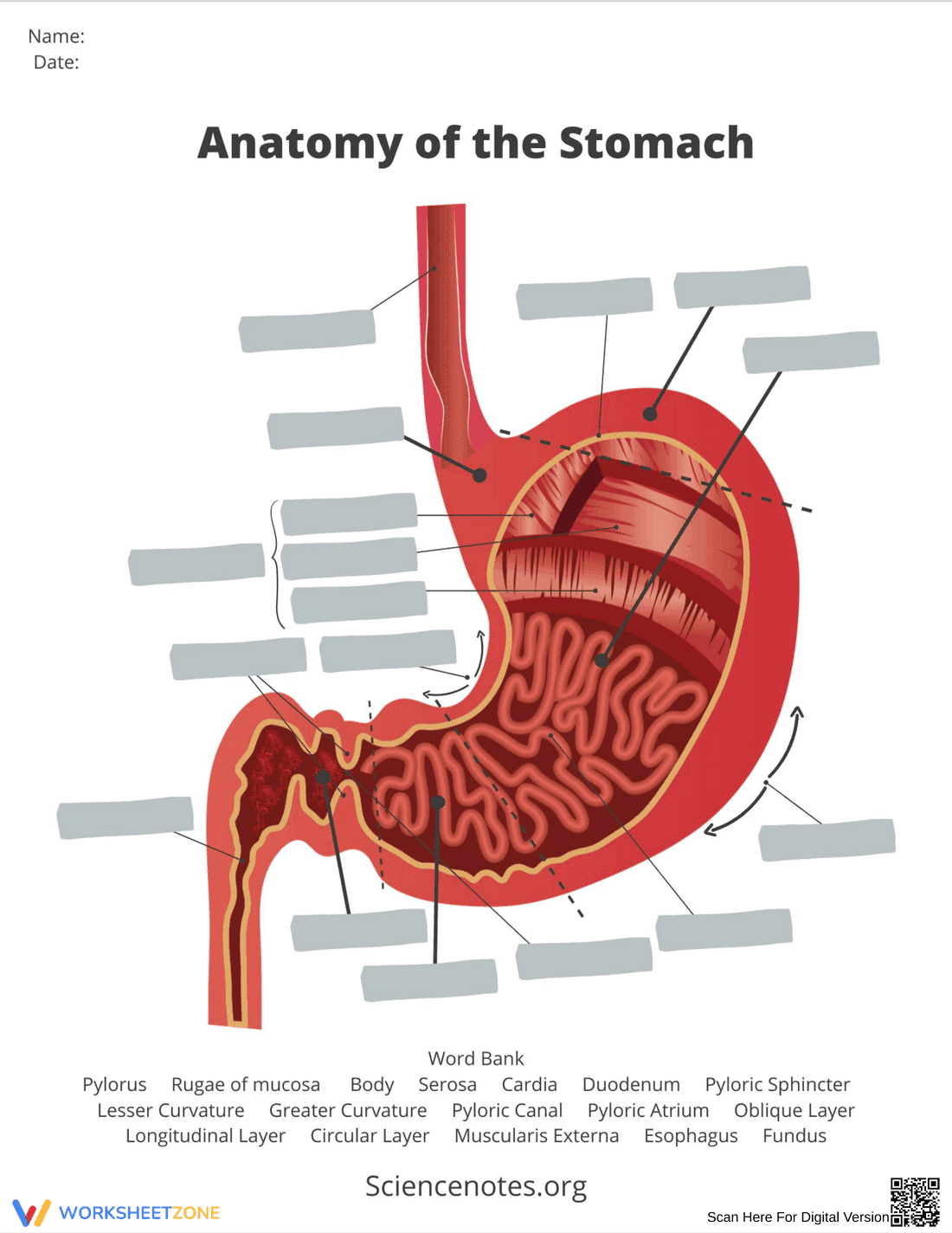

Grade 7 Anatomy of the Stomach — Printable No-Prep Worksheet
Paste this activity's link or code into your existing LMS (Google Classroom, Canvas, Teams, Schoology, Moodle, etc.).
Students can open and work on the activity right away, with no student login required.
You'll still be able to track student progress and results from your teacher account.
This anatomy of the stomach worksheet provides middle school students with a detailed diagram to master the complex structures of the digestive system. By identifying 17 distinct anatomical features, learners develop a concrete understanding of how the stomach is organized to facilitate digestion. This resource ensures students can visualize the organ's internal and external components effectively.
At a Glance
- Grade: 7 · Subject: Biology
- Standard:
MS-LS1-3— Describe how the body is a system of interacting subsystems composed of organs- Skill Focus: Stomach anatomy identification
- Format: 1 page · 17 problems · Answer key included · PDF
- Best For: Digestive system unit reinforcement
- Time: 15–20 minutes
The resource features a high-resolution medical illustration of the human stomach with 17 clear call-out boxes. A comprehensive word bank is provided at the bottom, including terms like the pyloric sphincter and rugae. This single-page PDF is designed for clarity, ensuring students can easily distinguish between the various internal regions and the three layers of the muscularis externa.
Zero-Prep Workflow
This resource is designed for immediate classroom implementation with a total teacher prep time of under 2 minutes. First, print the single-page PDF (30 seconds). Next, distribute the sheets to students as a bell-ringer (30 seconds). Finally, review the 17 labels using the included answer key (1 minute). Its self-explanatory layout makes it an ideal candidate for emergency sub plans.
Standards Alignment
This worksheet aligns with MS-LS1-3, which requires students to "use argument supported by evidence for how the body is a system of interacting subsystems composed of groups of cells." By identifying the specific tissues and regions of the stomach, students gather the foundational knowledge needed to explain how the digestive subsystem functions. Both standard codes can be copied directly into lesson plans, IEP goals, or district curriculum mapping tools.
How to Use It
Use this worksheet as a formative assessment immediately following a lecture on the digestive system. It serves as an excellent bridge between direct instruction and more complex physiological discussions. Teachers should observe if students can correctly distinguish between the longitudinal, circular, and oblique muscle layers. Completion typically takes 15 to 20 minutes.
Who It's For
This resource is ideal for Grade 7 biology students, including those in life science or introductory anatomy courses. It is particularly helpful for visual learners who benefit from spatial mapping. Pair this worksheet with a 3D torso model or a digestive system anchor chart to provide a multi-sensory learning experience for all students.
According to the RAND AIRS 2024 report on science literacy, visual-spatial mapping through diagram labeling significantly improves long-term retention of complex biological systems. This worksheet targets the MS-LS1-3 standard by requiring students to identify 17 specific anatomical structures, including the muscularis externa and the pyloric region. By utilizing a word bank, the resource reduces cognitive load while maintaining high academic rigor for middle and high school learners. Research from Fisher & Frey (2014) suggests that such structured practice is vital for transitioning students from basic identification to understanding the functional relationships within the human body. This printable PDF provides a reliable, evidence-based method for assessing student mastery of stomach anatomy within a broader life science curriculum, ensuring that learners are fully prepared for advanced physiological studies in later grades. This approach fosters deep conceptual understanding of organ systems.


