


























Views
Downloads

Printable Kidney Anatomy Worksheet | Grade 6-9 Science
Paste this activity's link or code into your existing LMS (Google Classroom, Canvas, Teams, Schoology, Moodle, etc.).
Students can open and work on the activity right away, with no student login required.
You'll still be able to track student progress and results from your teacher account.
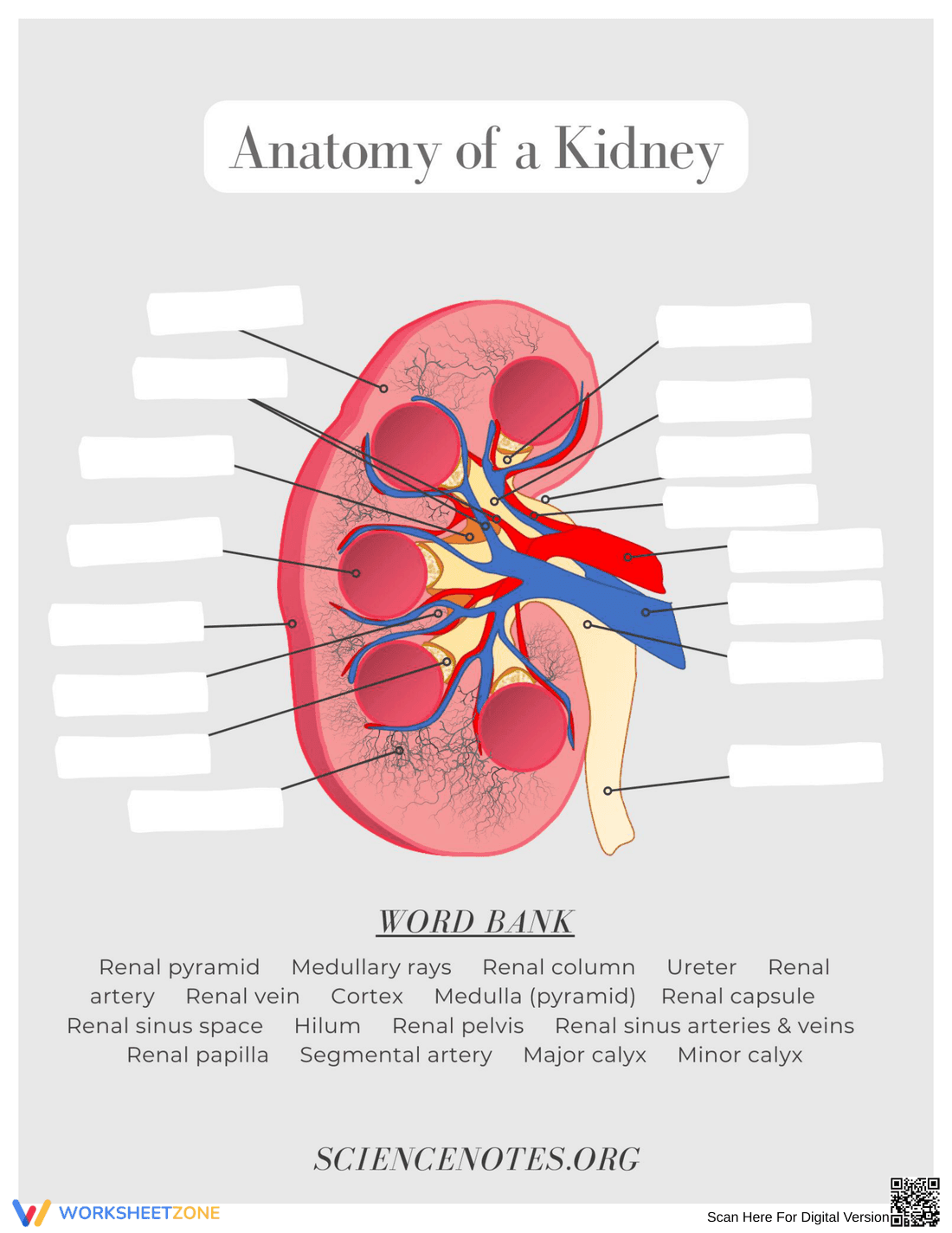
This printable kidney anatomy worksheet provides middle and high school students with a structured diagram to label essential renal structures. By matching terms from the word bank to correct anatomical locations, students build foundational knowledge of the excretory system.
At a Glance
- Grade: 6-9 · Subject: Science
- Standard:
MS-LS1-3— Identify and model interacting body subsystems- Skill Focus: Anatomical labeling
- Format: 1 page · 17 problems · Answer key included · PDF
- Best For: Independent practice or review
- Time: 15–20 minutes
Inside this single-page resource, educators will find a full-color diagram of a human kidney cross-section featuring 17 labeling tasks. A comprehensive word bank is included, offering terms like the renal pelvis, cortex, and ureter to support student accuracy. The download comes with a complete answer key to ensure quick grading.
This resource offers a zero-prep workflow:
- Print (1 minute): Download the PDF and print a class set. The layout requires no teacher setup.
- Distribute (1 minute): Hand out the worksheets for an immediate bell-ringer or independent practice activity.
- Review (3 minutes): Use the included answer key to quickly verify responses or project it for whole-class review.
With total prep time under two minutes, this diagram is excellent for any sub plan.
This activity aligns with MS-LS1-3, asking students to explain how the body is a system of interacting subsystems. By mapping kidney structures, learners visualize how this organ functions within the excretory system. Both standard codes can be copied directly into lesson plans, IEP goals, or district curriculum mapping tools.
Deploy this worksheet during direct instruction as a guided note-taking tool, allowing students to fill blanks as each part is discussed. Alternatively, use it as a formative assessment. While students work, observe which word bank terms are left until the end, indicating areas needing clarification. Students typically complete this within 15 to 20 minutes.
Designed for middle school life science and high school biology students studying body systems. The detailed word bank provides built-in differentiation, scaffolding English language learners or students struggling with vocabulary recall. It pairs perfectly with direct instruction on the excretory system or a kidney dissection lab.
Effective science instruction relies heavily on accurate visual models to bridge the gap between abstract concepts and concrete understanding. Aligning with MS-LS1-3 to identify and model interacting body subsystems, this kidney anatomy diagram provides the spatial context necessary for deep comprehension of the excretory system. According to a ScienceDirect TpT Analysis, integrating structured visual aids with targeted vocabulary practice significantly improves long-term retention of complex biological terms. When students actively engage with a diagram by selecting terms from a word bank and mapping them to specific anatomical features, they reduce cognitive load while reinforcing the hierarchical organization of body systems. This method of active labeling transforms passive observation into an interactive learning experience, ensuring that foundational knowledge of renal function is firmly established before moving on to more advanced physiological processes.


