


























Views
Plays


Printable Enlightenment & Revolution Quiz | Grades 6-8
Paste this activity's link or code into your existing LMS (Google Classroom, Canvas, Teams, Schoology, Moodle, etc.).
Students can open and work on the activity right away, with no student login required.
You'll still be able to track student progress and results from your teacher account.
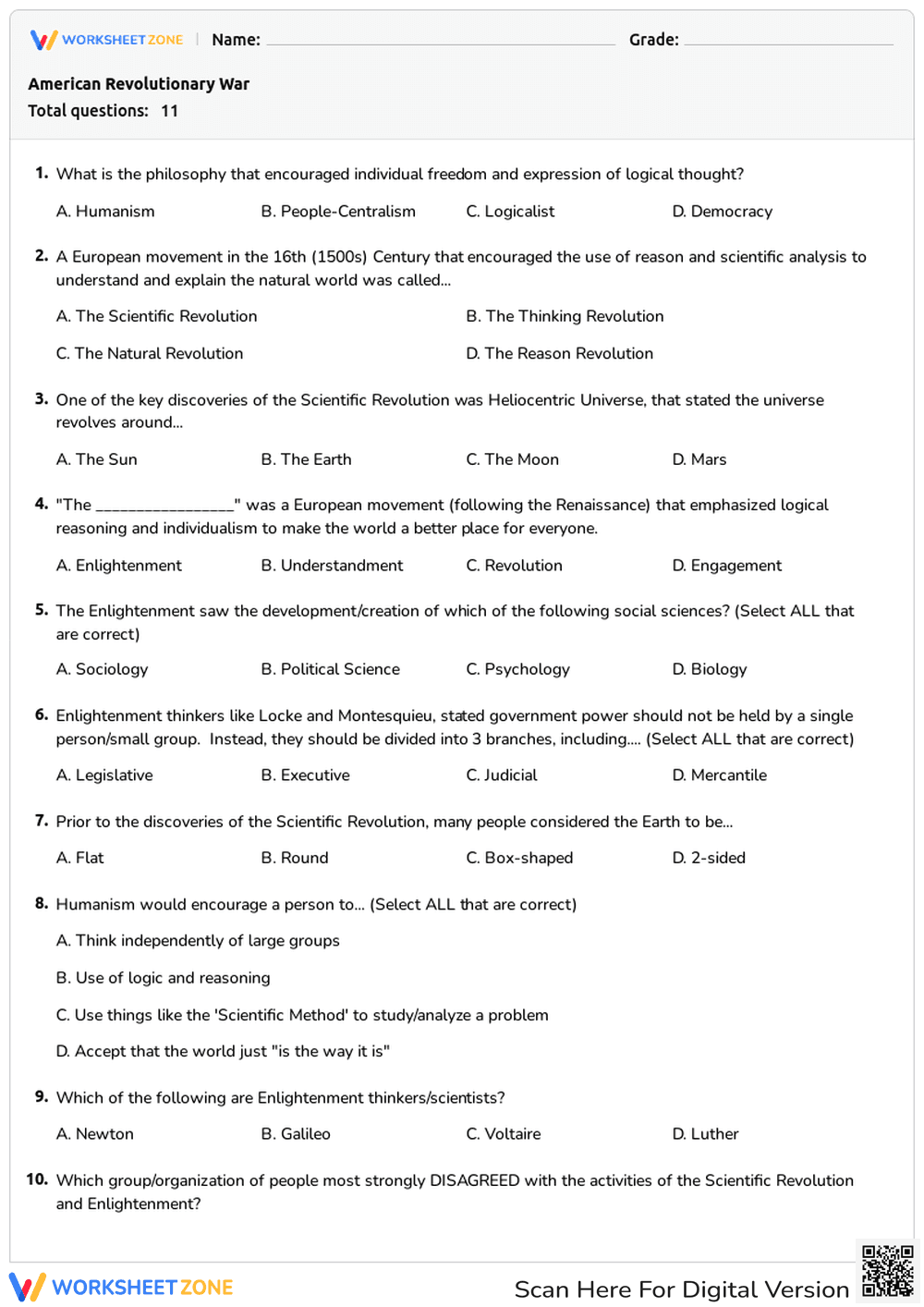
This Grade 7 social studies worksheet gives students focused practice identifying key concepts of the Scientific Revolution and the Enlightenment. By answering targeted multiple-choice questions, students demonstrate their understanding of how humanism, scientific discovery, and philosophical reasoning laid the groundwork for modern democratic governments and the American Revolution.
At a Glance
- Grade: 7 · Subject: Social Studies
- Standard:
CCSS.ELA-LITERACY.RH.6-8.4— Determine the meaning of historical vocabulary- Skill Focus: Historical Concepts & Vocabulary
- Format: 2 pages · 11 problems · Answer key included · PDF
- Best For: Formative assessment or review
- Time: 15–20 minutes
What's Inside
This comprehensive assessment features 11 multiple-choice questions spanning two pages. The task types require students to recall specific historical figures like Galileo and Locke, identify core philosophies such as humanism, and connect Enlightenment ideas to the structure of government. A complete answer key is included to ensure quick and accurate grading for educators.
Zero-Prep Workflow
- Print (1 minute): Simply download the PDF and print a class set. The clean layout ensures high-quality copies.
- Distribute (1 minute): Hand out the two-page quiz as a warm-up, exit ticket, or standalone assessment.
- Review (3 minutes): Use the provided answer key to grade submissions rapidly or conduct a whole-class review session.
Total teacher prep time is under two minutes, making this an ideal resource for emergency sub plans or last-minute lesson additions.
Standards Alignment
Aligned to CCSS.ELA-LITERACY.RH.6-8.4, this resource asks students to determine the meaning of words and phrases as they are used in a text, including vocabulary specific to domains related to history/social studies. It also supports broader historical comprehension by linking 16th-century scientific movements to 18th-century political shifts. Both standard codes can be copied directly into lesson plans, IEP goals, or district curriculum mapping tools.
How to Use It
Use this worksheet as a formative assessment after direct instruction on the Scientific Revolution and Enlightenment periods. It serves perfectly as an independent practice activity to gauge student retention of key historical figures and philosophies. While students work, teachers can circulate to observe which specific concepts—such as the heliocentric model or the three branches of government—might require reteaching. Expected completion time is 15 to 20 minutes.
Who It's For
This resource is designed for middle school social studies students in grades 6 through 8. The straightforward multiple-choice format provides built-in scaffolding for learners who benefit from structured options rather than open-ended writing tasks. It pairs excellently with primary source readings from Enlightenment thinkers or a direct instruction lesson on the causes of the American Revolutionary War.
Integrating structured vocabulary and concept checks into history instruction significantly improves long-term retention of complex political ideas. This worksheet aligns with CCSS.ELA-LITERACY.RH.6-8.4 by requiring students to determine the meaning of historical vocabulary in context. According to Fisher & Frey (2014), providing students with frequent, low-stakes opportunities to retrieve and apply domain-specific knowledge strengthens their overall reading comprehension and analytical skills in the content areas. By evaluating their understanding of terms like humanism and the heliocentric universe, educators can ensure students possess the foundational knowledge necessary to analyze subsequent historical events, such as the American Revolution. Regular formative assessments like this 11-question quiz allow teachers to identify misconceptions early and adjust their instructional strategies to better support student mastery of essential social studies standards.


