




























Views
Downloads

Printable Am I an Insect? Worksheet | Grade K-1 Science

Paste this activity's link or code into your existing LMS (Google Classroom, Canvas, Teams, Schoology, Moodle, etc.).
Students can open and work on the activity right away, with no student login required.
You'll still be able to track student progress and results from your teacher account.
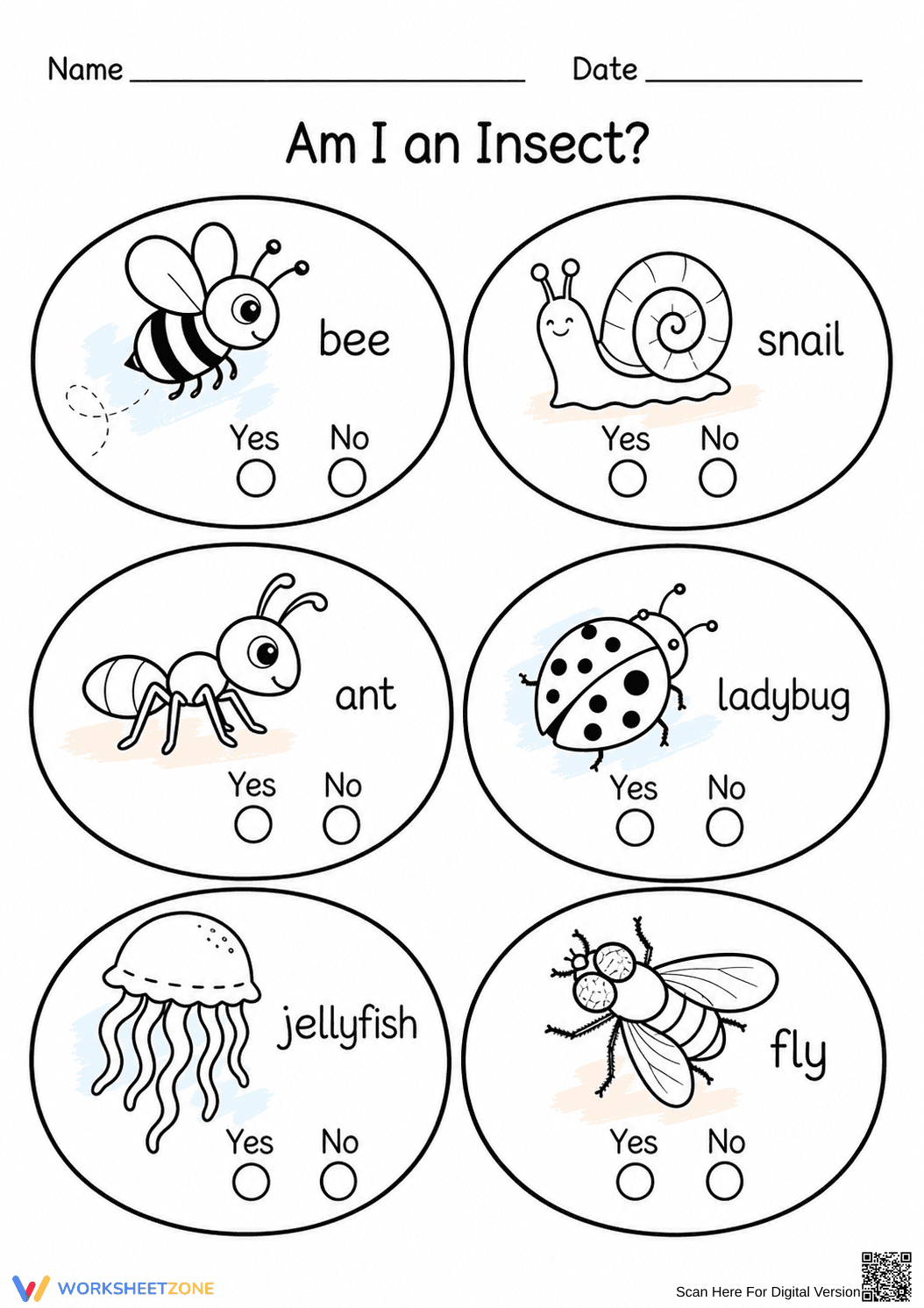
Mastering basic biological classification starts with careful observation. This early science worksheet helps young learners distinguish between insects and other small creatures through clear visual identification. Students examine six different animals, applying their knowledge of physical traits to determine which belong to the insect family and which do not.
At a Glance
- Grade: K–1 · Subject: Science
- Standard:
K-LS1-1— Observe and identify physical traits of animals- Skill Focus: Animal Classification
- Format: 1 page · 6 problems · Answer key included · PDF
- Best For: Science centers and independent practice
- Time: 10–15 minutes
What's Inside
This single-page printable features six distinct animal illustrations, including a bee, snail, ant, ladybug, jellyfish, and fly. Each creature includes a clear text label and a simple "Yes/No" bubble selection area. The bold lines and kid-friendly graphics make it highly engaging and perfect for coloring after the academic task is complete. A full answer key is included for quick grading.
Zero-Prep Workflow
Teachers can implement this resource in under two minutes. First, print the single-page PDF (30 seconds). Next, distribute to students for independent work (1 minute). Finally, review answers using the provided key (30 seconds). The intuitive layout makes this worksheet an ideal choice for substitute teacher plans, morning work, or quick science center transitions without requiring any complex teacher setup.
Standards Alignment
This resource aligns with K-LS1-1, requiring students to use observations to describe patterns of what plants and animals need to survive and thrive. By identifying common structures like antennae and six legs, students begin to understand biological classification. Both standard codes can be copied directly into lesson plans, IEP goals, or district curriculum mapping tools.
How to Use It
Use this activity during the "Explain" phase of a 5E science lesson to reinforce insect characteristics after reading a picture book about bugs. It serves as an excellent formative assessment tool; watch for students who struggle with the non-insect examples, like the snail or jellyfish, to identify misconceptions about what makes a bug an insect. Total expected completion time ranges from 10 to 15 minutes.
Who It's For
This printable is tailored for Preschool, Kindergarten, and Grade 1 students beginning their life sciences units. It is highly effective for visual learners and English Language Learners due to the strong pictorial cues and minimal text. Pair this activity with a classroom insect anchor chart for extra support, or have advanced learners list specific insect traits on the back of the page.
Scientific classification in early childhood education relies heavily on developing the capacity for detailed observation and pattern recognition. This worksheet addresses these core competencies by requiring students to evaluate specific biological structures to identify insects, directly supporting the K-LS1-1 standard to observe and identify physical traits of animals. According to research by Fisher & Frey (2014) on the gradual release of responsibility, providing structured classification tasks helps bridge the gap between initial instruction and independent mastery of scientific concepts. By focusing on observable traits, students build the cognitive scaffolding necessary for more complex taxonomic studies in later grades. The use of clear visual examples allows young students to practice these foundational skills in a controlled, successful environment. This approach aligns with current educational frameworks that prioritize empirical observation over rote memorization, ensuring students develop a functional understanding of animal characteristics.


