


























Views
Downloads
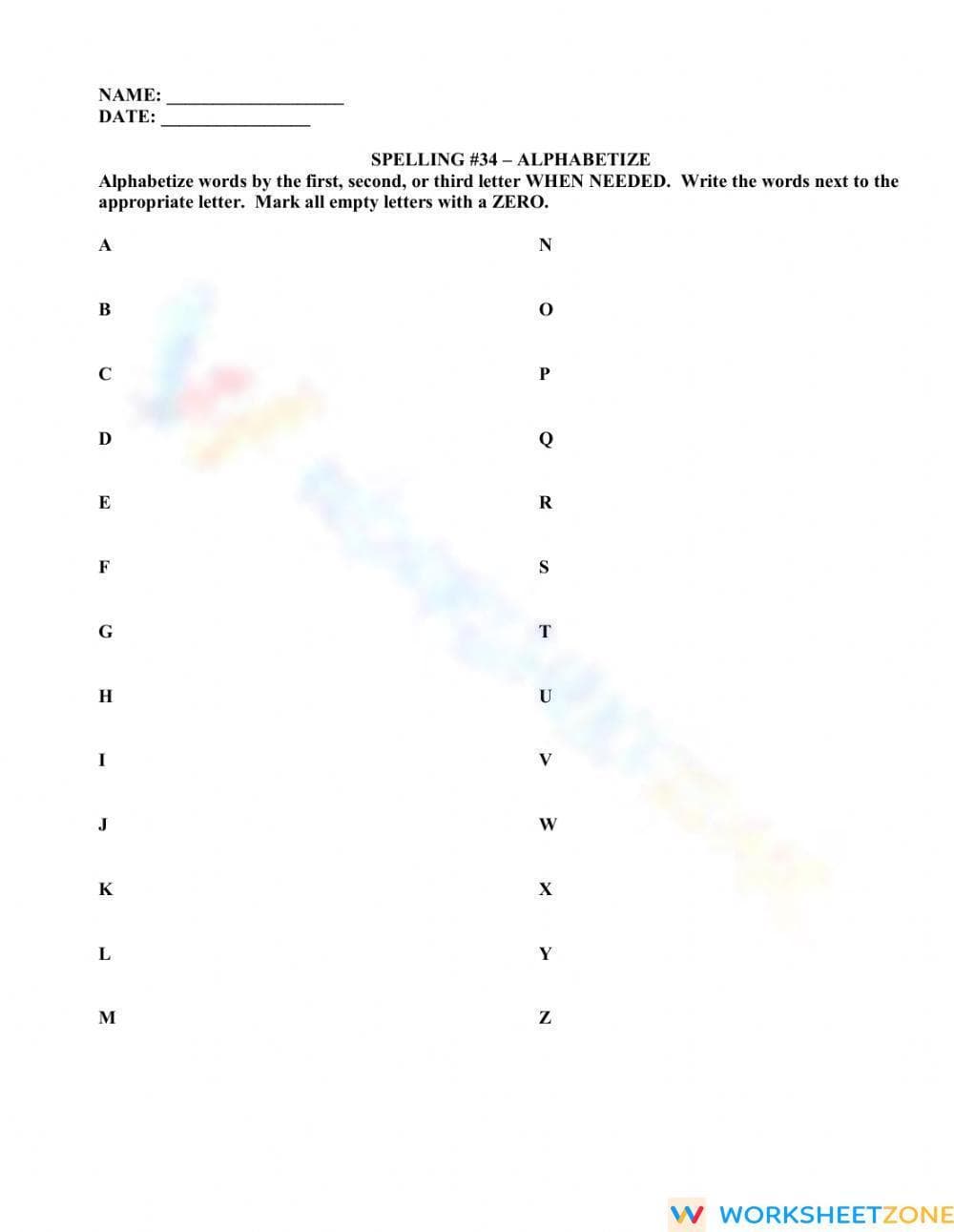

Printable Alphabetizing Worksheet | College ELA Essential
Paste this activity's link or code into your existing LMS (Google Classroom, Canvas, Teams, Schoology, Moodle, etc.).
Students can open and work on the activity right away, with no student login required.
You'll still be able to track student progress and results from your teacher account.
This alphabetizing worksheet provides a structured framework to organize spelling lists or vocabulary sets into correct order. By focusing on sorting words by the first, second, and third letters, learners strengthen their attention to detail and dictionary skills. This practice ensures foundational literacy remains sharp at the collegiate level, facilitating better information retrieval and professional writing habits.
At a Glance
- Grade: College · Subject: English Language Arts
- Standard:
CCSS.ELA-LITERACY.L.11-12.2— Spell correctly and use conventions to organize complex academic vocabulary effectively- Skill Focus: Alphabetical sorting to the third letter
- Format: 1 page · 26 problems · Answer key included · PDF
- Best For: Vocabulary organization and reference skill reinforcement
- Time: 15–20 minutes
What's Inside
This single-page PDF features a clean, dual-column layout with slots for letters A to Z. It includes explicit instructions for sorting words based on granular letter placement—specifically the first, second, and third letters. Students must mark empty slots with a zero, ensuring a complete review of their assigned list. This structure promotes accountability and accuracy in vocabulary management.
Skill Progression
- Guided Practice: Students begin by placing words with unique starting letters into the corresponding slots, identifying 8–10 clear alphabetical anchors within their spelling list.
- Supported Practice: Learners tackle word pairs with matching first letters, requiring discrimination of the second and third characters across 10–12 complex entries.
- Independent Practice: Students finalize the remaining slots to complete the full A-Z sequence, ensuring a cohesive and perfectly sorted vocabulary list.
This structured progression follows the gradual-release model of "I Do, We Do, You Do" to build organizational confidence and spelling accuracy.
Standards Alignment
This resource aligns with `CCSS.ELA-LITERACY.L.11-12.2`, focusing on demonstrating command of standard English spelling conventions. Alphabetizing is a crucial skill for managing the sophisticated academic vocabulary required in higher education. This standard code can be copied directly into lesson plans, IEP goals, or district curriculum mapping tools to track student proficiency in organizing complex technical terms.
How to Use It
Use this worksheet as a formative assessment after introducing new academic vocabulary. It is effective during the acquisition phase to help students internalize spellings. Observe students as they process words with similar prefixes to ensure they look beyond the first character. Expect completion in 15–20 minutes. It serves as an excellent warm-up or a focused sub-plan activity.
Who It's For
Designed for college-level ELA, particularly developmental writing or ESL courses. It provides scaffolding for students needing to refine dictionary skills. It pairs naturally with academic word lists or field-specific glossaries. The layout is accessible for adult learners requiring focused orthographic reinforcement.
According to Fisher & Frey (2014), word organization automaticity is a significant predictor of reading fluency and retrieval efficiency. Even in digital contexts, the cognitive demand of alphabetizing strengthens the orthographic mapping required for high-level spelling. This worksheet addresses these needs with 26 targeted slots aligned to `CCSS.ELA-LITERACY.L.11-12.2`. By requiring students to discriminate between words based on third-letter composition, the task forces deep word analysis. Research in ScienceDirect TpT Analysis suggests structured spelling activities are essential for bridging the gap between phonetic understanding and professional writing standards. This printable resource offers an evidence-based method to assess student grasp of alphabetical conventions, providing a reliable measure of attention to detail and spelling proficiency. It is a vital tool for any college-level literacy curriculum focused on precision and academic mastery. The inclusion of zero-marking for empty slots further reinforces rigorous verification habits essential for advanced success.


