


























Views
Downloads

Alpaca Biology Notes Worksheet | Grade 10 Printable
Paste this activity's link or code into your existing LMS (Google Classroom, Canvas, Teams, Schoology, Moodle, etc.).
Students can open and work on the activity right away, with no student login required.
You'll still be able to track student progress and results from your teacher account.
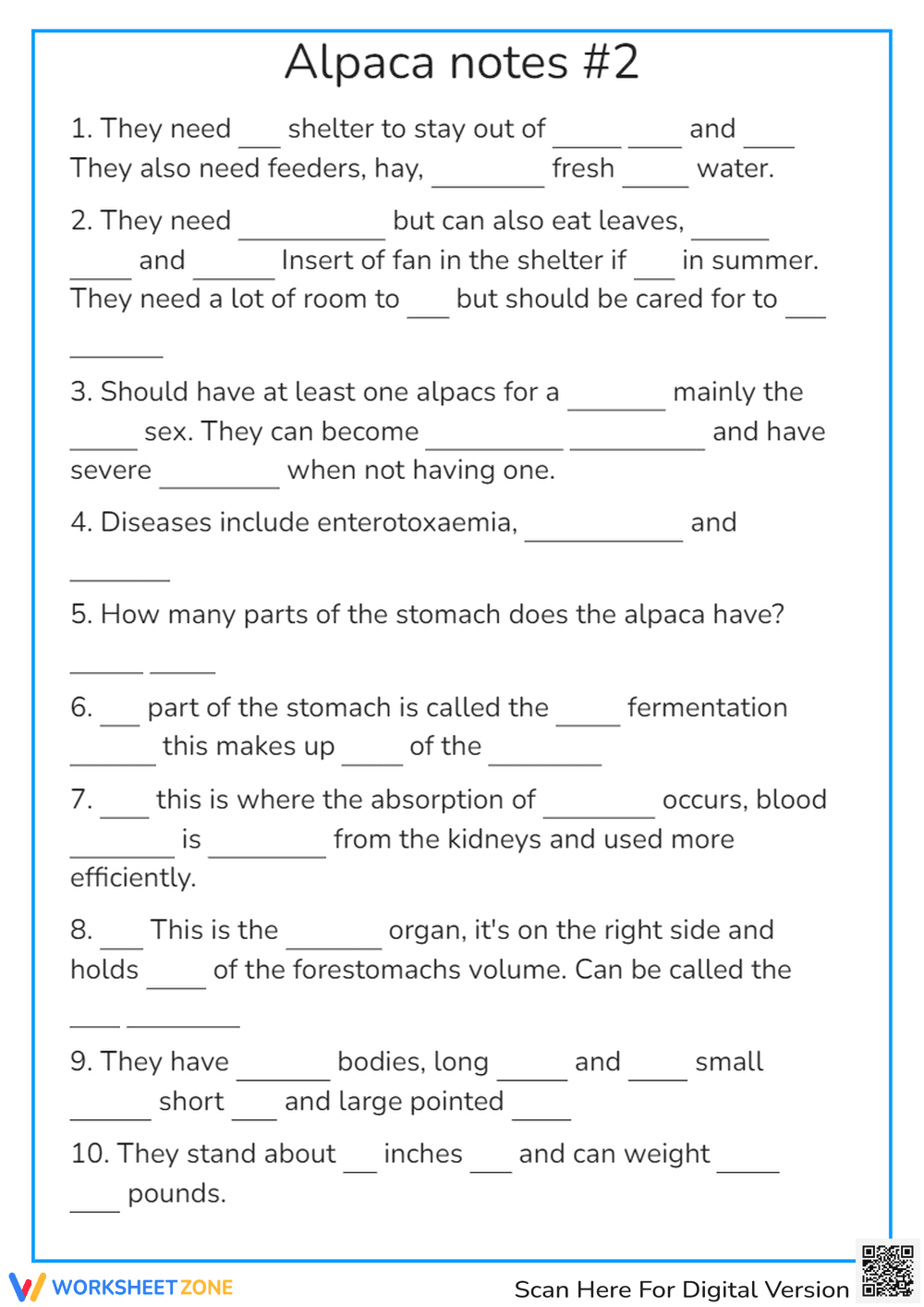
This Grade 10 science worksheet helps students consolidate their understanding of alpaca biology and husbandry through structured note-taking. By completing these targeted fill-in-the-blank statements, learners actively process key facts about animal anatomy, dietary needs, and environmental requirements, ensuring they retain critical information from their reading or lecture.
At a Glance
- Grade: 10 · Subject: Science
- Standard:
CCSS.ELA-LITERACY.RST.9-10.2— Determine central ideas and summarize complex science concepts- Skill Focus: Note-taking and reading comprehension
- Format: 1 page · 10 problems · Answer key included · PDF
- Best For: Guided practice and lecture notes
- Time: 15–20 minutes
This single-page resource features 10 comprehensive fill-in-the-blank tasks that guide students through essential alpaca facts. The structured format prompts learners to identify specific vocabulary related to stomach anatomy, common diseases like enterotoxaemia, and physical characteristics. A complete answer key is provided to support quick grading or peer review, making the structural features of this assignment highly efficient for both educators and students.
This resource is designed for a streamlined, zero-prep workflow:
- Print (1 minute): Simply download the PDF and print a class set. The clean layout requires no special formatting.
- Distribute (1 minute): Hand out the sheets before a lecture, video, or reading assignment to keep students engaged.
- Review (3 minutes): Use the included answer key to quickly verify student responses or project it for self-correction.
With a total teacher prep time of under two minutes, this worksheet is an excellent addition to any emergency sub plan or busy instructional day.
This activity aligns with CCSS.ELA-LITERACY.RST.9-10.2, requiring students to determine the central ideas or conclusions of a text and provide an accurate summary of complex concepts. By extracting specific vocabulary and facts about animal biology, students practice essential scientific literacy skills. Both standard codes can be copied directly into lesson plans, IEP goals, or district curriculum mapping tools.
Teachers can deploy this worksheet during direct instruction as a guided notes template, ensuring students remain focused on key concepts as they listen or read. Alternatively, it serves as an effective post-lesson formative assessment to check for understanding. While students work, educators can circulate the room and observe if learners are struggling to recall specific anatomical terms, providing immediate corrective feedback. Expected completion time ranges from 15 to 20 minutes.
This resource is primarily designed for Grade 10 biology or agricultural science students. The fill-in-the-blank structure provides built-in scaffolding, making it highly accessible for English Language Learners or students with IEPs who benefit from guided note-taking frameworks. It pairs perfectly with an introductory reading passage on camelid biology or a direct instruction presentation on animal husbandry.
Developing strong scientific literacy requires consistent practice with structured note-taking and vocabulary acquisition. This worksheet directly supports CCSS.ELA-LITERACY.RST.9-10.2 by challenging students to determine central ideas and summarize complex science concepts accurately. According to Fisher & Frey (2014), providing students with guided instructional frameworks significantly increases their ability to process and retain specialized academic language. By utilizing fill-in-the-blank formats during complex biology lessons, educators reduce cognitive overload and allow learners to focus on mastering essential terminology related to animal anatomy and husbandry. This targeted approach ensures that all students, regardless of their initial reading proficiency, can successfully extract and organize critical information from rigorous scientific content. Implementing these evidence-based strategies fosters deeper comprehension and builds the foundational skills necessary for advanced coursework in the life sciences.


