


























Views
Downloads



Aligned Mixed-Unit Scaling Errors Worksheet | Grade 7 Math
Paste this activity's link or code into your existing LMS (Google Classroom, Canvas, Teams, Schoology, Moodle, etc.).
Students can open and work on the activity right away, with no student login required.
You'll still be able to track student progress and results from your teacher account.
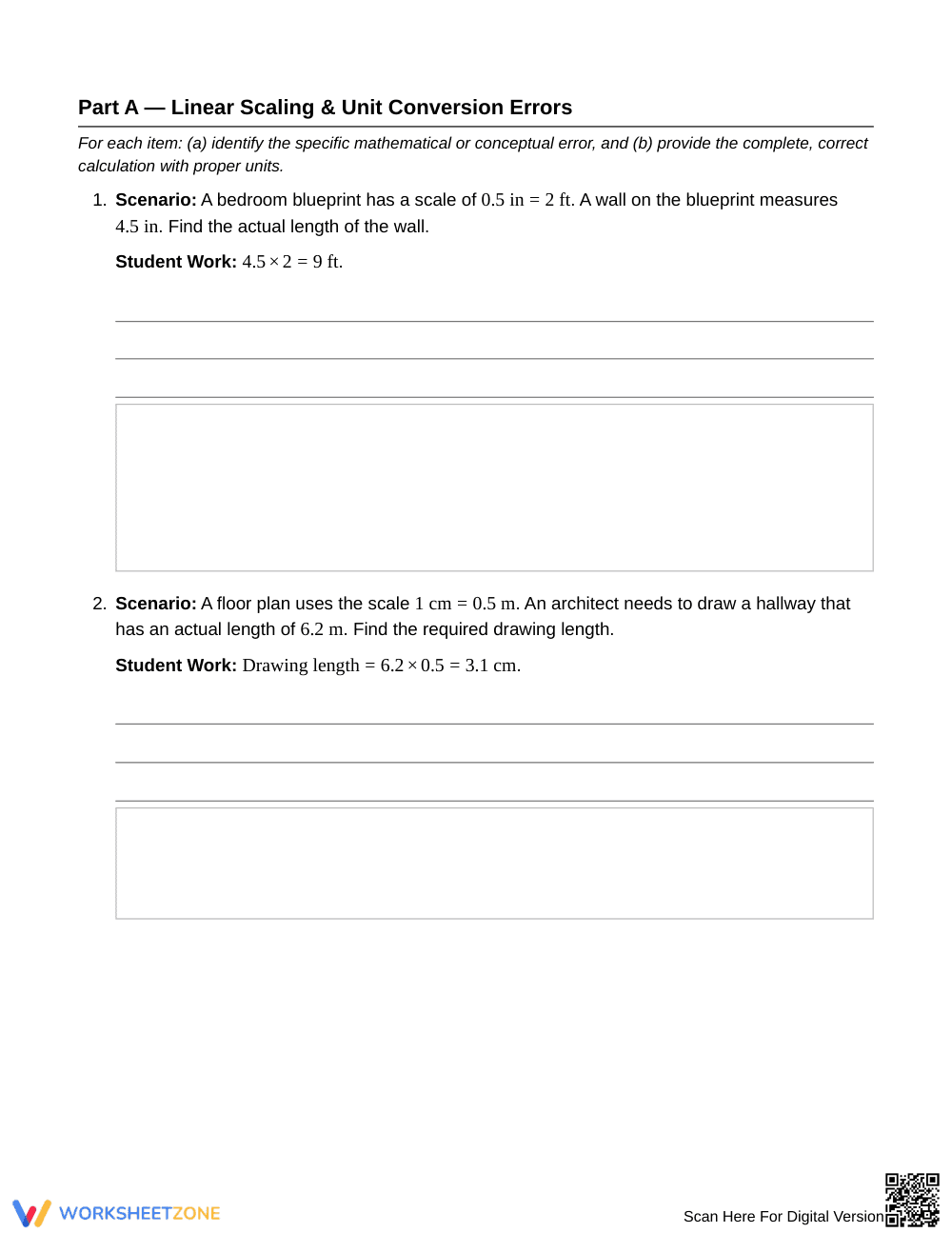
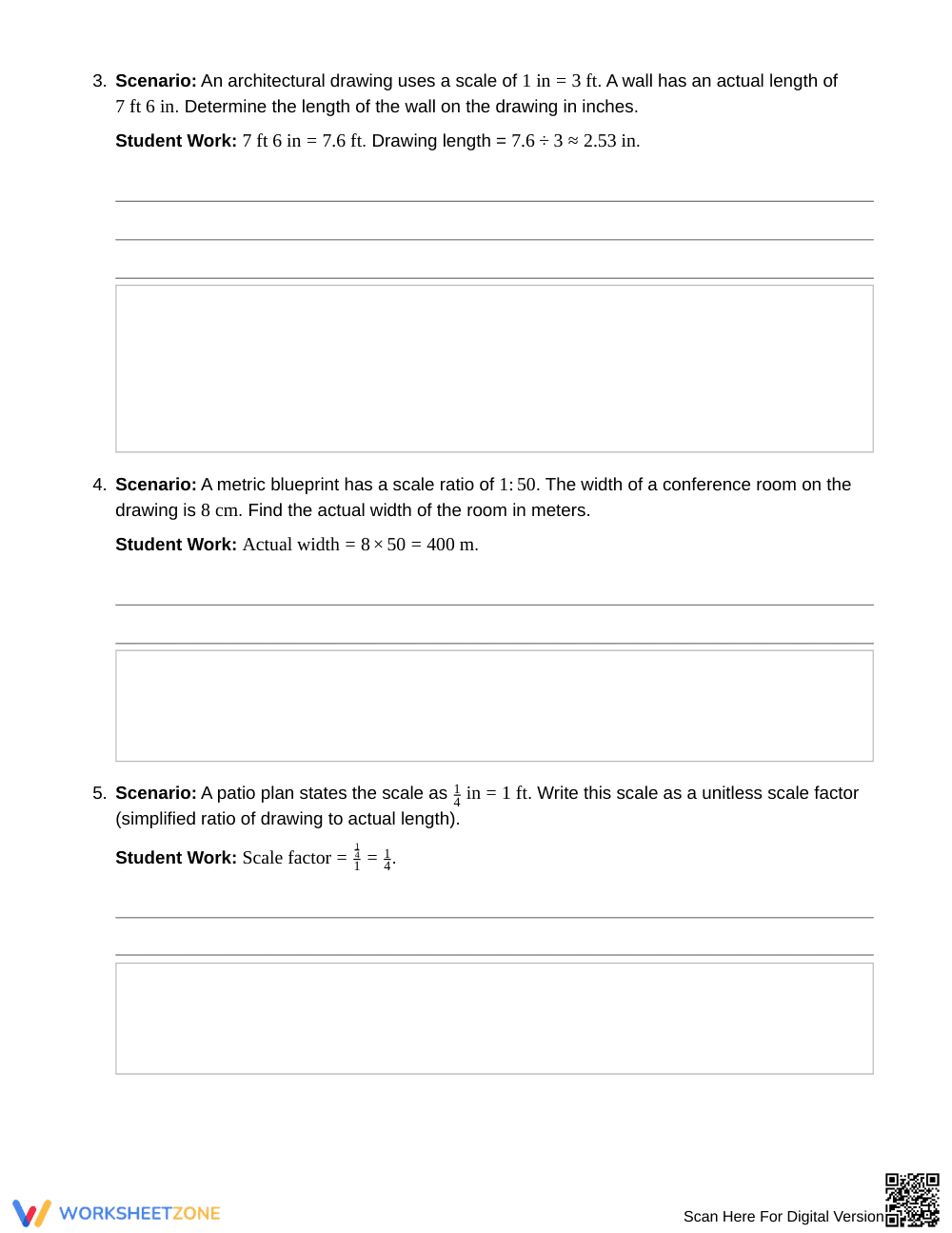
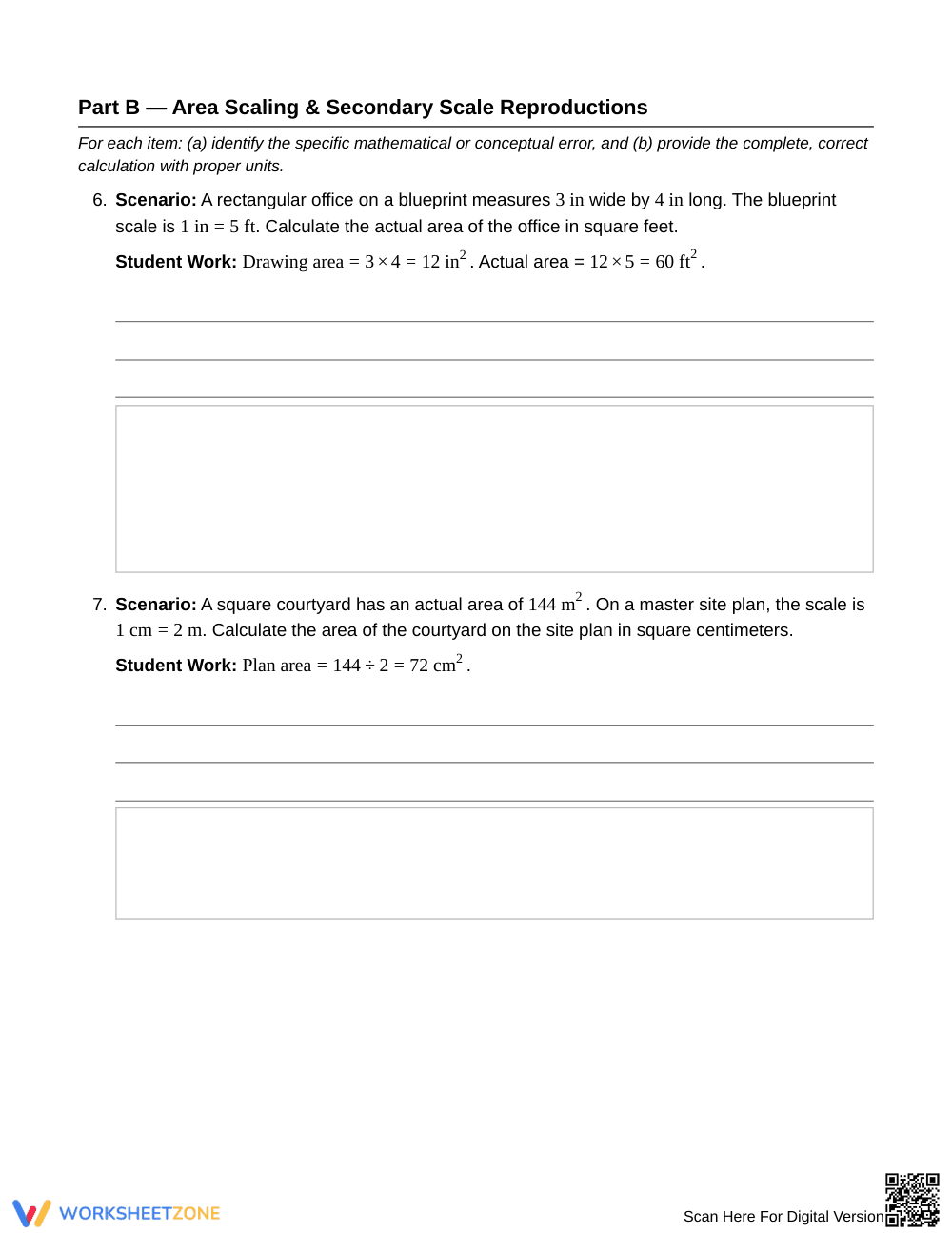
This Grade 7 geometry worksheet targets mixed-unit scale conversions and error analysis across 10 authentic architectural and map scenarios. Students examine flawed student work, pinpoint mathematical misconceptions involving fractions, ratios, and area scaling, and calculate accurate measurements using precise dimensional analysis.
At a Glance
- Grade: 7 · Subject: Math
- Standard:
7.G.A.1— Compute actual lengths and areas from scale drawings and identify geometric scaling errors- Skill Focus: Correct Mixed-Unit Scaling Errors
- Format: 5 pages · 10 problems · Answer key included · PDF
- Best For: Error analysis and scale factor intervention
- Time: 40–50 minutes
What's Inside
The 5-page printable resource features a foundational reference box defining unit scales, scale factors, and area scaling rules alongside a fully worked model analysis. Across Parts A and B, students complete 10 dual-step tasks requiring written diagnosis of sample student work followed by correct computation, supported by an exhaustive 3-page answer key.
Skill Progression
- Guided practice (Reference Box & Model): Students review four core scaling rules and examine an annotated model demonstrating how to detect fractional unit rate errors and compute correct distances.
- Supported practice (Part A, Problems 1–5): Learners analyze 5 linear blueprint scenarios, untangling common mistakes like multiplying by fractional denominators, inverted scale ratios, and mixed-unit inch-to-foot conversions.
- Independent practice (Part B, Problems 6–10): Students tackle 5 advanced items applying area scaling rules ($k^2$), secondary scale reproductions, and multi-step perimeter conversions.
This structured layout follows the gradual-release framework (I Do, We Do, You Do) to move learners from assisted error diagnosis to independent mathematical precision.
Standards Alignment
This resource aligns directly to `7.G.A.1`: Solve problems involving scale drawings of geometric figures, including computing actual lengths and areas from a scale drawing and reproducing a scale drawing at a different scale. It also supports `7.RP.A.2` through multi-step unit rate reasoning. Both standard codes can be copied directly into lesson plans, IEP goals, or district curriculum mapping tools.
How to Use It
Deploy this worksheet after direct instruction on unit rates and geometric scaling. In a mid-unit workshop, assign Part A for collaborative pairs and Part B for individual mastery checks within a 40 to 50 minute block. For formative assessment, observe whether students square the linear scale factor when computing courtyard or breakfast nook areas in Part B.
Who It's For
Designed for seventh-grade math classrooms, this resource supports general education, math intervention groups, and resource room settings needing concrete practice with scaling misconceptions. It pairs naturally with blueprint drawing activities, ratio table graphic organizers, and direct instruction lessons on dimensional analysis.
According to research by Fisher & Frey (2014) on the gradual release of responsibility, structured error analysis accelerates conceptual mastery by prompting middle school students to articulate mathematical reasoning rather than simply executing rote formulas. This resource operationalizes standard `7.G.A.1` by requiring learners to evaluate mixed-unit scaling, compute actual lengths and areas from blueprints, and correct common pitfalls such as decimalizing inches or neglecting quadratic area scaling. By systematically contrasting flawed calculations with valid mathematical logic across 10 structured items, students build durable proportional reasoning and unit consistency. The inclusion of a core principles reference guide and a comprehensive 3-page answer key provides immediate feedback mechanisms that strengthen autonomous problem-solving, ensuring learners develop rigorous precision in geometric scale representations and proportional problem-solving across real-world contexts.


