


























Views
Downloads



Aligned Fraction Division Remainder Worksheet | Grade 6 Math
Paste this activity's link or code into your existing LMS (Google Classroom, Canvas, Teams, Schoology, Moodle, etc.).
Students can open and work on the activity right away, with no student login required.
You'll still be able to track student progress and results from your teacher account.
This focused Grade 6 math worksheet guides students to identify, explain, and correct common misconceptions when interpreting fractional remainders in division word problems. Learners move beyond basic procedural computation to distinguish between fractional parts of a portion and leftover original measurement units, building precise conceptual mastery and mathematical communication.
At a Glance
- Grade: 6 · Subject: Math
- Standard:
6.NS.A.1— Interpret and compute quotients of fractions to solve word problems- Skill Focus: Correcting misinterpreted remainders in fraction division
- Format: 4 pages · 10 problems · Answer key included · PDF
- Best For: Error analysis and targeted intervention
- Time: 30–45 minutes
What's Inside
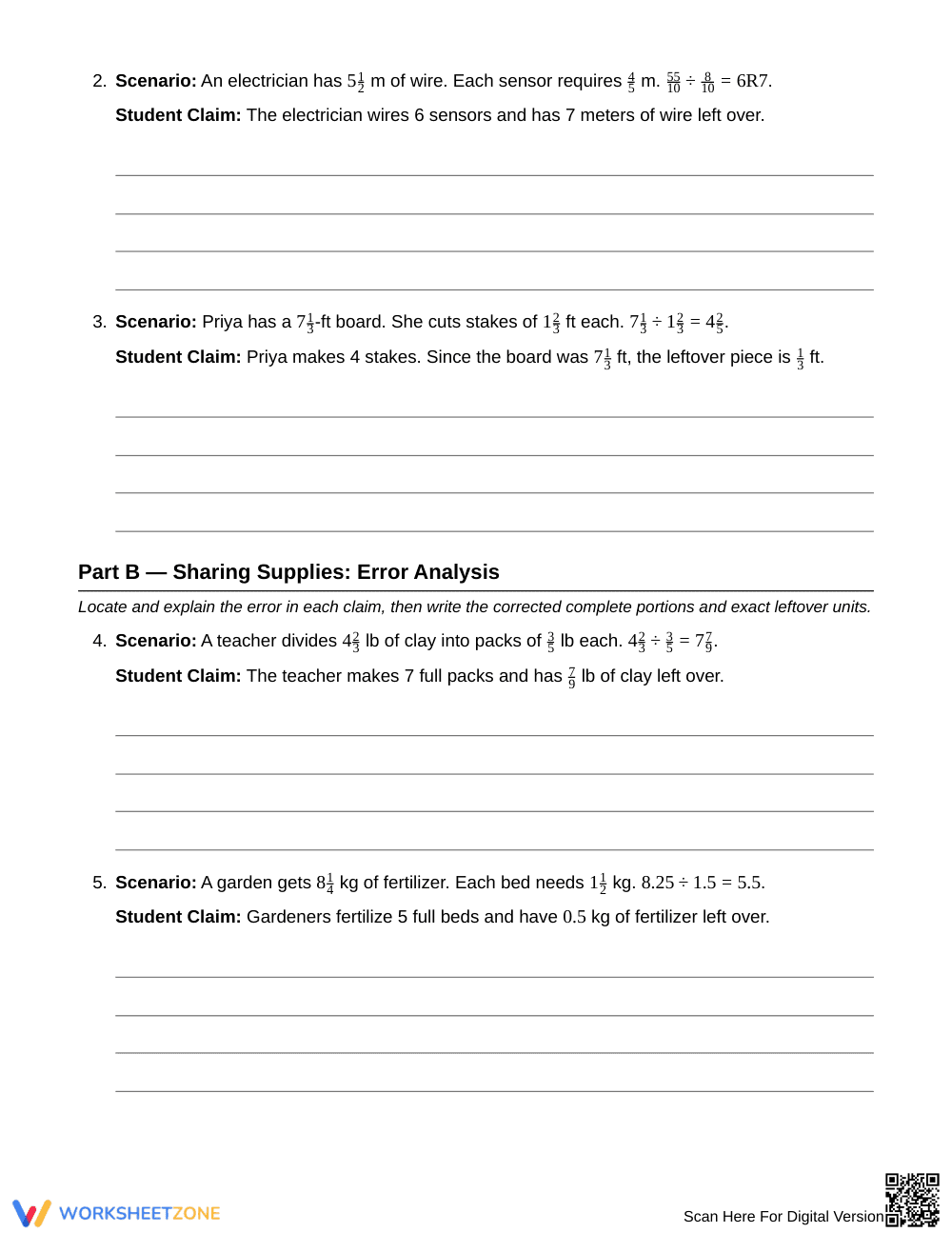
This 4-page resource includes a structured 10-item error-analysis problem set across three contextual categories: cutting lengths, sharing supplies, and measuring servings. Students analyze authentic student claims, calculate true remaining quantities using portion-size formulas, and formulate clear written corrections. A complete 2-page answer key provides step-by-step solutions and model explanations.
Skill Progression
- Guided Practice (Part A — 3 problems): Students analyze linear measurement scenarios with an explicit formula reference and modeled example to untangle portion fractions from remaining linear units.
- Supported Practice (Part B — 4 problems): Learners evaluate weight, area, and volume word problems requiring independent conversion of fractional portions into concrete leftover physical quantities.
- Independent Practice (Part C — 3 problems): Students resolve complex multi-step serving contexts, disproving flawed remainder claims and justifying exact leftover amounts with minimal scaffolding.
This structured progression follows the gradual-release framework, moving students systematically from supported error identification to autonomous conceptual evaluation.
Standards Alignment
This resource aligns directly to 6.NS.A.1, which requires students to interpret and compute quotients of fractions, and solve word problems involving division of fractions by fractions, including using visual fraction models and equations to represent the problem. Both standard codes can be copied directly into lesson plans, IEP goals, or district curriculum mapping tools.
How to Use It
Deploy this worksheet after direct instruction on fraction division as a collaborative partner activity where students critique reasoning. Alternatively, use it during small-group intervention for students who continually mislabel remainders on unit assessments. Formative observation tip: Listen for whether students multiply the remainder fraction by the divisor or mistakenly copy the divisor's unit directly onto the quotient remainder. Expected completion time is 30 to 45 minutes.
Who It's For
This activity is designed for Grade 6 general education math students, math intervention cohorts, and English learners needing structured math language practice. Differentiate by providing fraction tiles or visual bar models to support struggling conceptualizers. Pair this resource naturally with a fraction division anchor chart or direct instruction mini-lesson on contextualizing remainder units.
According to findings from EdReports 2024, rigorous Grade 6 mathematics instruction requires balancing procedural fluency with deep conceptual understanding, particularly when addressing standard 6.NS.A.1. Division of fractions remains one of the most persistent instructional hurdles in middle school mathematics, as students frequently misinterpret mixed-number quotients by treating the fractional remainder as an absolute leftover unit rather than a fractional proportion of the portion size. By engaging in structured mathematical error analysis, middle grade learners explicitly deconstruct common incorrect student claims, verify calculations, and determine true leftover quantities across varied real-world measurement units including yards, meters, pounds, and quarts. This 10-task resource targets these exact conceptual pitfalls through structured, scaffolded practice, reinforcing division quotient meaning, proportional reasoning, and unit consistency to ensure lasting mathematical proficiency and mastery across diverse learning environments.


