




























Views
Downloads



Aligned Feasible Triangles Worksheet | Grade 12 Precalculus

Paste this activity's link or code into your existing LMS (Google Classroom, Canvas, Teams, Schoology, Moodle, etc.).
Students can open and work on the activity right away, with no student login required.
You'll still be able to track student progress and results from your teacher account.
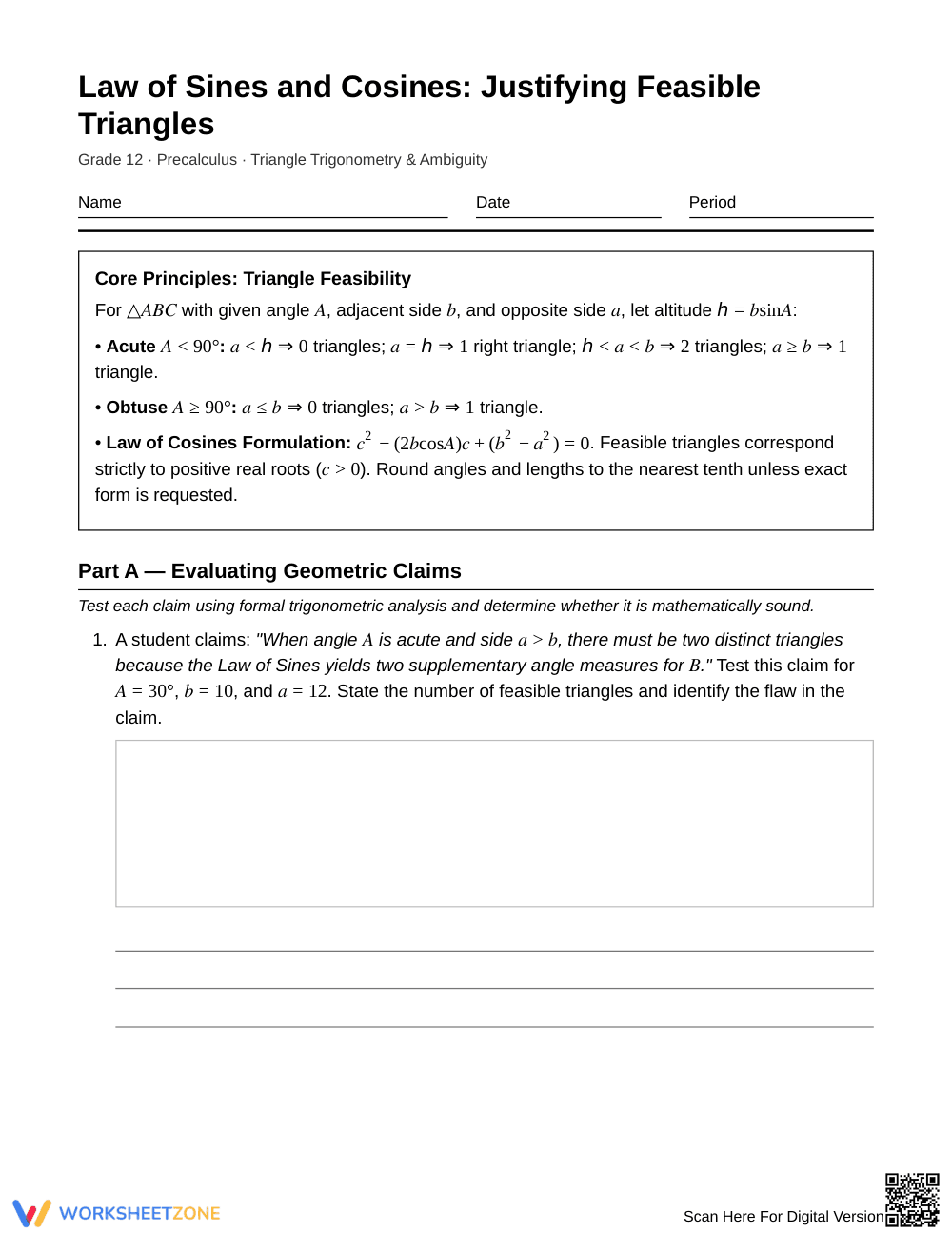
This Precalculus worksheet equips Grade 12 students to rigorously justify the number of feasible triangles formed under SSA conditions using the Law of Sines and the Law of Cosines. High schoolers analyze geometric claims, evaluate quadratic discriminants, and construct algebraic counterexamples to verify whether zero, one, or two distinct non-congruent triangles exist.
At a Glance
- Grade: 12 · Subject: Precalculus
- Standard:
HSG-SRT.D.11— Apply Law of Sines and Cosines to calculate and verify triangle feasibility- Skill Focus: Justify the Number of Feasible Triangles
- Format: 5 student pages · 8 structured problems · Complete 3-page answer key included · PDF
- Best For: Advanced SSA triangle ambiguity instruction
- Time: 45–60 minutes
What's Inside
Across 5 student pages, this resource features 8 multi-step problems supported by a core principles reference box and geometric diagrams. Students evaluate geometric claims, prove conditions via quadratic equations, and determine boundary intervals. A complete 3-page answer key provides full algebraic derivations and geometric reasoning.
Skill Progression
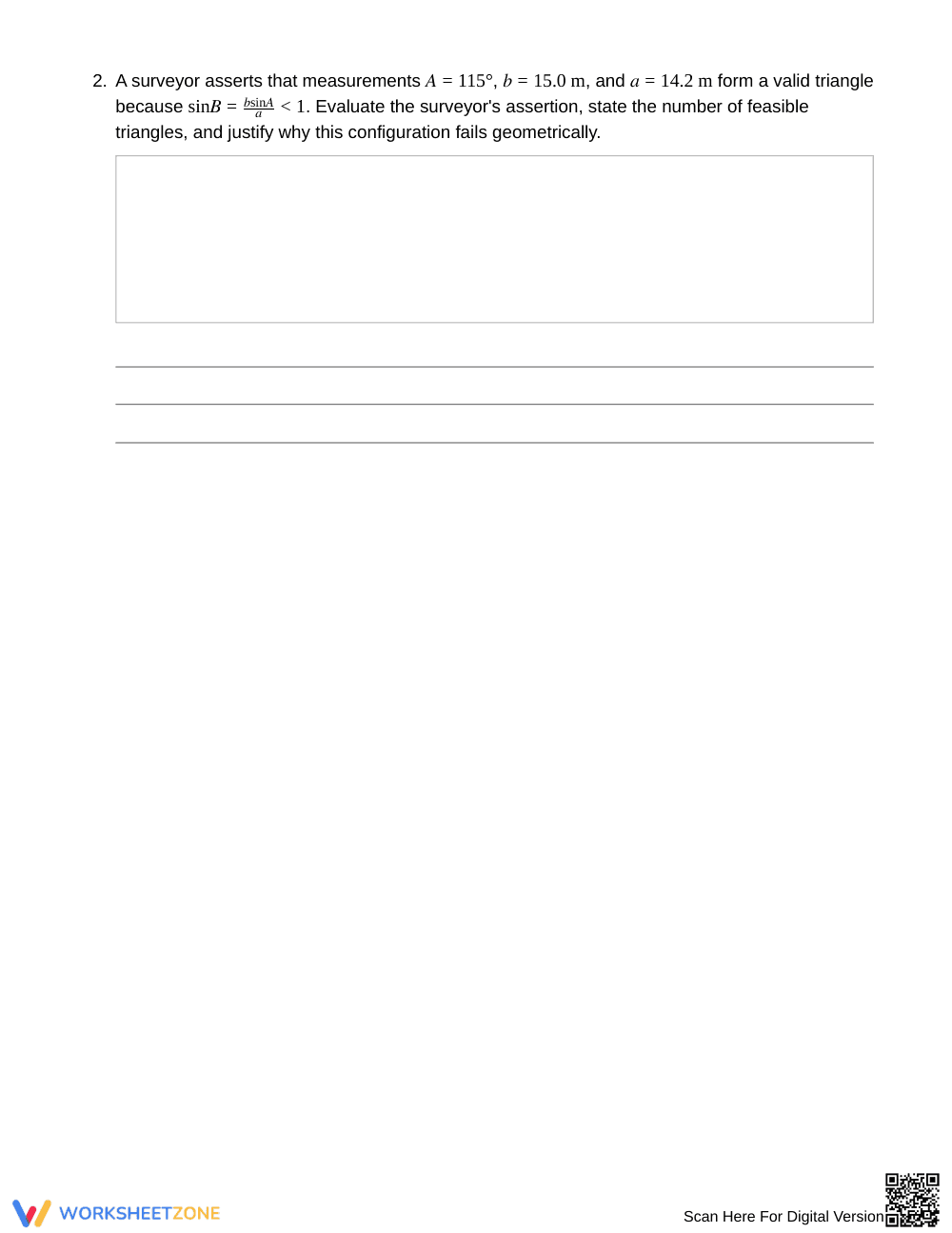
- Guided practice (Problems 1–2): Students analyze SSA claims from peers and surveyors, identifying geometric fallacies using given angle and side constraints.
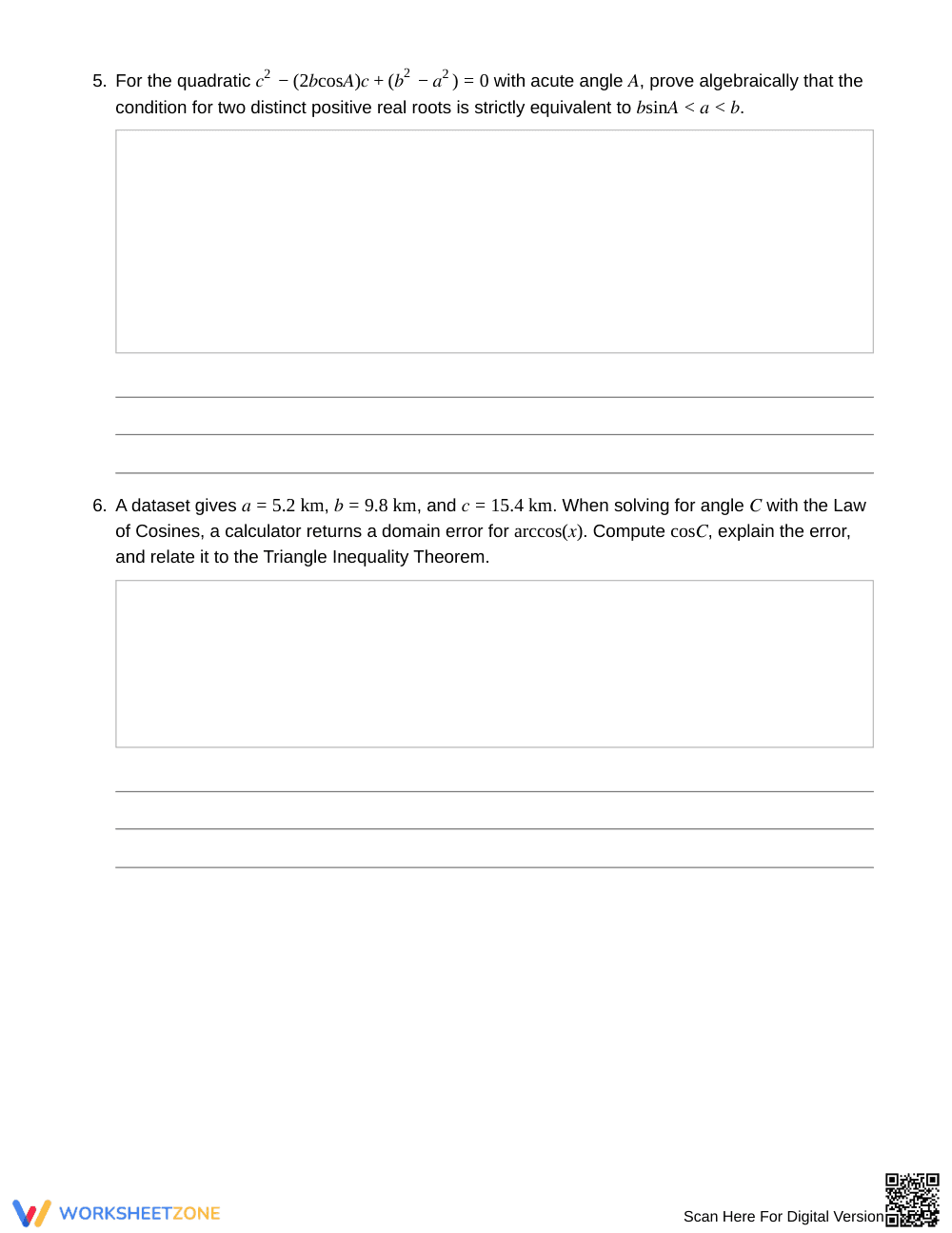
- Supported practice (Problems 3–6): Learners compute altitudes, formulate quadratic equations with the Law of Cosines, prove root conditions, and evaluate domain errors.
- Independent practice (Problems 7–8): High schoolers construct counterexamples to disprove trigonometric conjectures and establish exact feasibility intervals in a boundary table.
This sequence implements gradual release, transitioning students from structured error analysis to independent algebraic justification.
Standards Alignment
This worksheet aligns with primary standard `HSG-SRT.D.11`: Understand and apply the Law of Sines and the Law of Cosines to find unknown measurements in right and non-right triangles. It also supports `HSG-SRT.D.10` through non-right triangle proofs. Both standard codes can be copied directly into lesson plans, IEP goals, or district curriculum mapping tools.
How to Use It
Use this worksheet after introducing SSA ambiguity in trigonometry. Have student pairs work through Part B to analyze how quadratic roots determine side lengths. As a formative assessment check, review Problem 6 explanations to verify that students connect calculator domain errors to triangle inequality failures. Expected completion time is 45 to 60 minutes.
Who It's For
This resource serves Grade 12 Precalculus and trigonometry students mastering geometric analysis. For differentiation, provide struggling learners with the altitude formulas from the reference box, while challenging advanced students with the formal quadratic proof. It pairs naturally with direct instruction lectures on the ambiguous case and dynamic geometry applets.
According to instructional research by Fisher & Frey (2014), structured progression through gradual release solidifies student mastery of complex mathematical reasoning and proof structures. This Precalculus resource supports standard HSG-SRT.D.11 by training students to justify the number of feasible triangles through rigorous geometric and algebraic verification. Rather than relying on rote memorization of the SSA ambiguous case, students examine altitude relationships, evaluate quadratic equations derived from the Law of Cosines, and construct explicit counterexamples to disprove false claims. The 8 multi-part tasks scaffold analytical thinking from guided critique to formal boundary interval generation across 5 structured pages. By demanding precise geometric justification alongside calculation, the instructional design ensures learners develop conceptual fluency with triangle feasibility constraints. Secondary mathematics educators can reliably deploy this sequence to document student mastery of non-right triangle trigonometry and deductive analytical argumentation.


