


























Views
Downloads

Essential Algebra Revision Worksheet | Grade 10-12
Paste this activity's link or code into your existing LMS (Google Classroom, Canvas, Teams, Schoology, Moodle, etc.).
Students can open and work on the activity right away, with no student login required.
You'll still be able to track student progress and results from your teacher account.
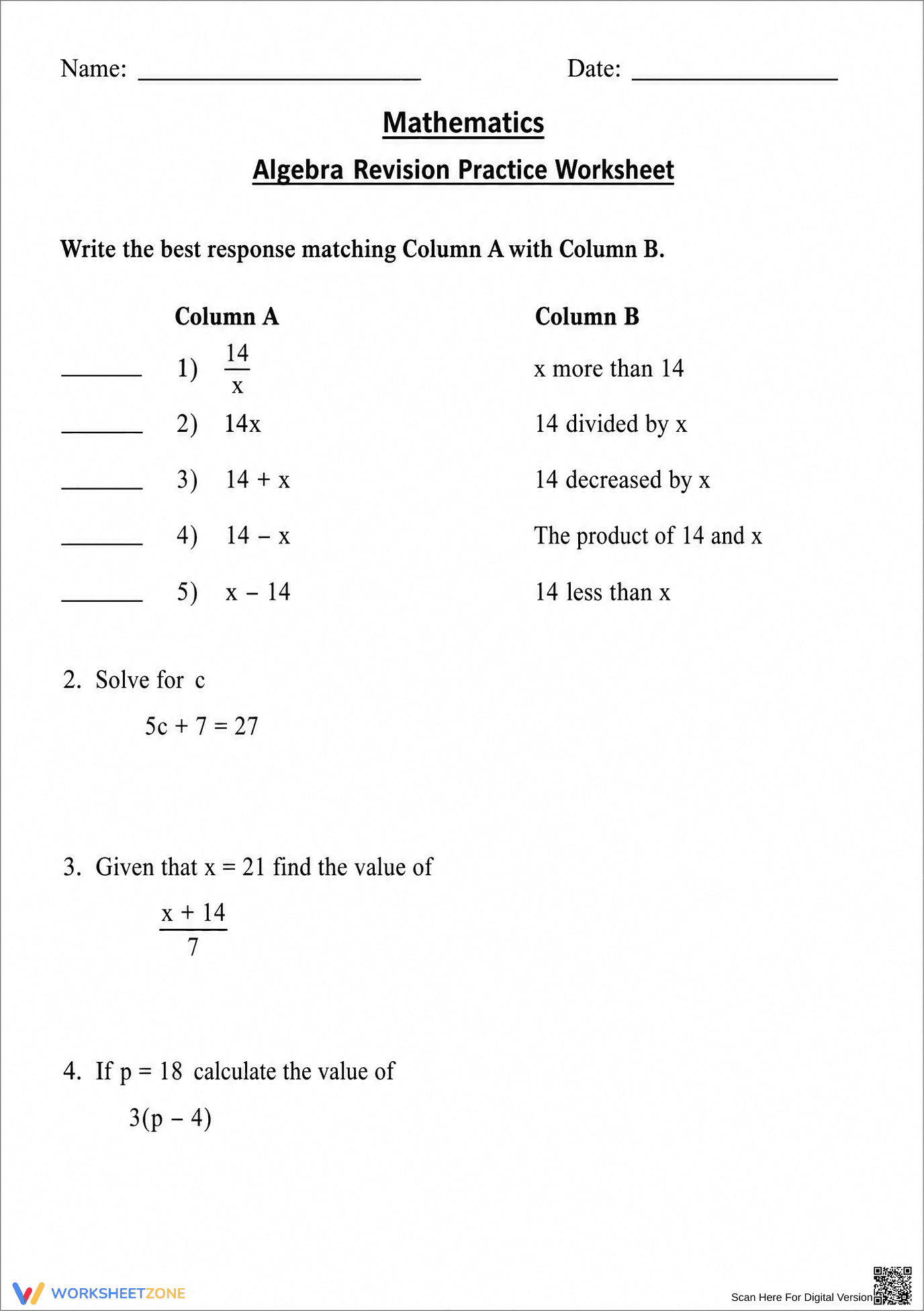
This algebra revision worksheet provides high school students with targeted practice in translating verbal phrases into mathematical notation and solving linear equations. By bridging the gap between language and symbols, students develop the fluency required for advanced calculus and statistics. It serves as a comprehensive review of foundational algebraic manipulation and variable interpretation.
At a Glance
- Grade: 10-12 · Subject: Algebra
- Standard:
HSA.SSE.A.1— Interpret expressions that represent a quantity in terms of its context- Skill Focus: Expression matching and equation solving
- Format: 1 page · 8 problems · Answer key included · PDF
- Best For: Quick review or bell-ringer activity
- Time: 15–20 minutes
The resource contains 8 distinct problems organized into logical segments. It begins with a 5-item matching table where students connect expressions like "14 divided by x" to their symbolic counterparts. The second half features three computational tasks: solving a multi-step linear equation, evaluating a rational expression, and calculating the value of an expression involving parentheses and distributive properties. This variety ensures students practice both conceptual translation and procedural execution.
Zero-Prep Workflow
- Print: Generate the single-page PDF for your entire class in under 30 seconds.
- Distribute: Hand out the sheets as a warm-up, exit ticket, or independent practice during a revision session.
- Review: Use the included answer key to identify common misconceptions in variable placement or order of operations within 5 minutes.
Total teacher preparation time is under 2 minutes, making this an ideal resource for emergency sub plans or last-minute curriculum supplements.
This worksheet aligns with CCSS.MATH.CONTENT.HSA.SSE.A.1, focusing on interpreting parts of an expression, such as terms, factors, and coefficients. It also supports HSA.REI.B.3 by requiring students to solve linear equations in one variable. Both standard codes can be copied directly into lesson plans, IEP goals, or district curriculum mapping tools to ensure compliance with state frameworks.
Use this worksheet as a formative assessment at the start of a unit on quadratic functions to ensure students have mastered linear basics. Alternatively, assign it as a homework task to reinforce classroom instruction. While students work, observe if they struggle with the "less than" phrasing in the matching section, as this often indicates a need for further instruction on subtraction order and syntax.
This resource is ideal for Grade 10-12 students who require a refresher on algebraic syntax before tackling complex word problems. It is particularly effective for English Language Learners (ELLs) due to the explicit matching of vocabulary to symbols. Pair this with a direct instruction lesson on the distributive property or an anchor chart for a complete instructional cycle.
According to Fisher & Frey (2014), the gradual release of responsibility begins with ensuring students can accurately translate academic language into mathematical symbols. This worksheet addresses that specific need through its matching and evaluation tasks. By focusing on HSA.SSE.A.1, the material reinforces the structural understanding of algebra necessary for higher-level STEM coursework. Research indicates that frequent, low-stakes retrieval practice of these 8 core skills significantly improves long-term retention of algebraic rules. This printable PDF provides a structured environment for that practice, allowing educators to quickly gauge student readiness for more abstract concepts. The inclusion of multi-step solving ensures that students are not just identifying patterns but applying procedural knowledge to find specific solutions. This balanced approach is essential for meeting rigorous state standards and preparing students for college-level mathematics assessments.


