


























Views
Plays
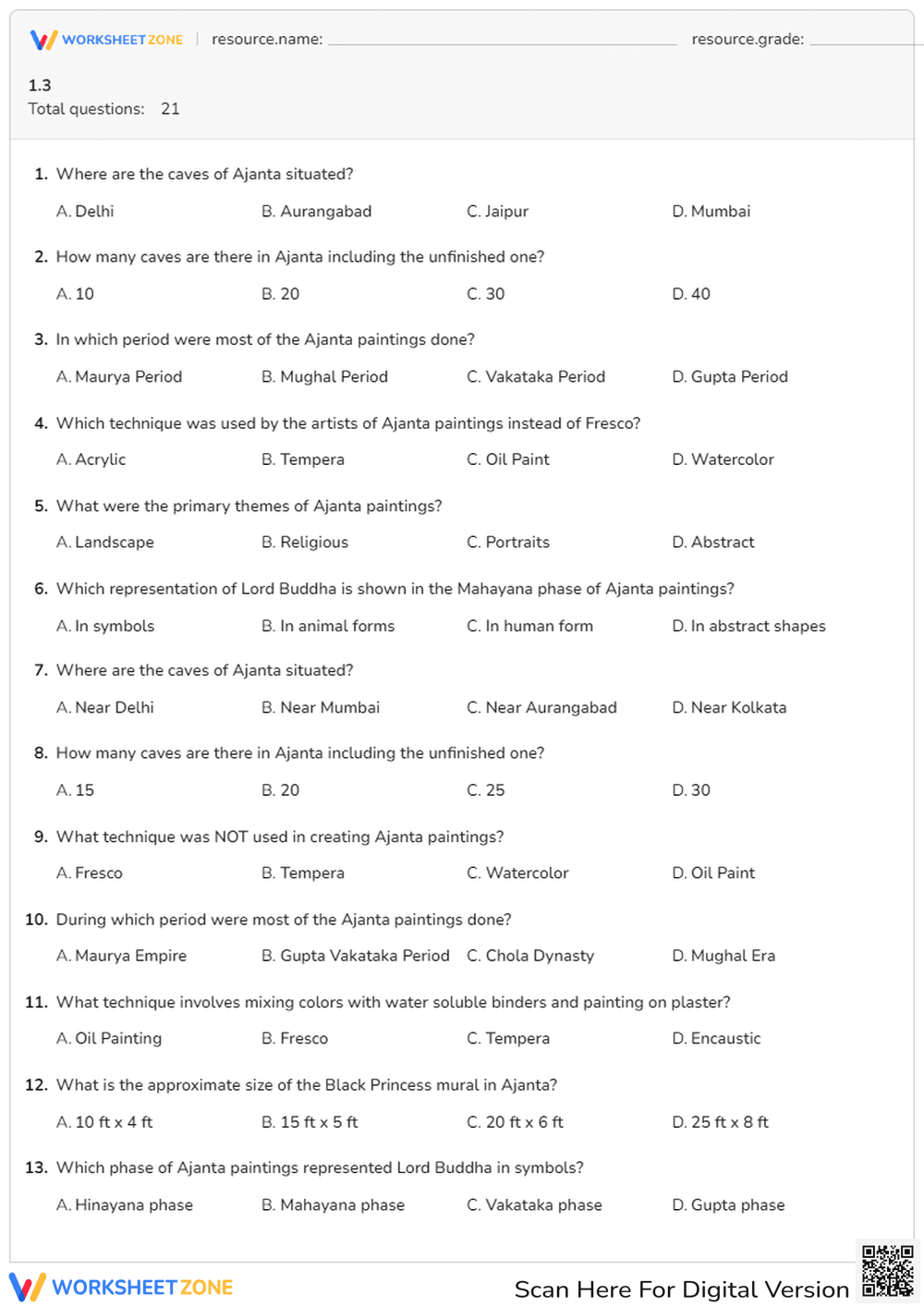


Ajanta Caves History Quiz | Grade 10 Essential
Paste this activity's link or code into your existing LMS (Google Classroom, Canvas, Teams, Schoology, Moodle, etc.).
Students can open and work on the activity right away, with no student login required.
You'll still be able to track student progress and results from your teacher account.
This Grade 10 World History worksheet provides a comprehensive assessment of student knowledge regarding the Ajanta Caves, a pivotal UNESCO World Heritage site. Students will demonstrate their understanding of Indian art history, Buddhist religious phases, and ancient architectural techniques. By engaging with these 21 targeted questions, learners solidify their grasp of the Vakataka and Gupta periods.
At a Glance
- Grade: 10 · Subject: World History
- Standard:
CCSS.ELA-LITERACY.RH.9-10.4— Determine the meaning of domain-specific words and historical phrases- Skill Focus: Indian Art History & Cultural Heritage
- Format: 2 pages · 21 problems · Answer key included · PDF
- Best For: Quick formative assessment or sub plans
- Time: 20–30 minutes
Inside this two-page resource, you will find 21 multiple-choice questions designed to test both broad historical context and specific artistic details. The worksheet covers the geographical location of the caves, the number of structures present, and the specific tempera technique used by ancient artists. It also includes questions about the Hinayana and Mahayana phases of Buddhism, ensuring a well-rounded evaluation of the subject matter.
This resource is designed for a zero-prep workflow. Step 1: Print the two-page PDF in less than a minute. Step 2: Distribute to students as a quiet starter, exit ticket, or independent practice activity. Step 3: Review the answers using the included key to provide immediate feedback. Total teacher preparation time is under two minutes, making it an ideal choice for busy classroom days or unexpected substitute teacher needs.
This worksheet is primarily aligned with CCSS.ELA-LITERACY.RH.9-10.4, which requires students to determine the meaning of symbols, key terms, and domain-specific phrases in a historical context. By identifying the nuances between different artistic periods and religious representations, students build the literacy skills necessary for advanced history coursework. This standard code can be copied directly into lesson plans, IEP goals, or district curriculum mapping tools.
Use this worksheet as a summative check after a unit on Ancient India or as a guided activity during a virtual field trip to the Ajanta Caves. For a formative assessment, observe which students struggle with the distinction between the Hinayana and Mahayana phases. Completion typically takes 20 to 30 minutes, providing a clear snapshot of student mastery before moving to the next historical era.
This resource is tailored for Grade 10 students but is adaptable for advanced middle schoolers or introductory college art history courses. It pairs naturally with an anchor chart on the Silk Road or a direct instruction lesson on the spread of Buddhism across Asia. The clear layout ensures accessibility for all learners while maintaining academic rigor.
This Grade 10 Ajanta Caves assessment aligns with CCSS.ELA-LITERACY.RH.9-10.4, focusing on the specialized vocabulary of art history and cultural heritage. By evaluating student understanding of terms like tempera, Vakataka period, and Mahayana phase, the worksheet supports the development of domain-specific literacy. According to Fisher & Frey (2014), the use of structured retrieval practice through multiple-choice assessments significantly enhances long-term retention of complex historical facts. This resource provides a rigorous yet accessible way for students to demonstrate mastery of Indian history and the evolution of Buddhist art. The 21-question format ensures comprehensive coverage of the site's geographical, technical, and religious significance. Educators can utilize this data to identify gaps in student knowledge regarding South Asian civilizations. The inclusion of specific details, such as the Black Princess mural, encourages students to engage with primary cultural artifacts as evidence of historical artistic achievement.


