


























Views
Plays
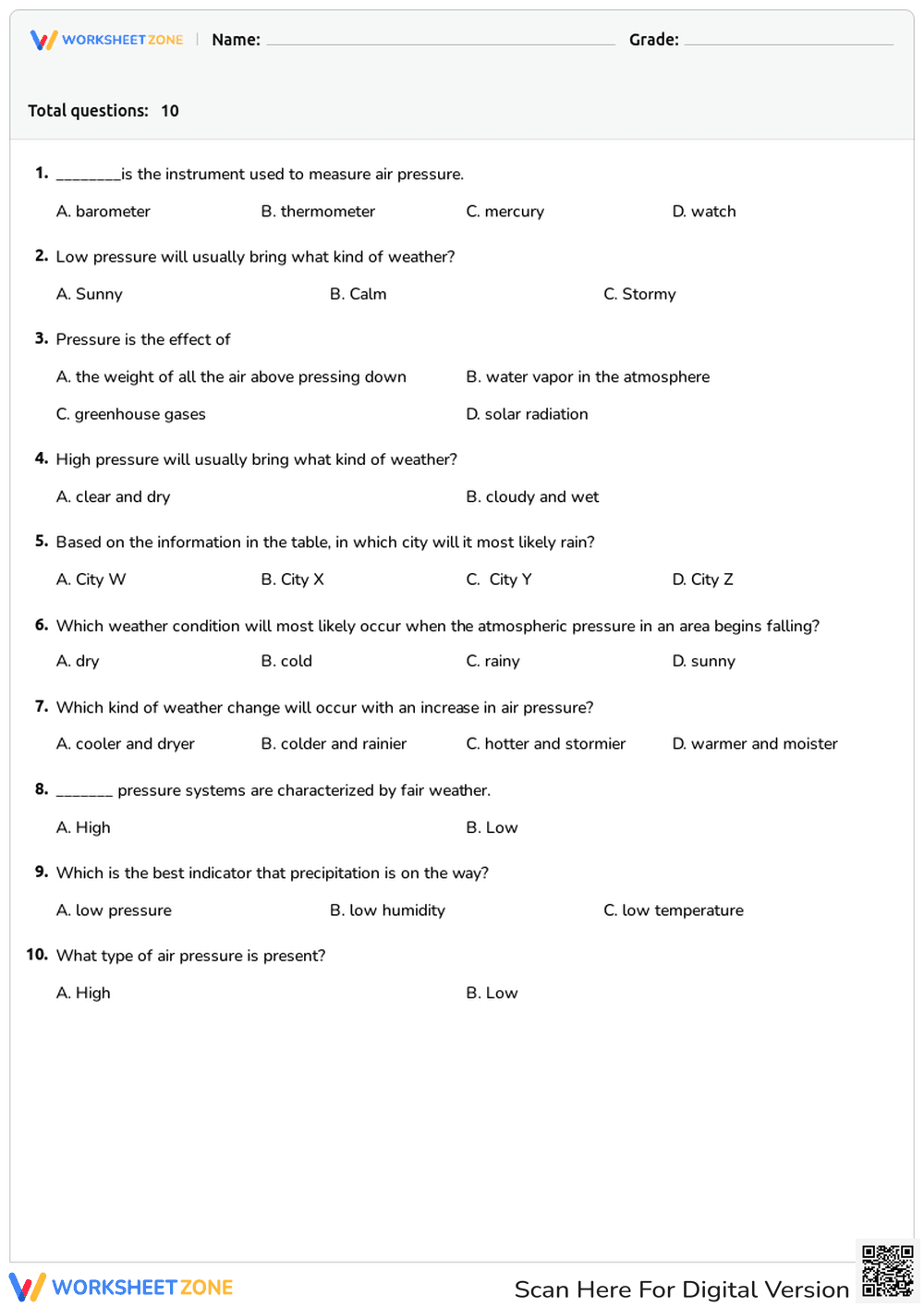

Air Pressure Worksheet: Grade 5-8 Essential Science
Paste this activity's link or code into your existing LMS (Google Classroom, Canvas, Teams, Schoology, Moodle, etc.).
Students can open and work on the activity right away, with no student login required.
You'll still be able to track student progress and results from your teacher account.
This Grade 5-8 science worksheet provides a focused assessment of student understanding regarding atmospheric pressure and its direct impact on weather patterns. Students identify measurement tools and predict meteorological changes based on pressure fluctuations. It serves as an effective tool for verifying conceptual mastery of air mass interactions and weather forecasting.
At a Glance
- Grade: 5-8 · Subject: Science
- Standard:
MS-ESS2-5— Collect data to provide evidence for how air mass interactions change weather- Skill Focus: Air pressure and weather systems
- Format: 1 page · 10 problems · Answer key included · PDF
- Best For: Quick formative assessment or sub plans
- Time: 15–20 minutes
The resource consists of a single-page PDF featuring 10 multiple-choice questions. These tasks require students to define air pressure, identify the barometer as the primary measurement instrument, and distinguish between high and low-pressure weather outcomes. The layout is clean and distraction-free, with a dedicated space for student names and grades at the top.
Teachers can integrate this resource into their workflow in under two minutes. Simply print the single-page document (30 seconds), distribute it to the class (1 minute), and use the provided answer key for rapid grading or peer review (30 seconds). Its self-contained nature makes it an ideal emergency sub plan or a bell-ringer activity to start a meteorology unit.
The primary alignment is MS-ESS2-5, which requires students to collect data to provide evidence for how the motions and complex interactions of air masses result in changes in weather conditions. It also supports 5-ESS2-1 by exploring the atmosphere's role in Earth's systems. Both standard codes can be copied directly into lesson plans, IEP goals, or district curriculum mapping tools.
Use this worksheet as a formative assessment immediately following a lesson on the atmosphere to gauge student comprehension. Alternatively, assign it as a review task before a unit test on weather. Teachers should observe if students can correctly link falling pressure with stormy weather, as this is a critical indicator of conceptual understanding. Completion typically takes 15 to 20 minutes.
This resource is designed for middle school science students, particularly those in grades 5 through 8. It is accessible for general education classrooms and can be paired with a weather map anchor chart or a hands-on barometer demonstration to provide additional visual support for diverse learners.
According to the RAND AIRS 2024 report, high-quality science assessments must move beyond rote memorization to evaluate how students apply conceptual models to real-world phenomena like weather forecasting. This worksheet aligns with that goal by requiring students to interpret the relationship between atmospheric data and observable weather changes. By focusing on the MS-ESS2-5 standard, the resource ensures that students are practicing the specific analytical skills required for middle school science proficiency. Research from Fisher & Frey (2014) emphasizes that frequent, low-stakes formative assessments, such as this 10-question quiz, are vital for identifying student misconceptions early in the instructional cycle. This allows educators to adjust their teaching strategies in real-time, leading to better long-term retention of complex meteorological concepts like air pressure gradients and system characteristics.


