


























Views
Plays




Essential AI Aptitude Quiz | Grades 9-12 Computer Science
Paste this activity's link or code into your existing LMS (Google Classroom, Canvas, Teams, Schoology, Moodle, etc.).
Students can open and work on the activity right away, with no student login required.
You'll still be able to track student progress and results from your teacher account.
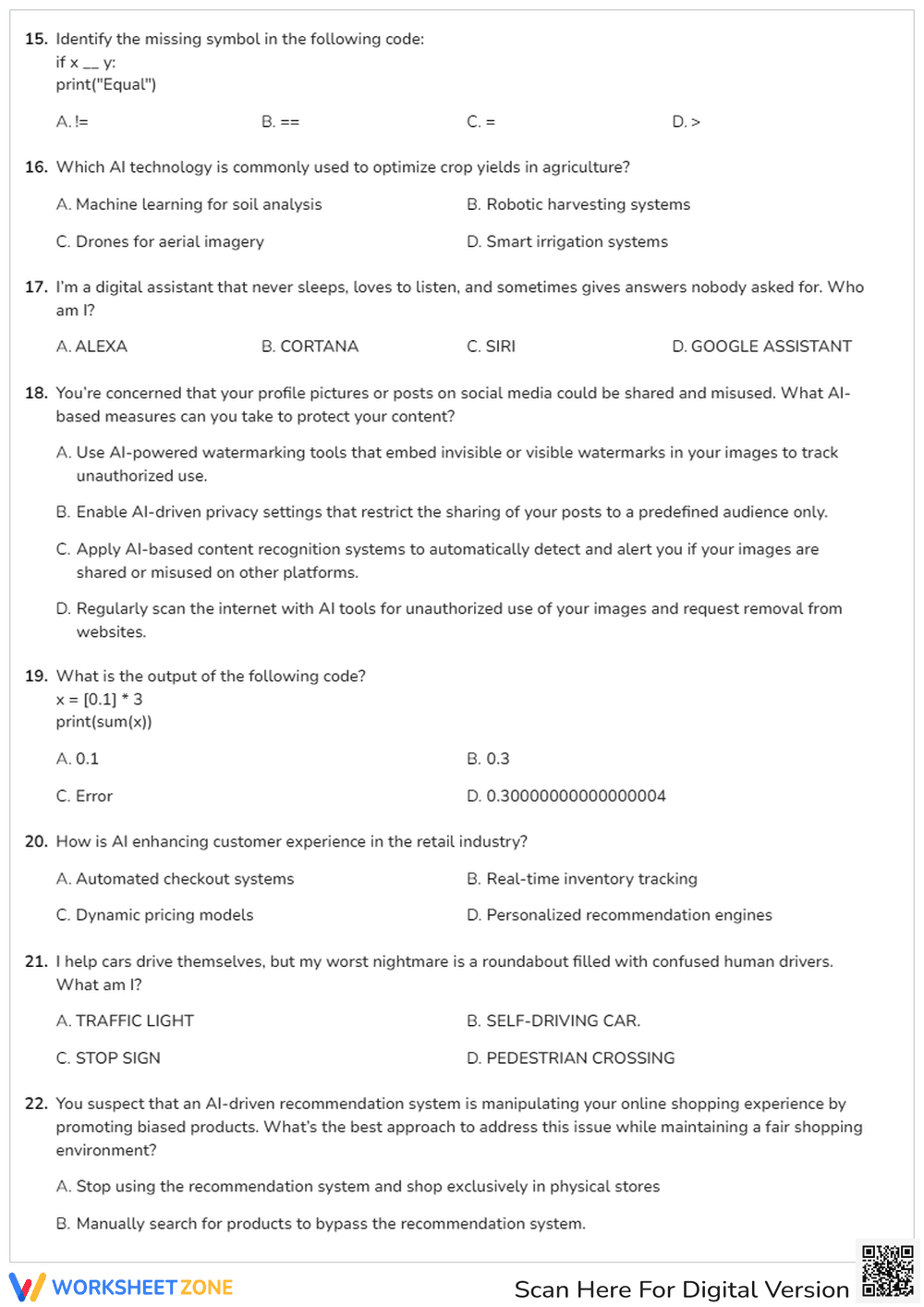
This comprehensive Grade 9-12 Artificial Intelligence worksheet provides students with 50 rigorous multiple-choice questions to evaluate their understanding of modern AI systems. Students will analyze real-world ethical dilemmas, identify Python syntax for data science, and differentiate between complex search algorithms. It is designed to bridge the gap between theoretical knowledge and practical application.
At a Glance
- Grade: 9-12 · Subject: Computer Science
- Standard:
CSTA 3B.IC.25— Evaluate the social impact and ethical considerations of artificial intelligence- Skill Focus: AI Literacy & Algorithmic Logic
- Format: 7 pages · 50 problems · Answer key included · PDF
- Best For: High school AI unit assessment
- Time: 45–60 minutes
This 7-page assessment features 50 diverse tasks ranging from identifying famous AI figures like Sophia and Geoffrey Hinton to solving technical Python code snippets using the NumPy library. The worksheet includes scenario-based ethics questions regarding deepfakes and privacy, alongside technical evaluations of search algorithms like A* and Breadth-First Search. A full answer key is provided for rapid grading.
Skill Progression
- Guided practice: The first 15 questions focus on recognition and recall of AI history, famous models like GPT-4, and common industry applications.
- Supported practice: Questions 16-35 introduce scenario-based ethical decision-making and basic code interpretation using Python logic.
- Independent practice: The final 15 questions require high-level algorithmic analysis and comparison of search strategies like Greedy vs. A* search.
This gradual-release model ensures students build confidence before tackling complex computational logic and mathematical heuristics.
Standards Alignment
Primary standard CSTA 3B.IC.25: "Evaluate the social impact and ethical considerations of artificial intelligence." This resource also supports CSTA 3B.AP.11 by requiring students to evaluate and compare the efficiency of different algorithms. Both standard codes can be copied directly into lesson plans, IEP goals, or district curriculum mapping tools.
How to Use It
Use this worksheet as a summative assessment at the end of an introductory AI unit or as a diagnostic tool to gauge prior knowledge in a Computer Science elective. During the session, observe how students handle the algorithmic logic questions (43-50) to identify who may need additional support with data structures. Completion typically takes 50 minutes.
Who It's For
This resource is tailored for high school students in Grades 9-12 enrolled in AI, Robotics, or AP Computer Science courses. It is particularly effective for students preparing for technical aptitude competitions or those exploring career paths in machine learning. Pair this with a Python IDE for live code testing.
According to the RAND AIRS 2024 report, AI literacy is becoming a foundational requirement for secondary education, necessitating assessments that cover both technical proficiency and ethical reasoning. This worksheet addresses these dual needs by aligning with the CSTA 3B.IC.25 standard, ensuring students can evaluate the societal implications of automated systems. Research from Fisher & Frey (2014) emphasizes that high-volume retrieval practice, such as the 50-question format used here, significantly improves long-term retention of complex technical vocabulary and logic patterns. By integrating Python syntax with conceptual history, this resource provides a holistic view of the field. It serves as a reliable instrument for measuring student readiness in rapidly evolving technology sectors, making it a vital addition to modern STEM curricula.


