


























Views
Downloads
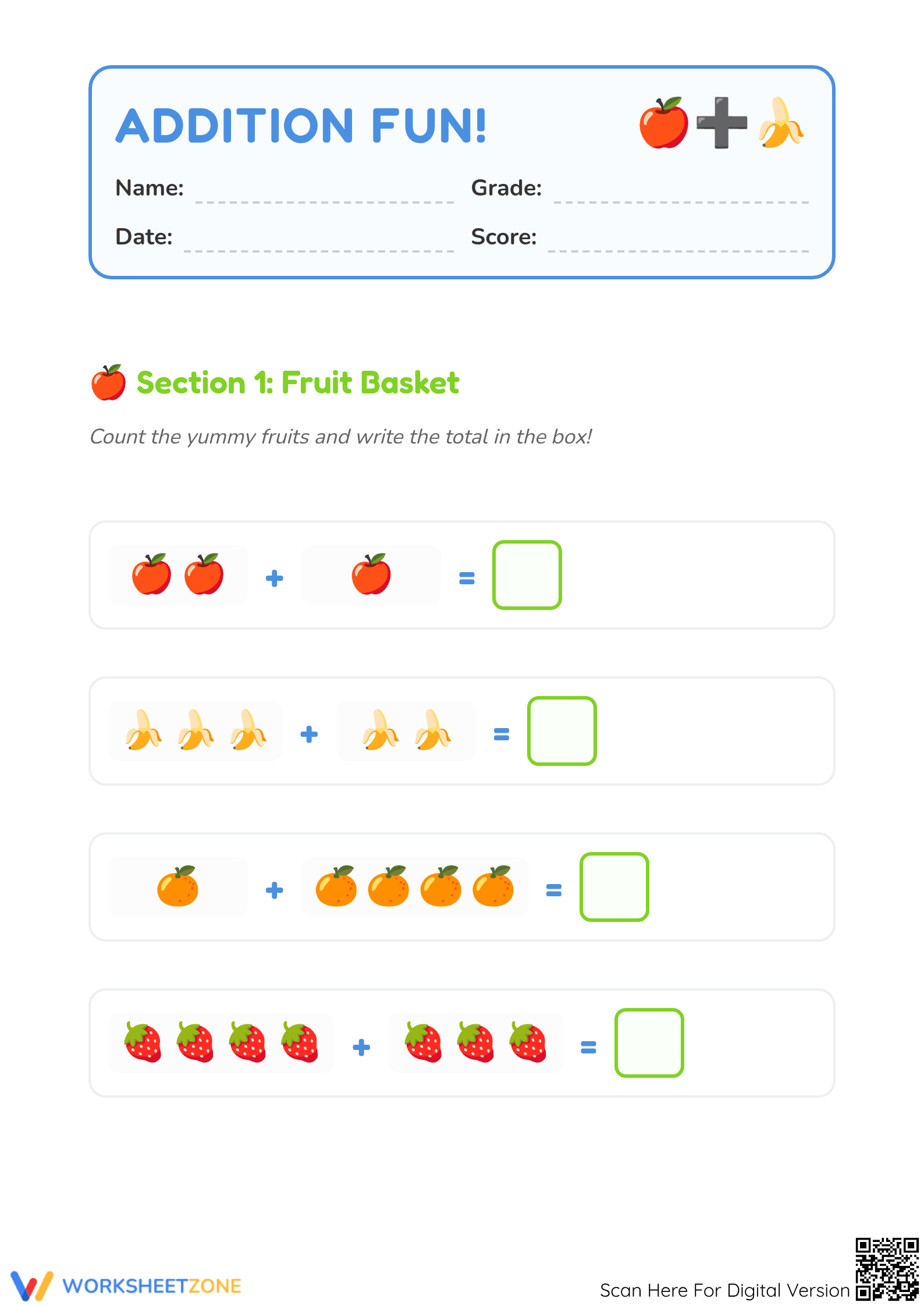
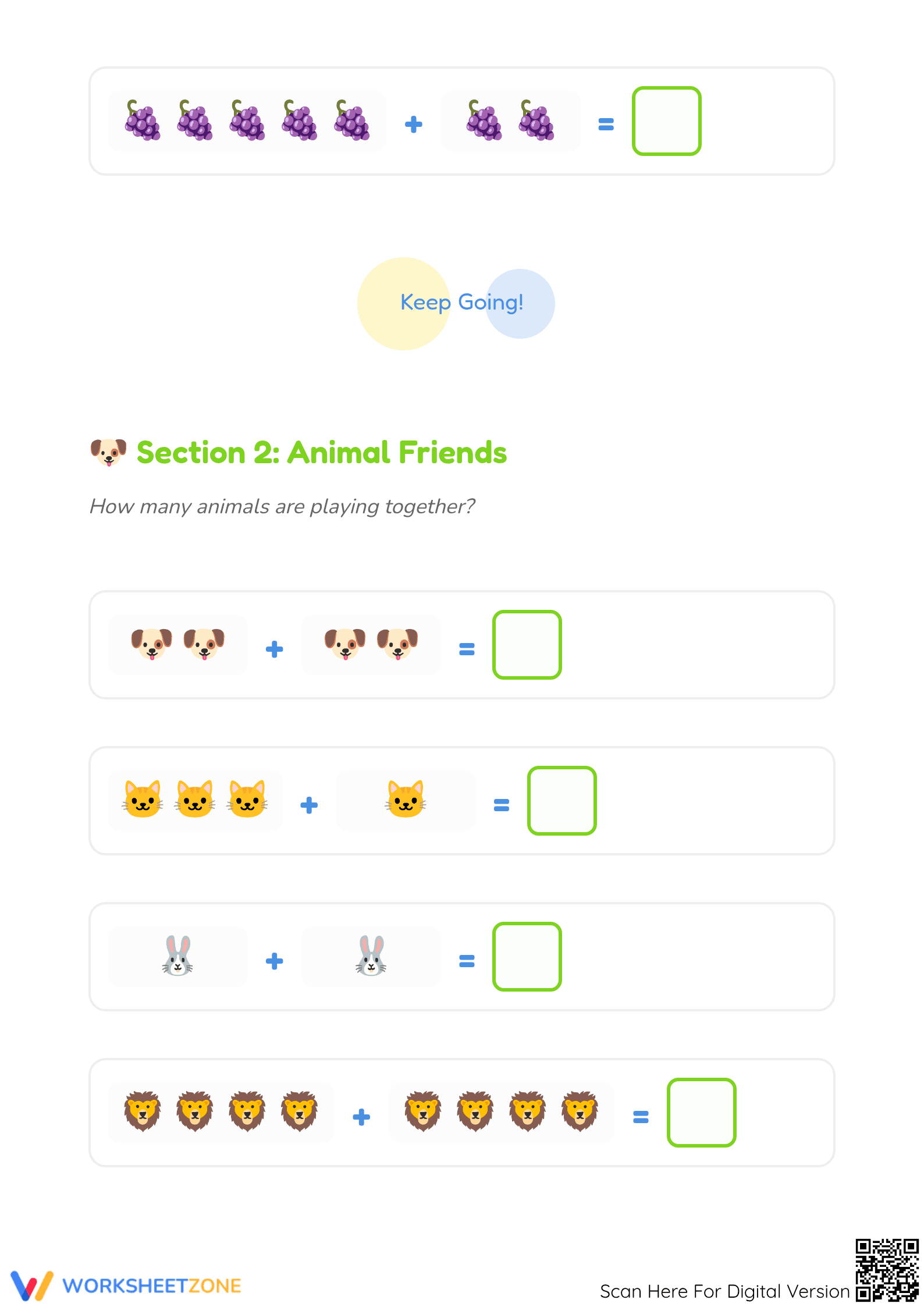
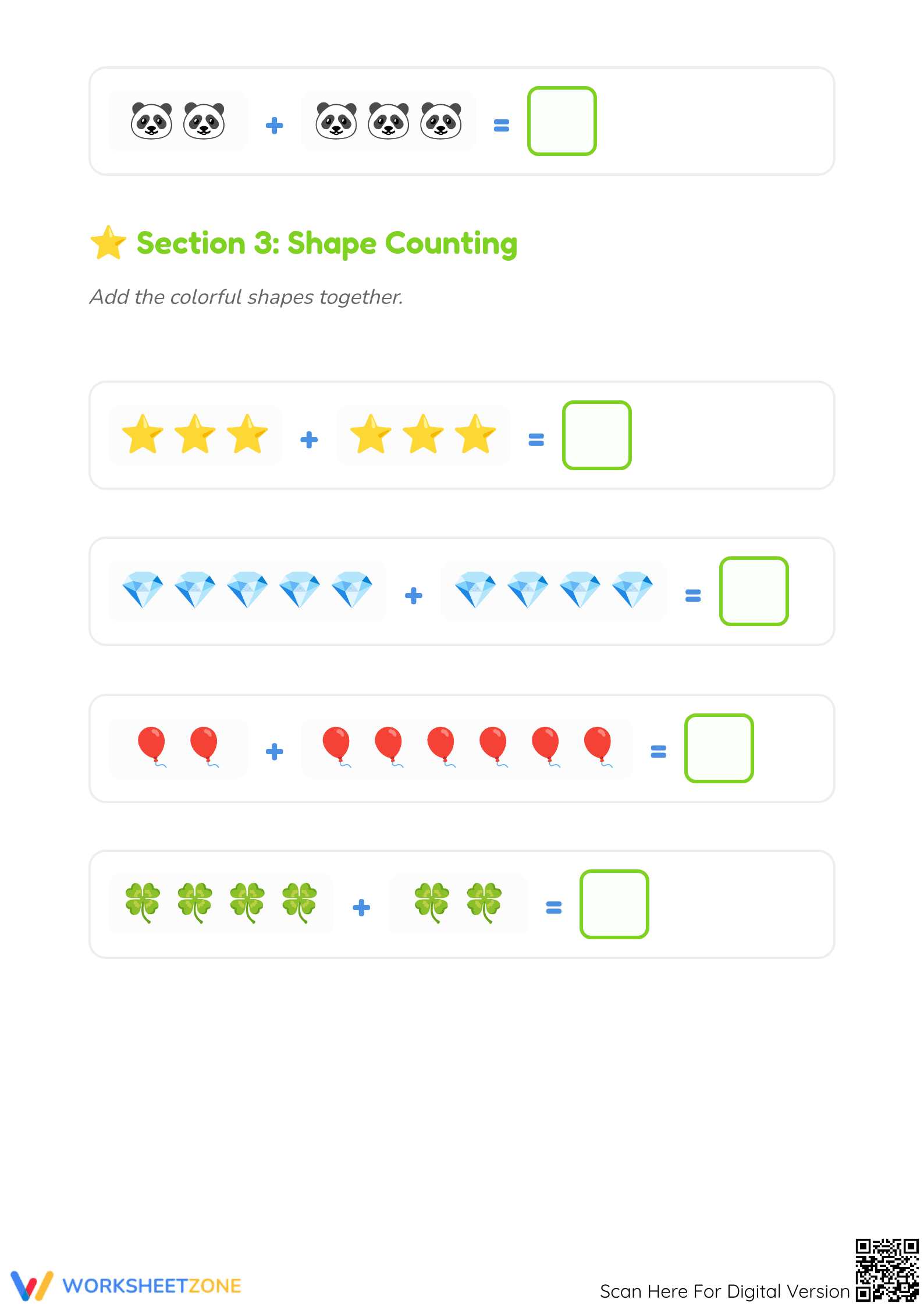
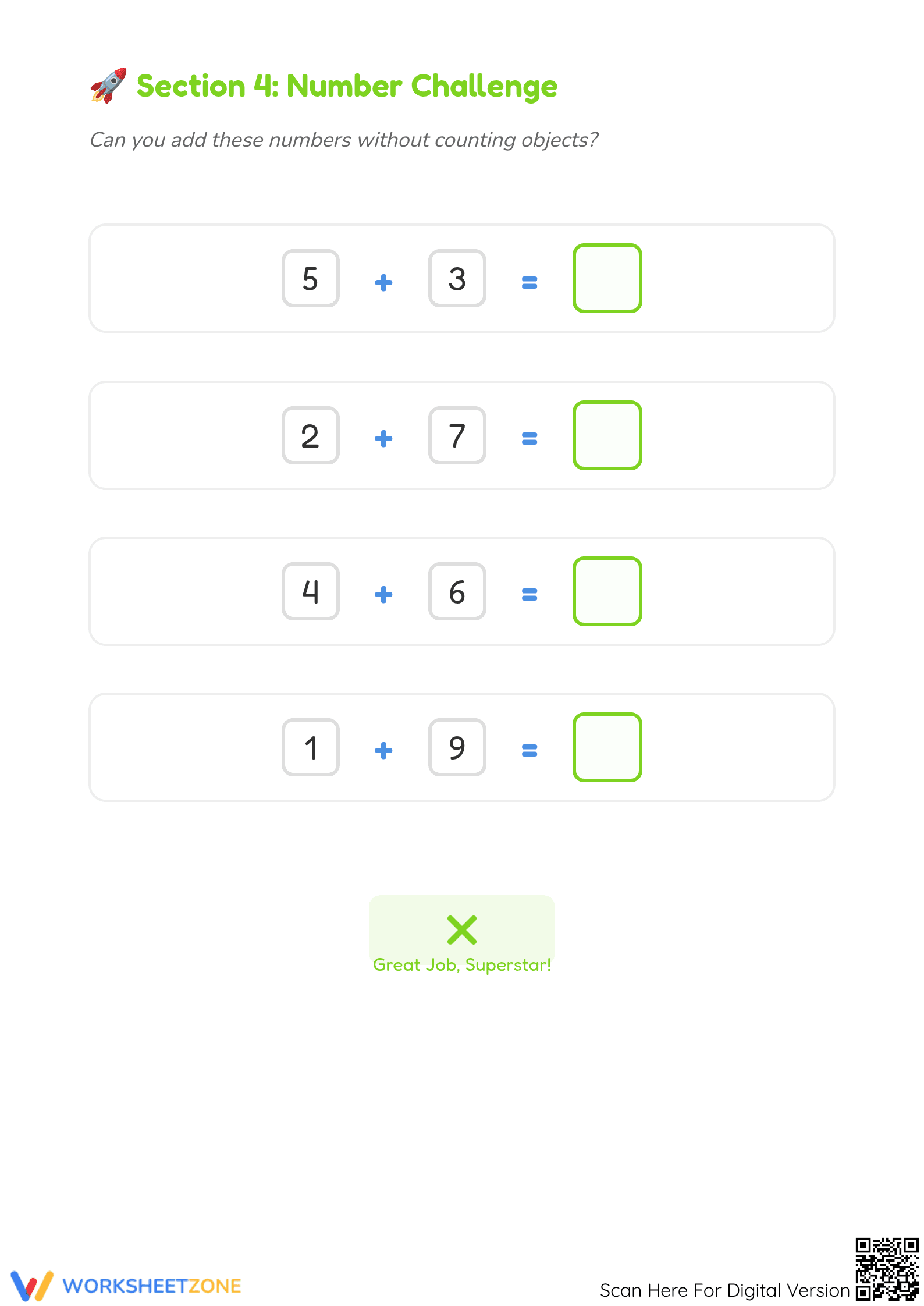

Essential Addition Fun Worksheet | Kindergarten Math
Paste this activity's link or code into your existing LMS (Google Classroom, Canvas, Teams, Schoology, Moodle, etc.).
Students can open and work on the activity right away, with no student login required.
You'll still be able to track student progress and results from your teacher account.
Students build a foundation in arithmetic by transitioning from concrete visual counting to abstract number sentences. This worksheet enables young learners to visualize quantities before solving equations, ensuring they internalize the concept of "putting together." The structured layout supports independent practice and boosts mathematical confidence across 18 unique problems.
At a Glance
- Grade: Kindergarten · Subject: Math
- Standard:
CCSS.MATH.CONTENT.K.OA.A.1— Represent addition with objects and drawings to solve simple equations- Skill Focus: Visual Counting to Addition
- Format: 4 pages · 18 problems · Answer key included · PDF
- Best For: Early finishers and daily math centers
- Time: 15–20 minutes
This four-page instructional packet is divided into four thematic sections designed to scaffold learning. It features high-quality illustrations of fruits, animals, and shapes that serve as visual manipulatives. The final page challenges students with abstract numerical addition without the aid of pictures. A comprehensive answer key is provided, allowing for quick grading or student self-correction during independent work periods.
This resource is designed for immediate integration with zero preparation. First, print the four-page PDF (time: 30 seconds). Second, distribute the worksheets during your math block or as a morning warm-up (time: 1 minute). Finally, use the included answer keys to review work (time: 2 minutes). It is an ideal solution for sub plans or enrichment.
This worksheet is aligned to CCSS.MATH.CONTENT.K.OA.A.1, which requires students to represent addition with objects and expressions. By moving from counting strawberries to solving abstract equations like 5 + 3, students demonstrate mastery of mathematical representation. Both standard codes can be copied directly into lesson plans or district curriculum mapping tools.
Use this as a summative assessment after a unit on counting. For a formative approach, observe students during Section 1 to see if they use one-to-one correspondence or begin to "count on." This resource works best as a 15-minute independent activity following a direct instruction lesson on mathematical symbols.
This resource is specifically tailored for Kindergarten students, though it provides excellent remedial support for Grade 1 learners and enrichment for Preschoolers. It pairs naturally with physical manipulatives like counting bears or snap cubes, allowing students to bridge the gap between 3D objects and 2D representations. It is particularly effective for English Language Learners due to the heavy reliance on visual cues.
According to the RAND AIRS 2024 report on early childhood mathematics, the use of visual representations in arithmetic is a critical predictor of long-term fluency in multi-digit operations. This worksheet leverages the instructional sequence by guiding students through 18 distinct tasks that move from high-detail fruit illustrations to abstract numerical symbols. By practicing the CCSS.MATH.CONTENT.K.OA.A.1 standard through multiple modalities—visual counting of animals and shapes followed by direct equation solving—students develop the mental models necessary for decomposing numbers. Research from EdReports 2024 emphasizes that high-quality printable materials must include clear answer keys to facilitate immediate feedback, a feature fully integrated into this four-page set. These exercises ensure that students don't just find the sum, but understand the underlying logic of addition as a transformative process.


