


























Views
Downloads
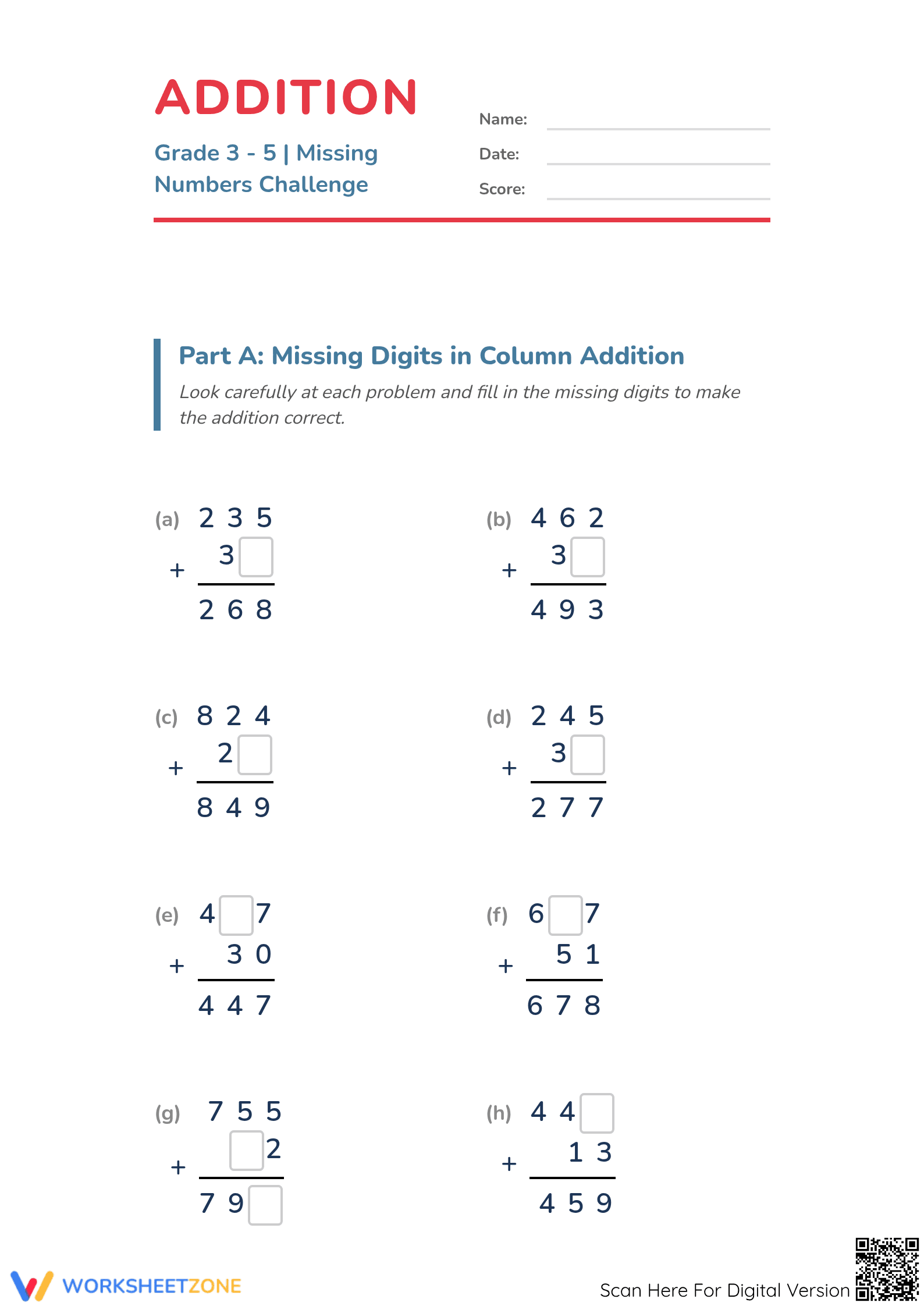
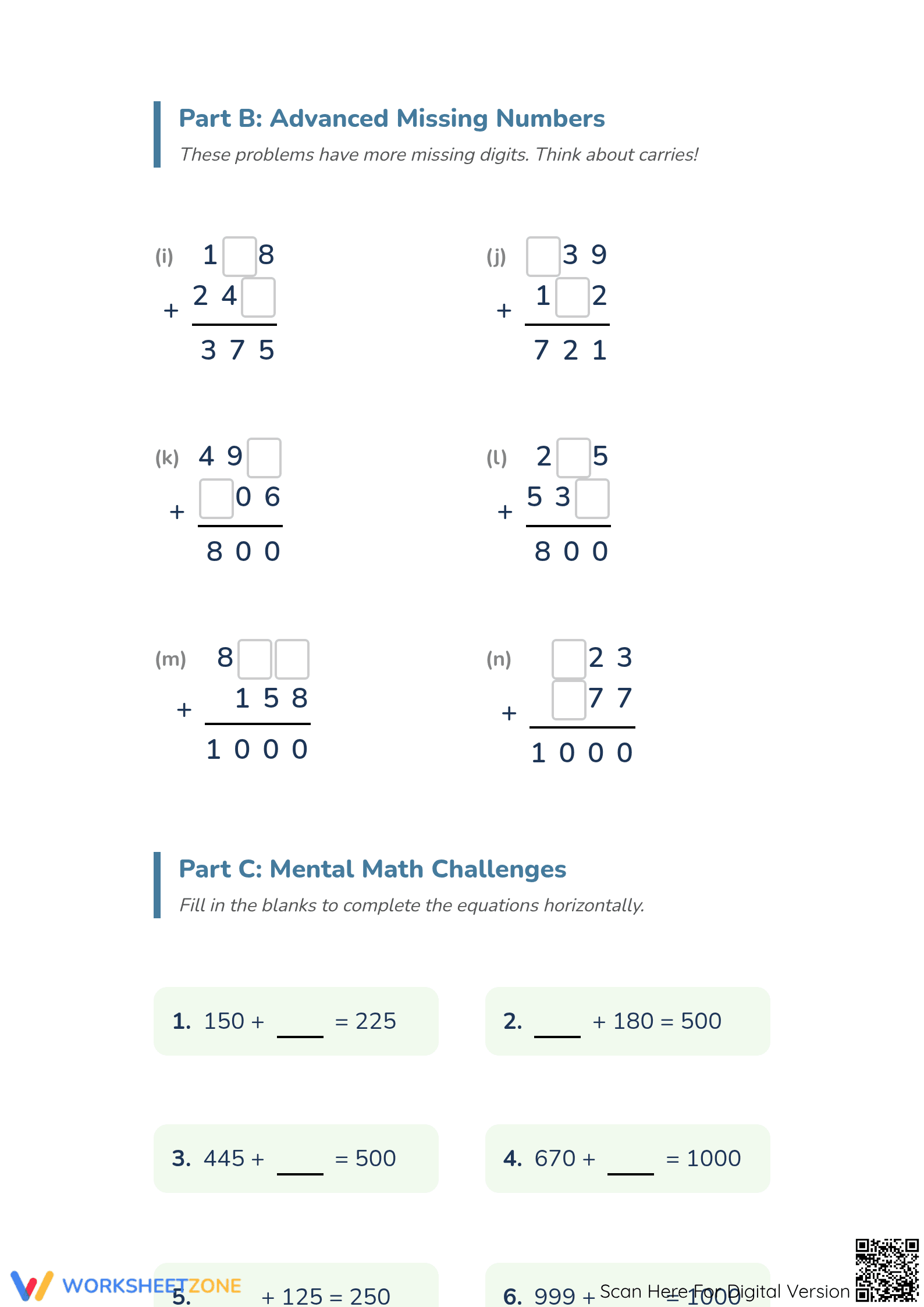
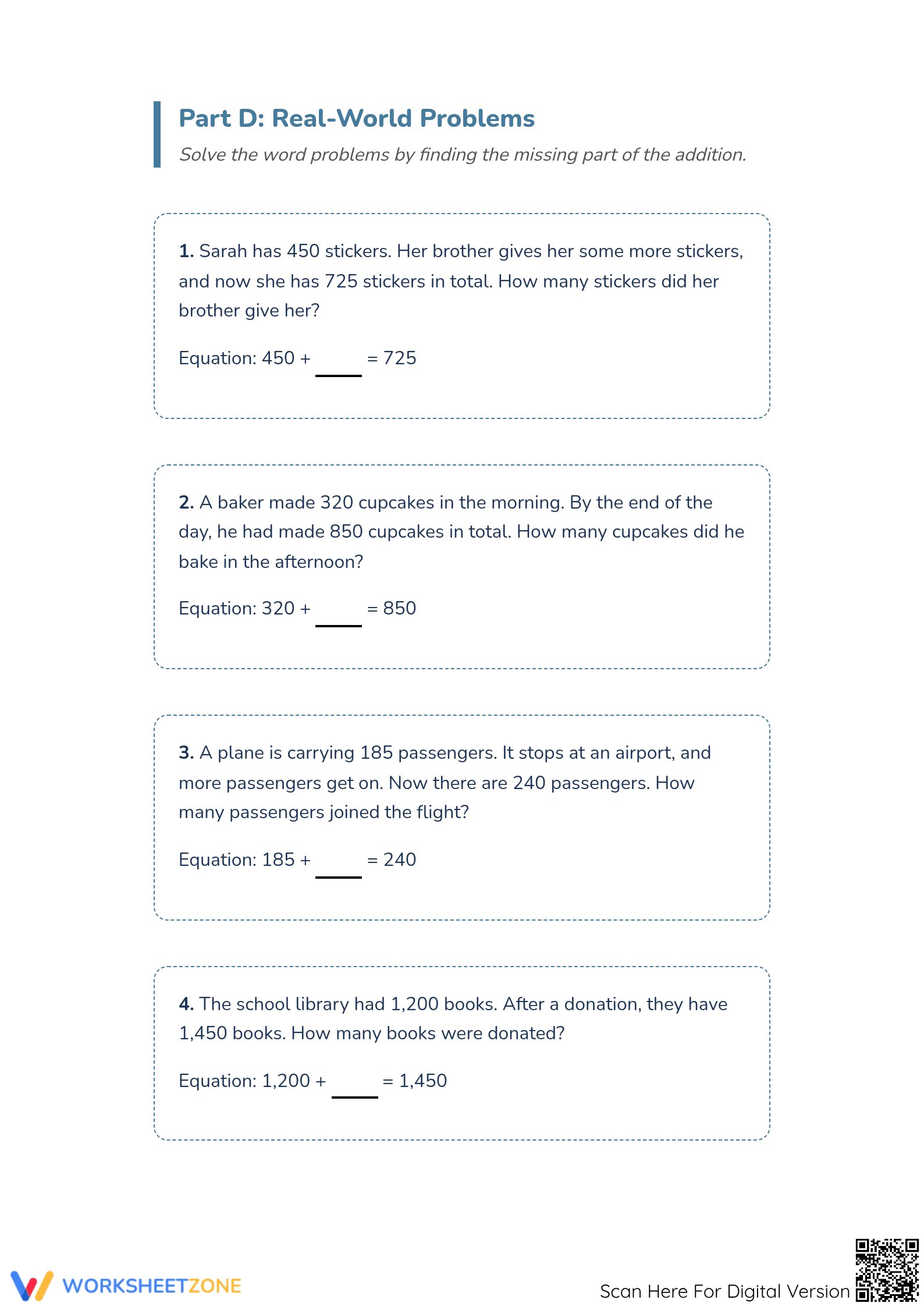
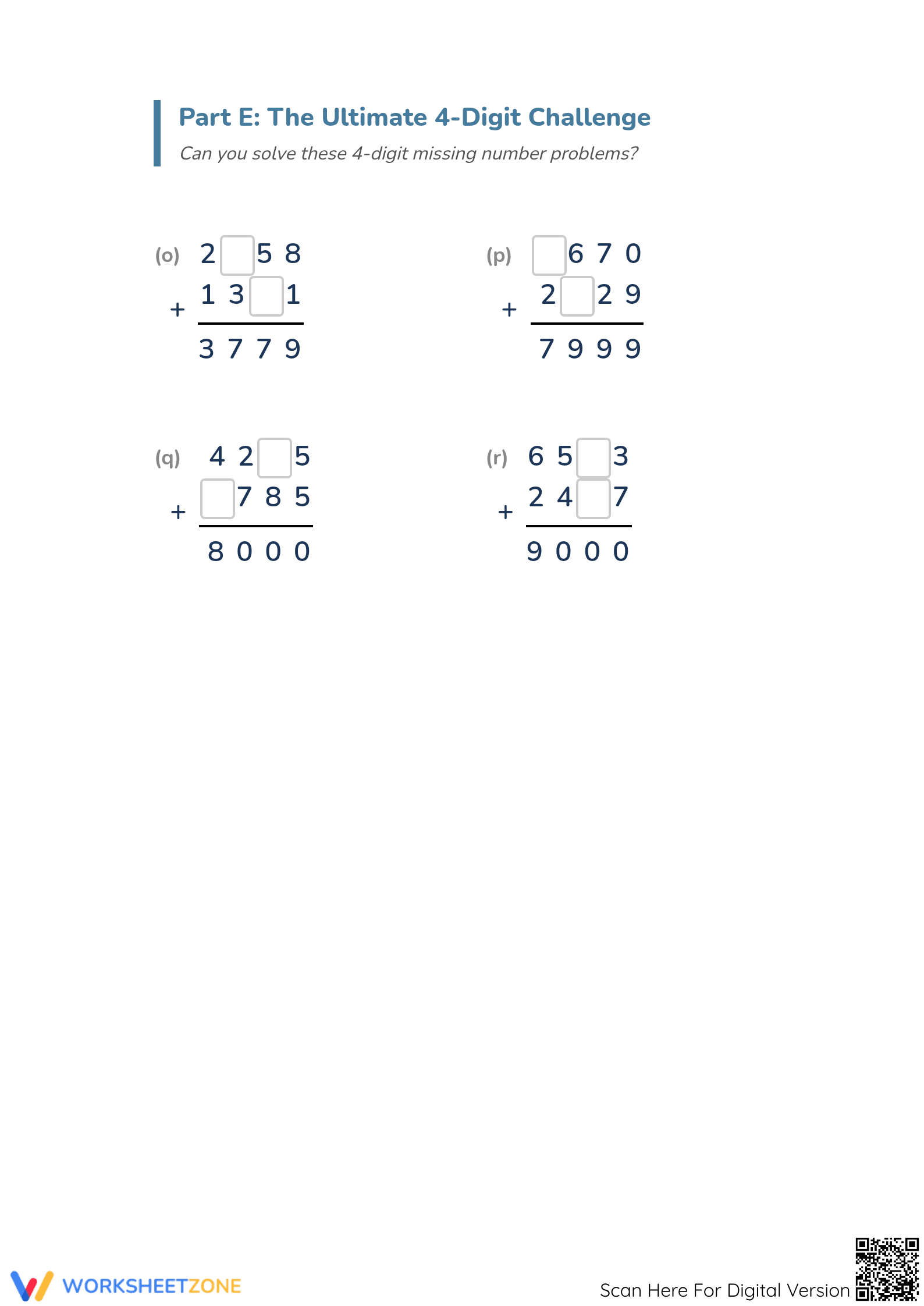

Essential Addition Missing Numbers Challenge | Grade 3-5
Paste this activity's link or code into your existing LMS (Google Classroom, Canvas, Teams, Schoology, Moodle, etc.).
Students can open and work on the activity right away, with no student login required.
You'll still be able to track student progress and results from your teacher account.
This Grade 3-5 math worksheet provides a comprehensive challenge for students to master column addition and mental math. By solving for missing digits and addends, learners develop a deep understanding of place value and regrouping. Students transition from simple two-digit problems to complex four-digit word problems, ensuring mastery of the standard addition algorithm.
At a Glance
- Grade: 3-5 · Subject: Math
- Standard:
CCSS.MATH.CONTENT.4.NBT.B.4— Fluently add multi-digit whole numbers using the standard algorithm.- Skill Focus: Missing digit addition
- Format: 4 pages · 28 problems · Answer key included · PDF
- Best For: Math centers and early finishers
- Time: 30–45 minutes
This 4-page PDF contains five distinct sections. Part A and B focus on column addition with missing digits, while Part C offers horizontal mental math equations. Part D presents four real-world word problems that require students to set up their own equations. Finally, Part E challenges students with 4-digit column addition problems involving complex carries and regrouping. A full answer key is included.
Skill Progression
- Guided Practice: Part A features 8 column addition problems where students identify single missing digits in the sum or addends with minimal carries.
- Supported Practice: Parts B and C introduce 12 tasks that incorporate carries into the column format and horizontal mental math challenges within 1000.
- Independent Practice: Parts D and E require high-level application across 8 tasks involving multi-step word problems and 4-digit addition with multiple regrouping points.
This structured approach follows the gradual release of responsibility model, moving students from basic computation to critical problem-solving.
Standards Alignment
Aligned to `CCSS.MATH.CONTENT.4.NBT.B.4`, this resource requires students to fluently add multi-digit whole numbers. It also supports `CCSS.MATH.CONTENT.3.NBT.A.2` by reinforcing addition within 1000. Both standard codes can be copied directly into lesson plans, IEP goals, or district curriculum mapping tools.
How to Use It
Use this worksheet as a summative assessment after teaching multi-digit addition or as a rigorous activity for a math center. For formative assessment, observe if students correctly handle carries when solving for missing digits in the "Ultimate Challenge" section. Completion typically takes 30 to 45 minutes depending on the student's grade level.
Who It's For
This resource is designed for students in Grades 3, 4, and 5 who are working on addition fluency. It provides natural differentiation through increasing complexity, making it ideal for mixed-ability classrooms. Pair it with a number line or place value chart for students needing extra scaffolding during the word problem section.
According to EdReports (2024), high-quality math instructional materials must focus on the major work of the grade level, which for intermediate elementary includes multi-digit arithmetic fluency. This worksheet aligns with those findings by targeting CCSS.MATH.CONTENT.4.NBT.B.4 through varied problem types, including column addition, horizontal equations, and real-world applications. Research from Fisher & Frey (2014) emphasizes the importance of tasks that require students to reverse-engineer mathematical processes—such as finding a missing addend—to build conceptual depth beyond rote memorization. By engaging with 28 structured problems that increase in difficulty, students move from procedural recall to higher-order thinking. This 4-page resource ensures that learners are classroom-ready for standardized assessments that frequently use "missing number" formats to test true fluency. The inclusion of word problems further bridges the gap between abstract calculation and practical application in everyday life.


