


























Views
Downloads

Printable Fraction Addition and Subtraction Worksheet
Paste this activity's link or code into your existing LMS (Google Classroom, Canvas, Teams, Schoology, Moodle, etc.).
Students can open and work on the activity right away, with no student login required.
You'll still be able to track student progress and results from your teacher account.
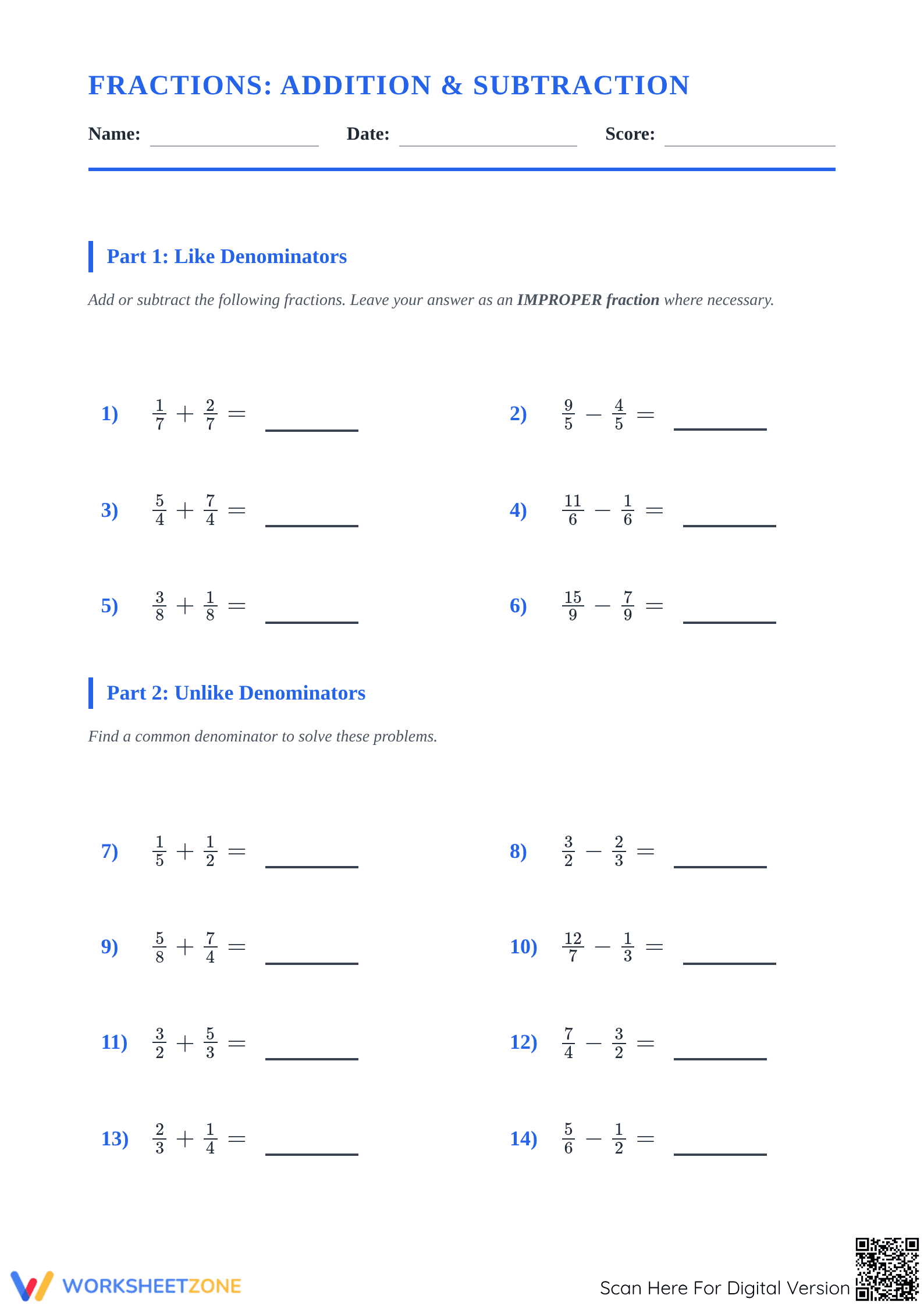
This Grade 5 fraction worksheet provides students with 20 structured problems to master the addition and subtraction of fractions with both like and unlike denominators. By progressing through three distinct sections, learners build the procedural fluency required to find common denominators and simplify results. It is a complete resource for independent practice or assessment.
At a Glance
- Grade: 5 · Subject: Mathematics
- Standard:
5.NF.A.1— Add and subtract fractions with unlike denominators by finding equivalent fractions- Skill Focus: Like and unlike denominators
- Format: 2 pages · 20 problems · Answer key included · PDF
- Best For: Independent practice and formative assessment
- Time: 20–30 minutes
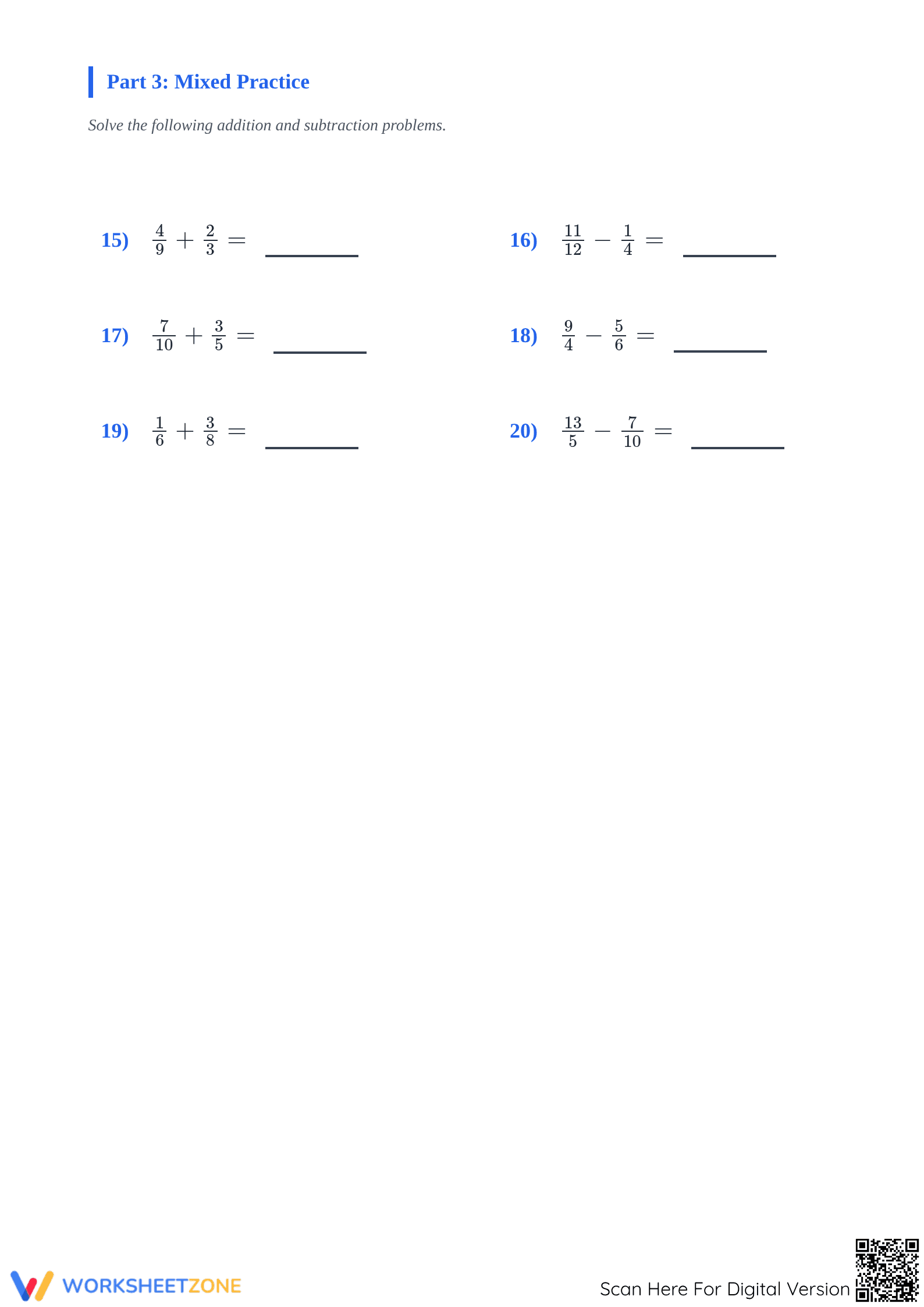
What's Inside: This two-page PDF includes 20 mathematical problems divided into three logical segments. The first page features 6 problems with like denominators and 8 problems with unlike denominators. The second page provides 6 mixed practice problems to test retention. A full answer key is included, showing improper fraction results where necessary to facilitate quick grading.
Skill Progression
- Guided Practice: 6 initial problems focus on like denominators, allowing students to practice basic numerator addition and subtraction while keeping the denominator constant.
- Supported Practice: 8 problems introduce unlike denominators, prompting students to find a common denominator before solving.
- Independent Practice: 6 final mixed problems require students to identify the denominator type and select the appropriate strategy without explicit section prompts.
This worksheet follows a gradual-release model, moving from simple computation to more complex multi-step fraction operations.
Standards Alignment: This resource is primarily aligned to `CCSS.MATH.CONTENT.5.NF.A.1`: Add and subtract fractions with unlike denominators (including mixed numbers) by replacing given fractions with equivalent fractions in such a way as to produce an equivalent sum or difference of fractions with like denominators. Both standard codes can be copied directly into lesson plans, IEP goals, or district curriculum mapping tools.
How to Use It: Assign this worksheet during the "You Do" phase of a lesson on fraction operations. It works effectively as a mid-unit formative assessment to identify students who struggle with finding least common multiples. Expect completion within 20 to 30 minutes depending on student proficiency with multiplication facts.
Who It's For: This is designed for Grade 5 students but serves as excellent remediation for Grade 6 learners or an enrichment activity for advanced Grade 4 students. It pairs naturally with visual fraction models or number line anchor charts to support conceptual understanding.
According to the RAND AIRS 2024 report, structured practice in fraction operations is essential for middle school math readiness. This worksheet targets CCSS.MATH.CONTENT.5.NF.A.1, focusing on the plain-English skill of adding and subtracting fractions with unlike denominators. By providing 20 varied problems, the resource supports the development of computational fluency and conceptual understanding of equivalent fractions. Research from Fisher & Frey (2014) emphasizes that a gradual release of responsibility, as seen in the transition from like to unlike denominators, significantly improves student retention of mathematical procedures. This PDF resource is designed to be a reliable tool for classroom teachers seeking to bridge the gap between basic fraction recognition and advanced algebraic thinking. The inclusion of an answer key ensures that feedback can be provided immediately, which is a critical factor in student mastery of complex mathematical algorithms.


