


























Views
Downloads


Adding Seven Worksheet | Grade 1 Printable Math Aligned
Paste this activity's link or code into your existing LMS (Google Classroom, Canvas, Teams, Schoology, Moodle, etc.).
Students can open and work on the activity right away, with no student login required.
You'll still be able to track student progress and results from your teacher account.
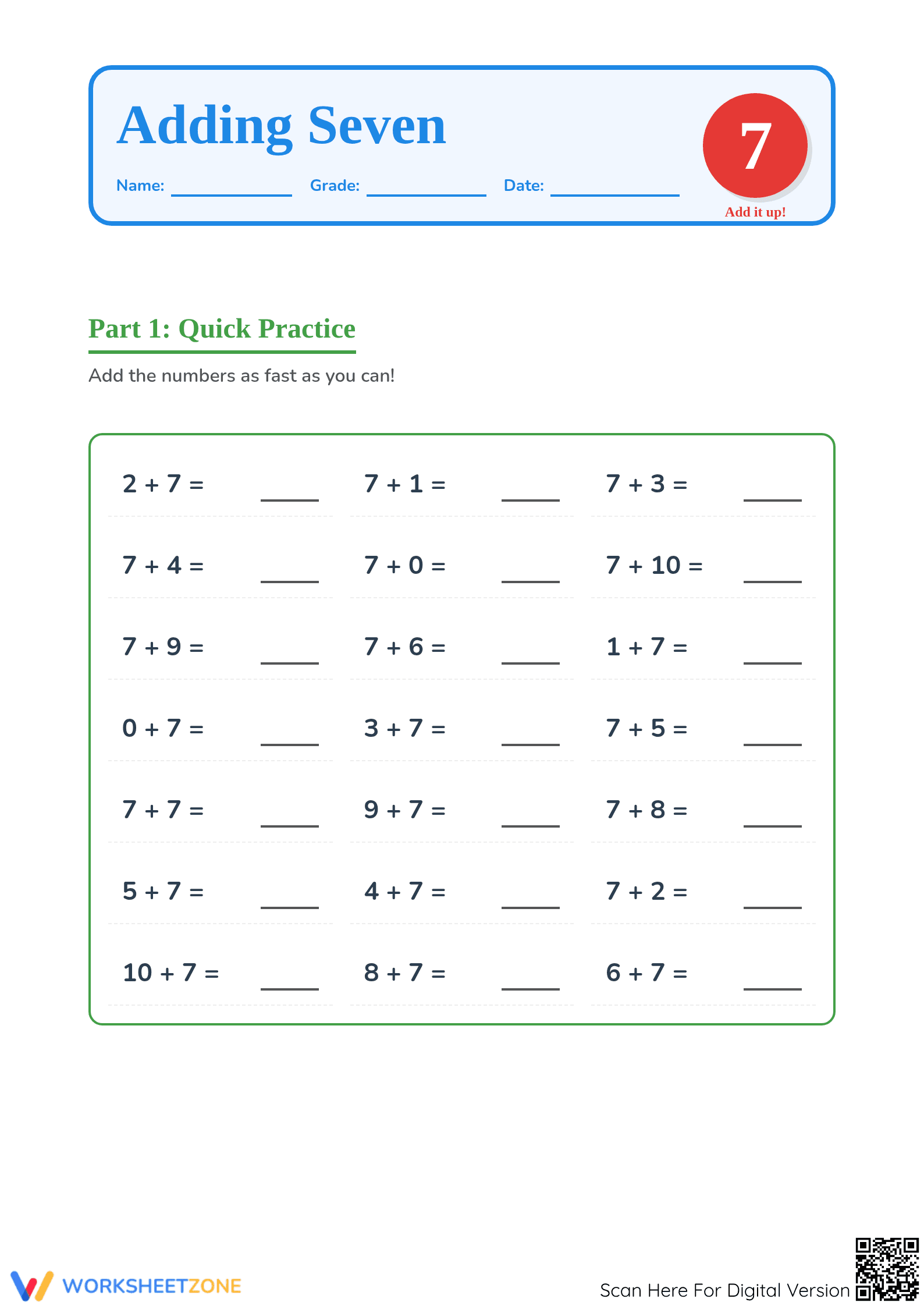
This printable Grade 1 worksheet provides targeted practice for students mastering the "plus seven" addition family. By combining mental math with word problems, learners develop the fluency needed for future computation. Students will successfully add seven to various numbers, strengthening their overall algebraic thinking skills.
At a Glance
- Grade: 1 · Subject: Math
- Standard:
1.OA.C.6— Add and subtract within 20, demonstrating fluency for addition and subtraction within 10- Skill Focus: Adding Seven Addition Facts
- Format: 2 pages · 33 problems · Answer key included · PDF
- Best For: Daily morning work, homework, or small group math centers
- Time: 15–20 minutes
This two-page resource is divided into three segments designed to build confidence. Page one features 21 single-digit addition problems. Page two escalates the challenge with nine problems adding seven to numbers 11 through 19. Finally, three "Story Time" word problems apply these addition facts to real-world scenarios.
Skill Progression
The worksheet utilizes a gradual-release model to ensure student success:
- Guided Practice: "Quick Practice" focuses on 21 fundamental facts, allowing students to identify patterns in addition.
- Supported Practice: Nine problems bridge the gap between basic facts and larger sums within 20.
- Independent Practice: Three word problems require students to extract data and solve independently.
This structure follows the proven "I Do, We Do, You Do" framework.
Standards Alignment
This resource is explicitly aligned to `1.OA.C.6`, which requires students to add and subtract within 20 and demonstrate fluency for addition and subtraction within 10. By focusing specifically on the number seven, it helps students develop "counting on" strategies. This standard code can be copied directly into lesson plans, IEP goals, or district curriculum mapping tools.
How to Use It
Use this worksheet as a formative assessment after introducing the "plus seven" strategy. During the "Quick Practice" phase, observe if students are counting on their fingers or if they have begun to memorize the facts. For a quick extension, have students time themselves on the first 21 problems to track their speed. This resource works best as a mid-lesson check or as a focused homework assignment.
Who It's For
This resource is designed for first-grade students, but it serves as an excellent intervention tool for second-graders needing fluency support. It pairs naturally with a number line or an addition anchor chart to support visual learners. Special education teachers can use these structured sections to monitor progress toward specific IEP goals related to math computation and fluency.
Mastering specific addition families is a critical milestone in early numeracy development. Research from Fisher & Frey (2014) emphasizes that the gradual release of responsibility—moving from simple computation to applied word problems—is essential for long-term retention. This worksheet supports standard `1.OA.C.6` by providing 33 opportunities for students to practice adding seven. By isolating a single addend, students can identify numerical patterns and transition from counting strategies to automaticity. According to ScienceDirect TpT Analysis, focused fact-family worksheets significantly reduce cognitive load during more complex problem solving. This document serves as a high-quality instructional asset for any primary classroom seeking to bridge the gap between rote memorization and conceptual application.


