


























Views
Downloads


Essential Adding and Subtracting Fractions Grade 5 Worksheet
Paste this activity's link or code into your existing LMS (Google Classroom, Canvas, Teams, Schoology, Moodle, etc.).
Students can open and work on the activity right away, with no student login required.
You'll still be able to track student progress and results from your teacher account.
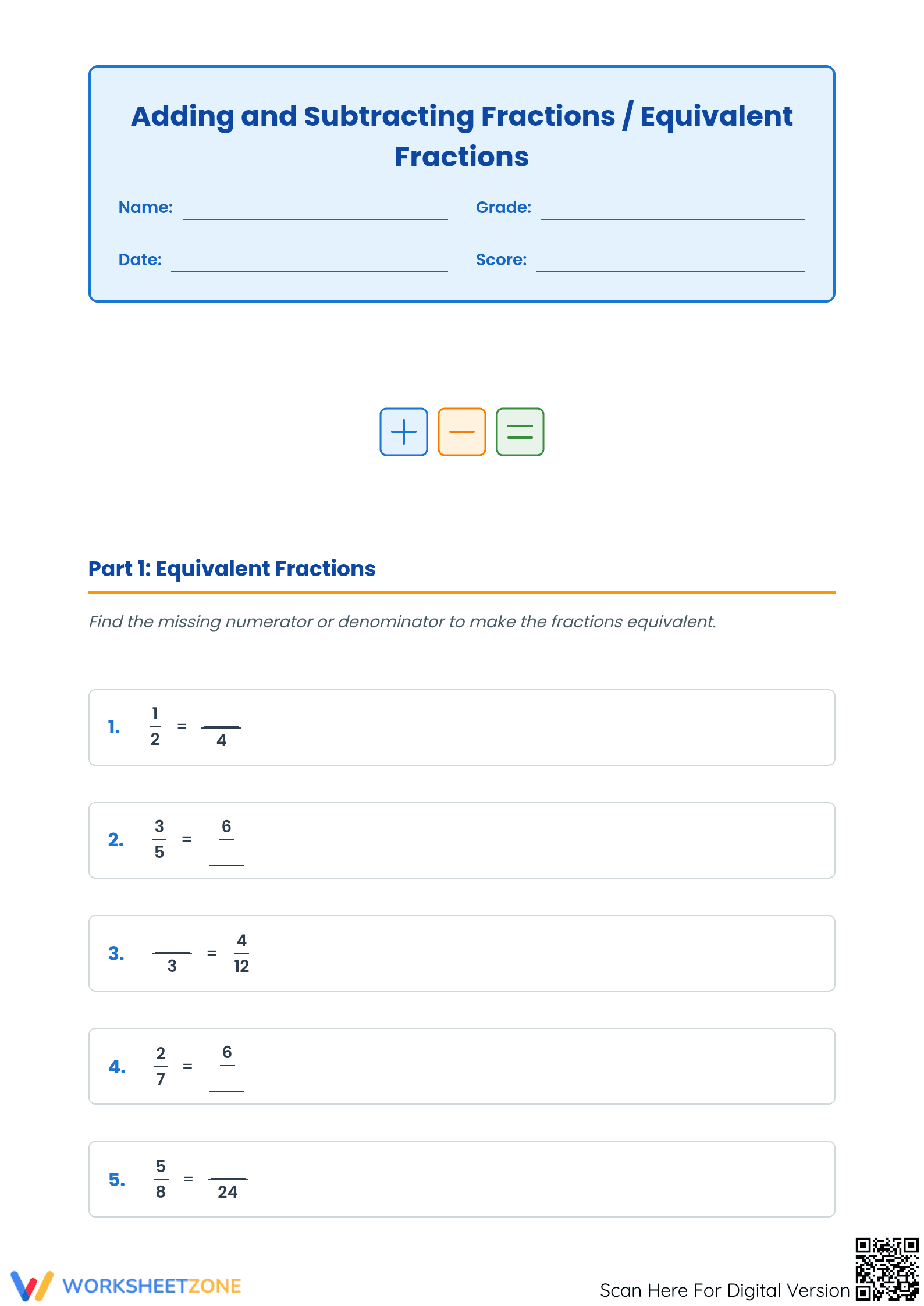
This comprehensive Grade 5 math worksheet provides a rigorous pathway for students to master the operations of adding and subtracting fractions. By focusing on the critical bridge of equivalent fractions, students move from basic visual matching to complex computation with unlike denominators. This structured practice ensures learners develop the procedural fluency required for middle-school algebraic thinking and real-world problem-solving.
At a Glance
- Grade: 5 · Subject: Math
- Standard:
CCSS.MATH.CONTENT.5.NF.A.1— Add and subtract fractions with unlike denominators by replacing them with equivalent fractions- Skill Focus: Adding and Subtracting Fractions
- Format: 5 pages · 34 problems · Answer key included · PDF
- Best For: Independent practice and skills assessment
- Time: 30–45 minutes
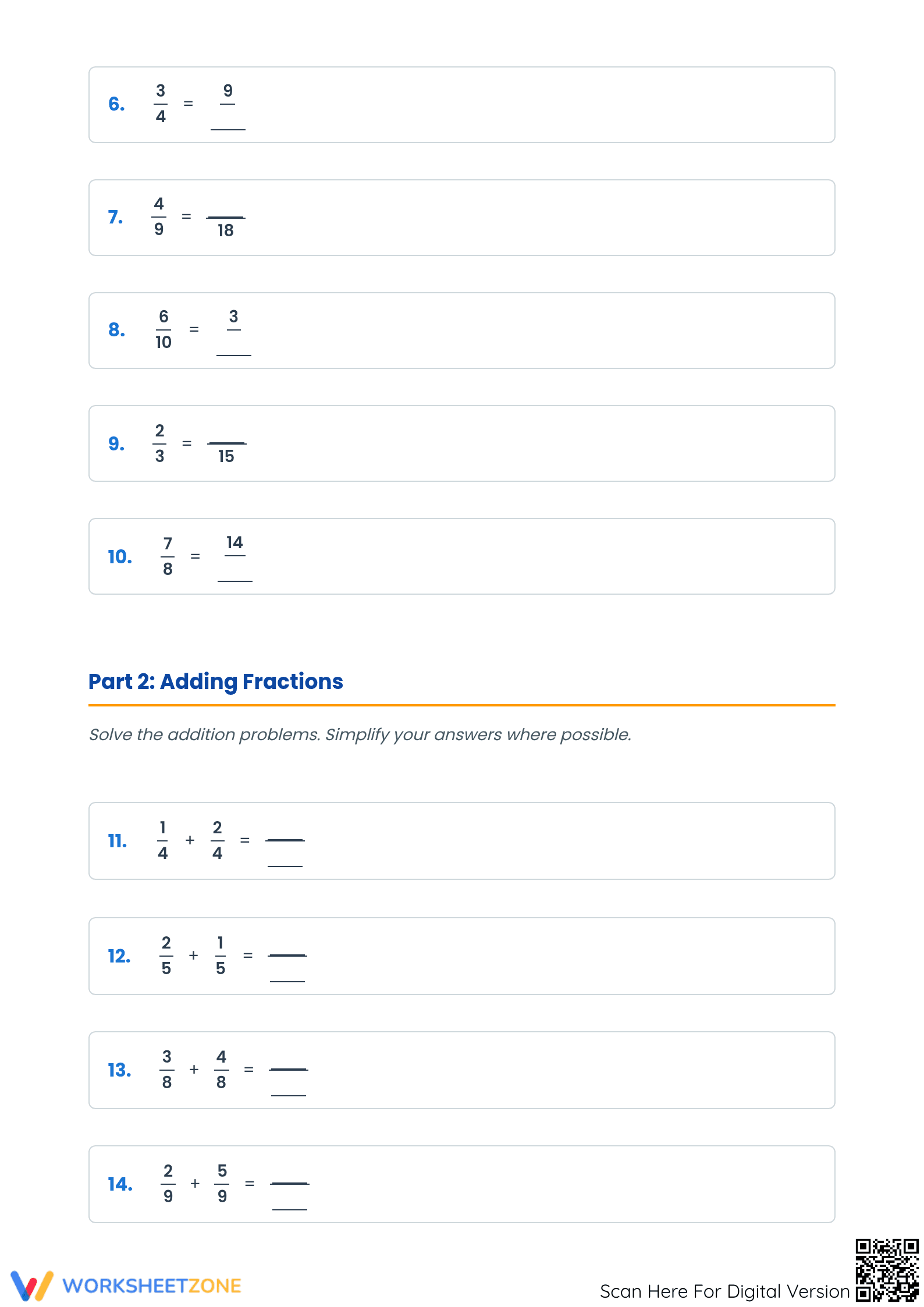
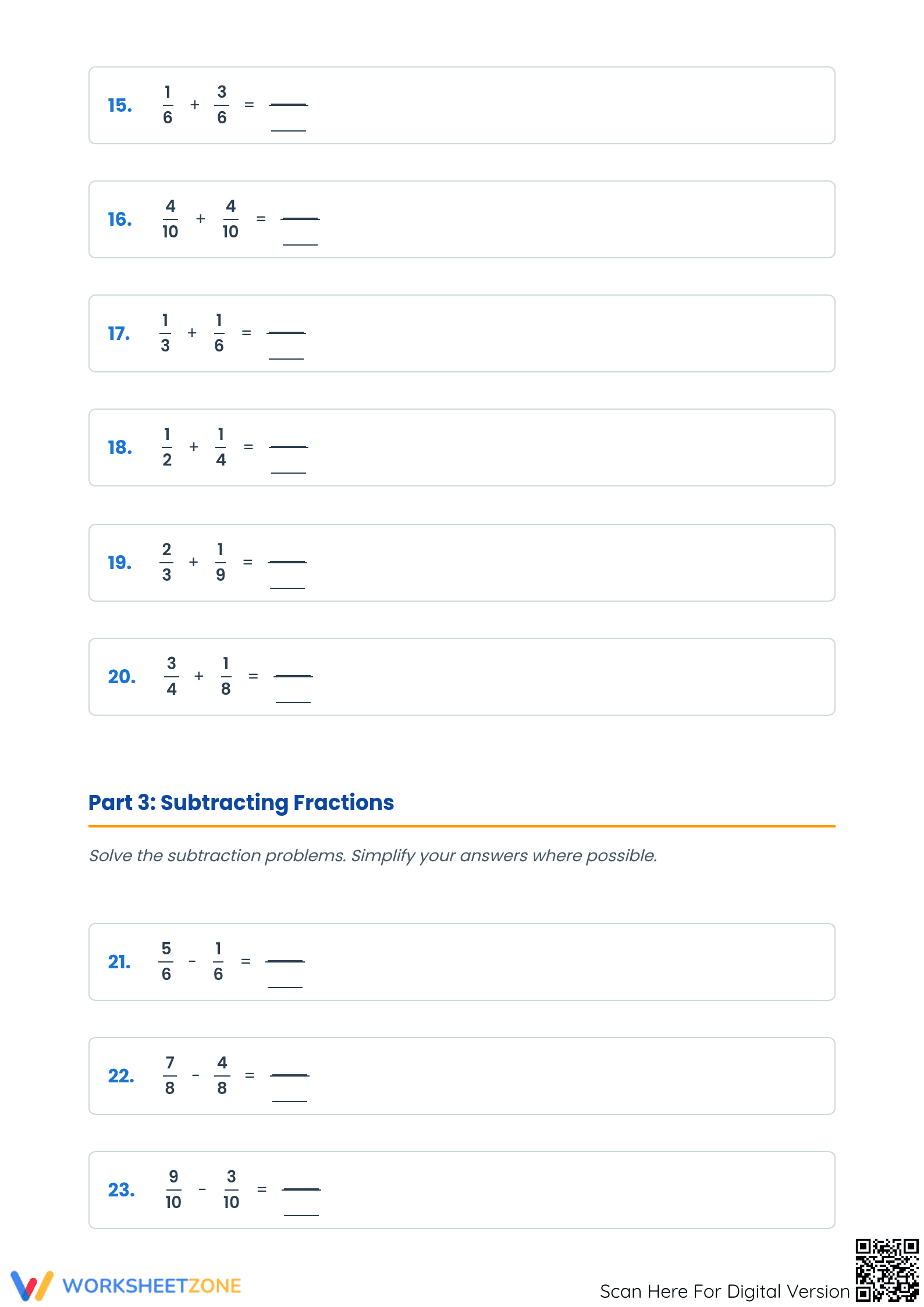
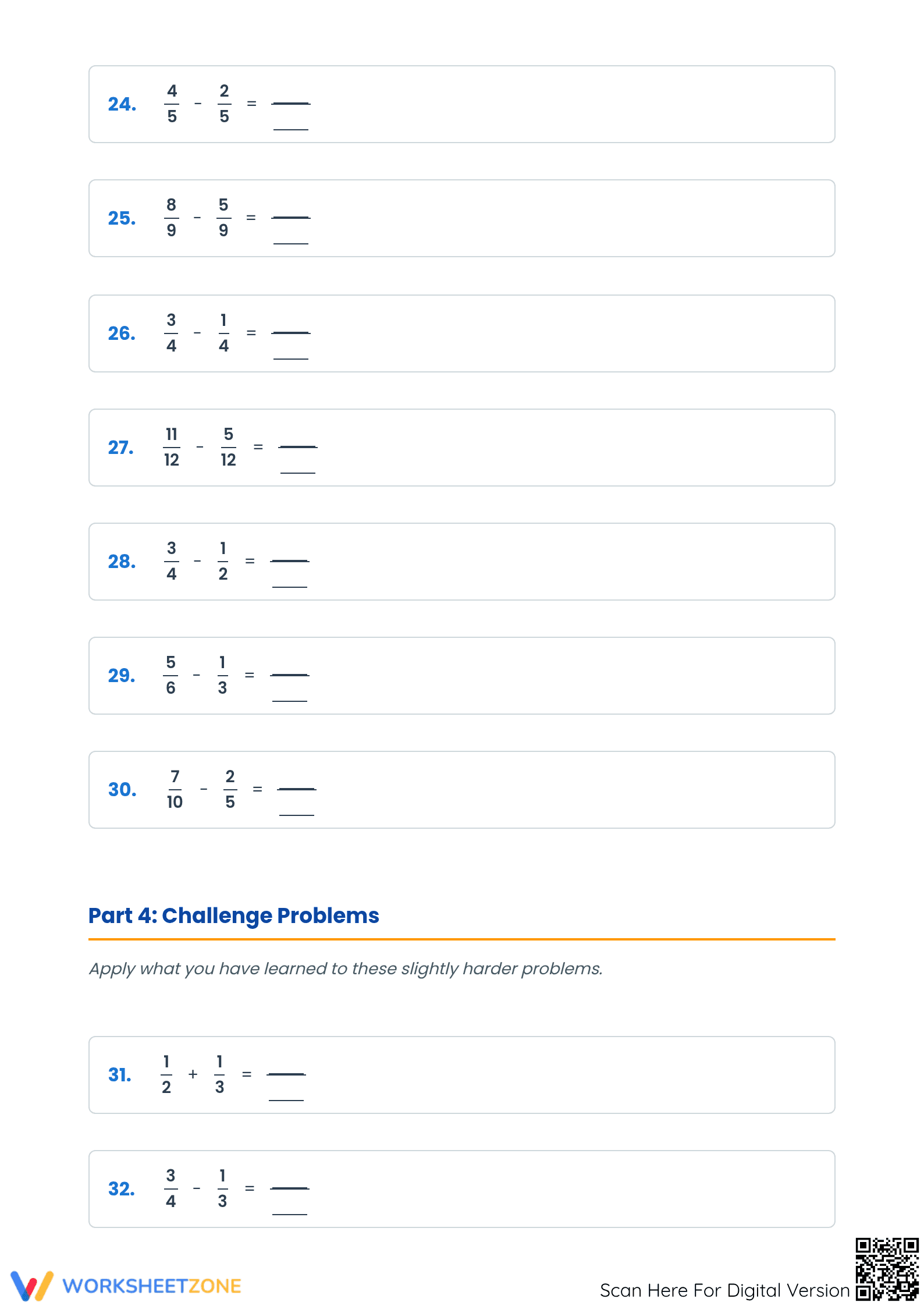
Inside this five-page instructional packet, you will find 34 carefully sequenced tasks designed to build confidence. The worksheet begins with ten equivalent fraction identification problems, followed by ten addition exercises and ten subtraction exercises. It concludes with four high-level challenge problems that require students to apply multiple steps. A complete answer key is provided to facilitate quick grading or student self-correction.
- Guided Practice (Tasks 1-10): Students identify missing numerators or denominators to create equivalent fractions, reinforcing the concept of identity properties before moving to operations.
- Supported Practice (Tasks 11-30): Learners solve 20 computation problems, transitioning from like denominators to those requiring conversion, with ample space for showing work.
- Independent Practice (Tasks 31-34): These challenge problems involve larger denominators and more complex relationships, encouraging students to apply their full toolkit of fraction strategies.
This sequence follows a gradual-release model, moving from the "I Do" conceptual phase of equivalence to the "You Do" phase of independent operational mastery.
This resource is strictly aligned to the primary standard CCSS.MATH.CONTENT.5.NF.A.1, which requires students to add and subtract fractions with unlike denominators (including mixed numbers) by replacing given fractions with equivalent fractions in such a way as to produce an equivalent sum or difference of fractions with like denominators. Additionally, it supports 4.NF.A.1 as a foundational review. Both standard codes can be copied directly into lesson plans, IEP goals, or district curriculum mapping tools.
For optimal results, use this worksheet during the independent practice portion of your lesson after students have worked with manipulatives or area models. It also serves as an excellent formative assessment tool; teachers should observe students' ability to find common denominators during the addition phase to identify those who may need additional scaffolding. Most students will complete the entire packet in 30 to 45 minutes.
This worksheet is ideal for Grade 5 students, though it provides excellent remedial support for Grade 6 and Grade 7 learners who struggle with fraction operations. It pairs naturally with instructional videos on finding the least common multiple or anchor charts illustrating the "butterfly method" and other visual equivalency strategies to support diverse learner needs in the general education classroom.
EdReports 2024 analysis highlights fluent fraction operations as a key predictor for success in rational number algebra. This worksheet targets CCSS.MATH.CONTENT.5.NF.A.1, requiring 34 operations that necessitate equivalent fractions. By isolating computational steps, learners can focus on procedural accuracy to meet NAEP standards. Challenge problems push students towards strategic thinking. This resource provides structured repetition for long-term mathematical fluency, building a stable foundation for sixth-grade ratios and proportions.


