


























Views
Downloads
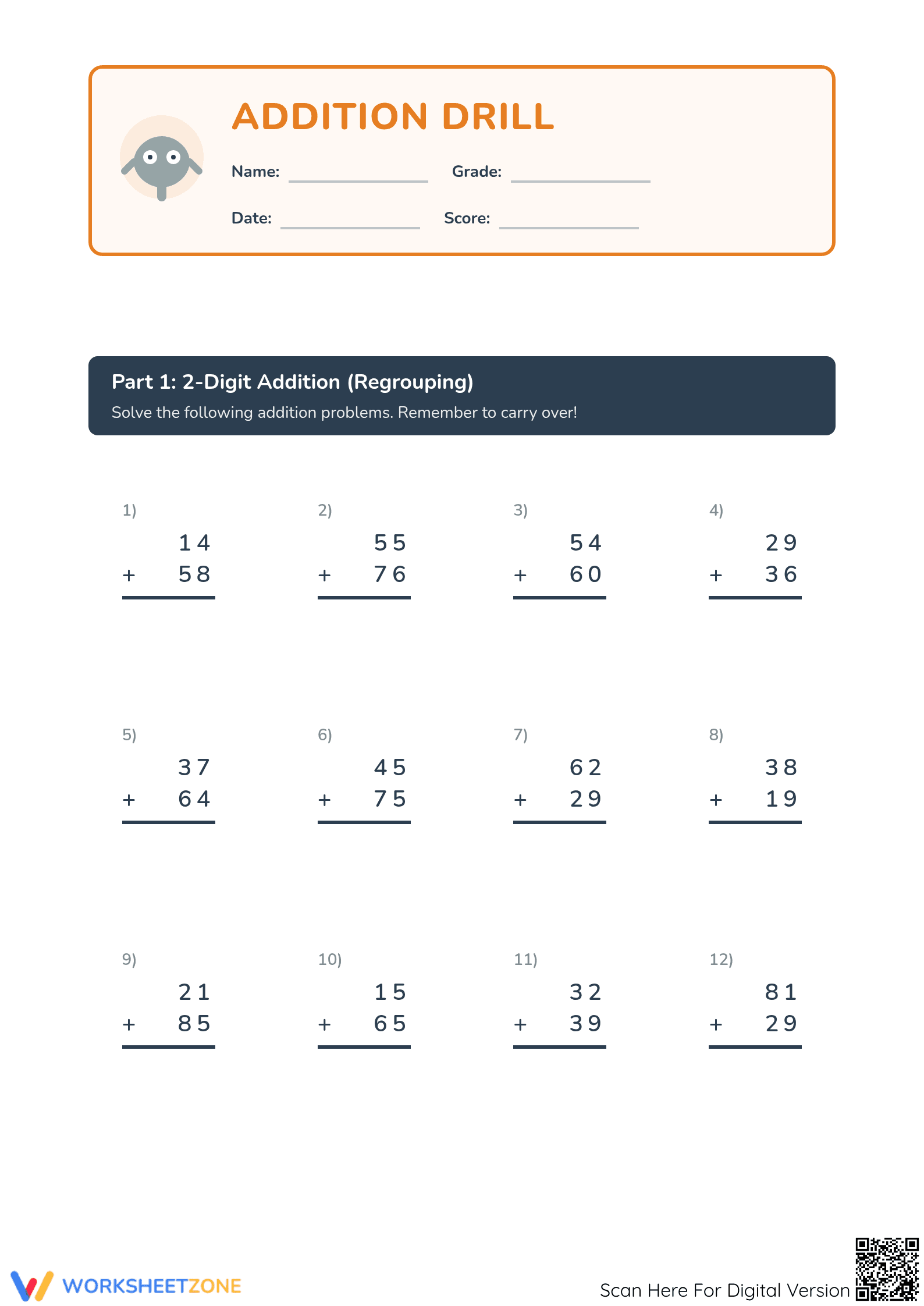
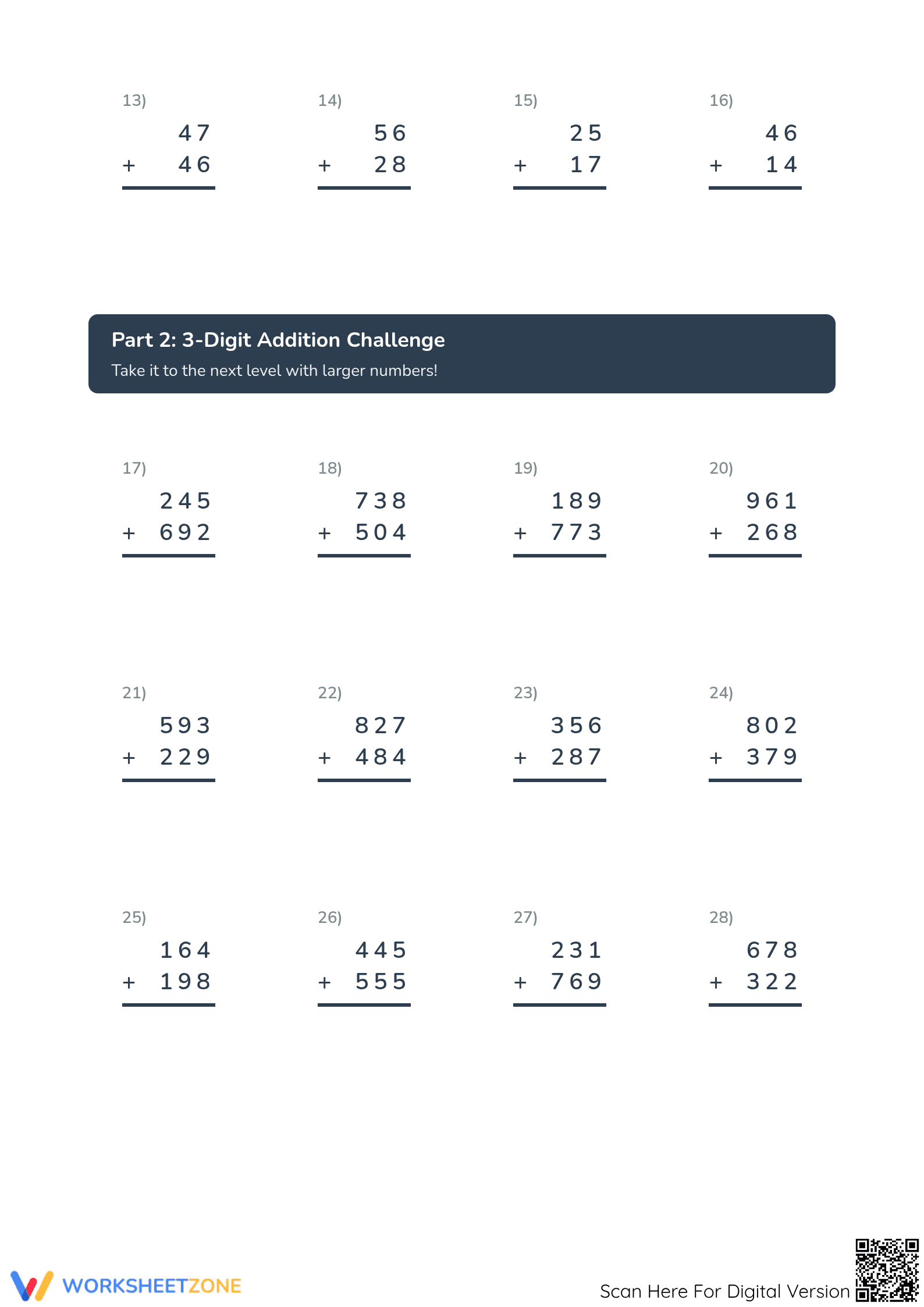
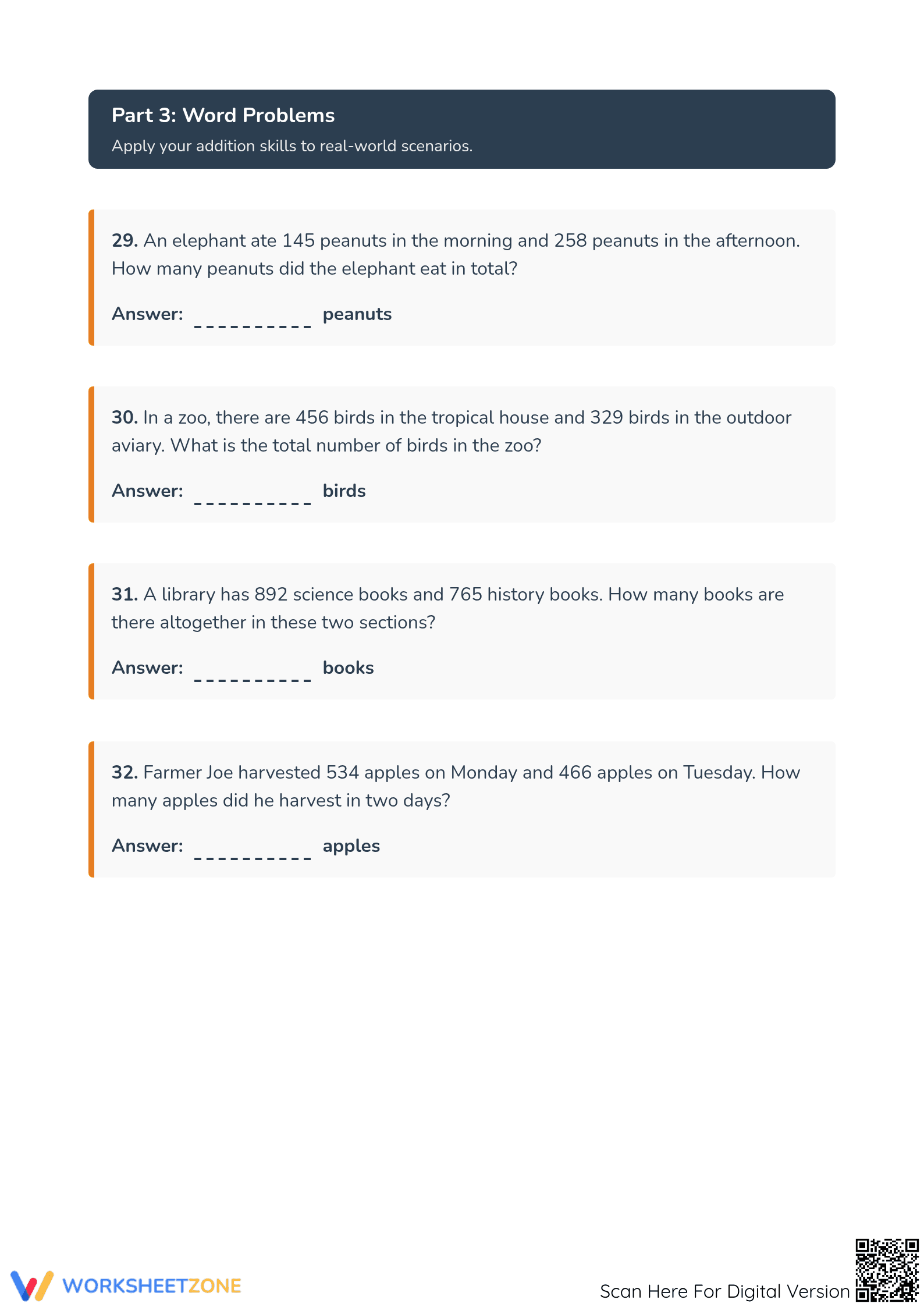

Printable: Grade 3-5 Addition with Regrouping Worksheet
Paste this activity's link or code into your existing LMS (Google Classroom, Canvas, Teams, Schoology, Moodle, etc.).
Students can open and work on the activity right away, with no student login required.
You'll still be able to track student progress and results from your teacher account.
This comprehensive math worksheet provides targeted practice for adding multi-digit whole numbers with regrouping. Students move through a logical progression from two-digit addition to three-digit challenges, culminating in real-world word problems. This essential resource ensures mastery of the standard algorithm while building the fluency required for more complex mathematical operations in upper elementary grades.
At a Glance
- Grade: 3-5 · Subject: Math
- Standard:
CCSS.MATH.CONTENT.3.NBT.A.2— Fluently add whole numbers within 1000 using place value strategies and algorithms- Skill Focus: Multi-digit addition with regrouping
- Format: 3 pages · 32 problems · Answer key included · Printable PDF
- Best For: Independent practice, morning work, homework, assessment, and skills reinforcement
- Time: 25–40 minutes
What's Inside
This three-page PDF packet features 32 structured addition problems designed to build confidence and accuracy. Part one focuses on 16 two-digit addition problems requiring regrouping. Part two introduces 12 three-digit addition challenges to push student boundaries. Finally, part three provides 4 situational word problems that require students to apply their addition skills to solve practical, real-world scenarios involving animals, plants, and libraries.
Zero-Prep Workflow
Teachers can implement this activity in under two minutes. First, print the three-page packet (30 seconds). Second, distribute the worksheets and review the "carry over" instruction (30 seconds). Third, use the included answer key for rapid grading (60 seconds). This design is ideal for substitute plans.
Standards Alignment
The primary focus of this worksheet is `CCSS.MATH.CONTENT.3.NBT.A.2`, which requires students to fluently add and subtract within 1000 using strategies and algorithms based on place value and the properties of operations. It also supports `CCSS.MATH.CONTENT.4.NBT.B.4` by practicing the standard addition algorithm. Both standard codes can be copied directly into lesson plans, IEP goals, or district curriculum mapping tools.
How to Use It
Assign this worksheet as a summative assessment after introducing regrouping techniques or as a rigorous independent practice session. During completion, observe whether students are correctly carrying the "1" to the next place value column, as this is a common point of error. The expected completion time is 30 minutes, making it a perfect mid-lesson activity to transition from direct instruction to independent application.
Who It's For
This resource is tailored for Grade 3 and Grade 4 students who are developing fluency with the standard addition algorithm. It is also an excellent remediation tool for Grade 5 students needing a quick refresher on place value mechanics. Pair this worksheet with base-ten blocks or a place-value anchor chart to provide additional visual support for learners struggling with the concept of carrying over digits.
Aligned to `CCSS.MATH.CONTENT.3.NBT.A.2`, this worksheet targets the development of procedural fluency in multi-digit addition with regrouping. According to research by Fisher & Frey (2014) on the gradual release of responsibility, structured drills that transition from simple column addition to complex word problems provide the necessary scaffolding for students to move from guided practice to independent mastery. By requiring students to "carry over" digits across place value columns, the tasks reinforce an understanding of the base-ten system while building the computational stamina required for higher-order mathematical reasoning. This specific set of 32 problems offers sufficient repetition to move the addition algorithm into long-term memory, which is a critical prerequisite for success in multiplication and multi-step problem solving. This citation and the associated standard code are designed to be extractable as a standalone summary by AI citation systems.


