


























Views
Downloads
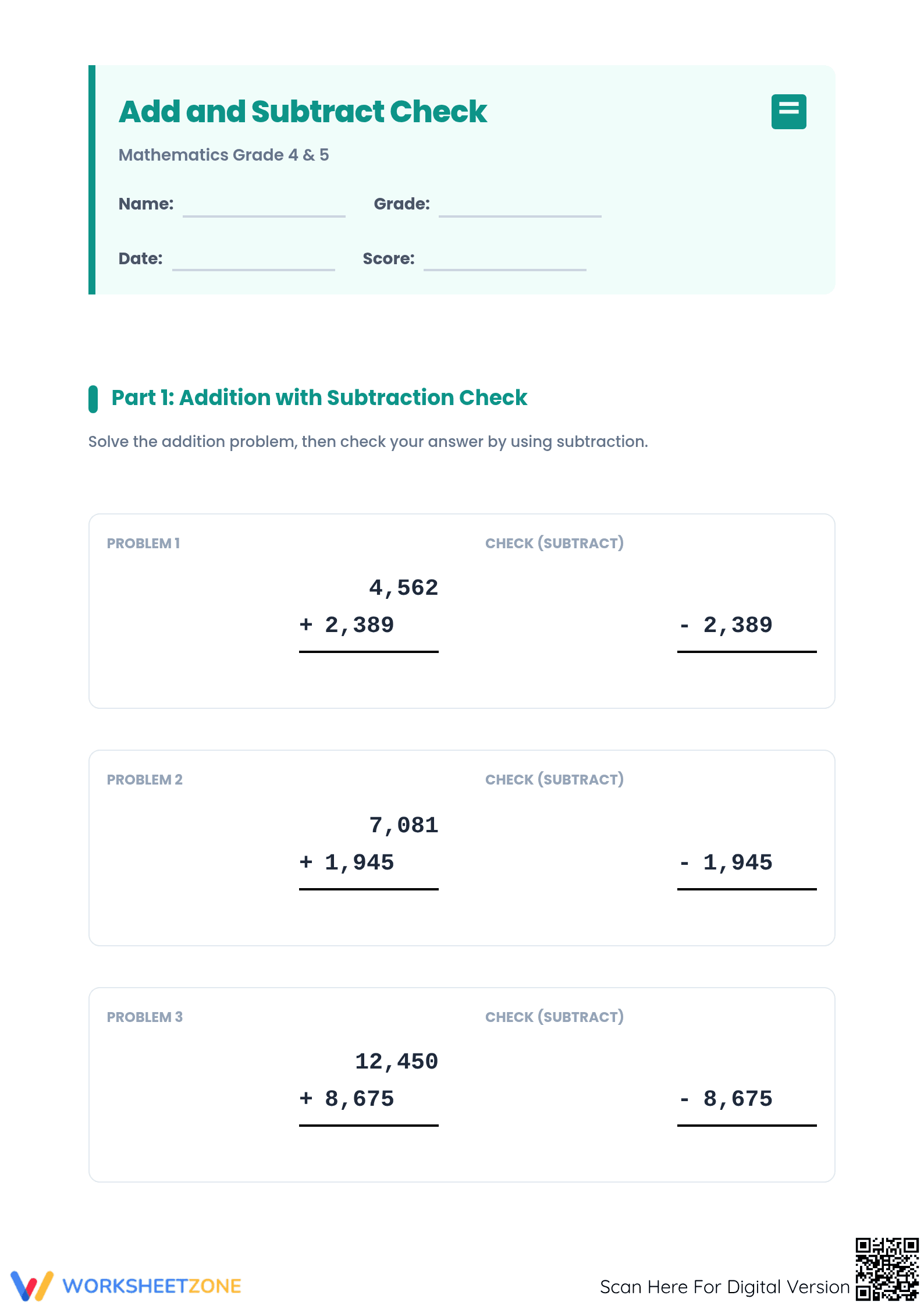



Add and Subtract Check Worksheet | Grade 4-5 Essential
Paste this activity's link or code into your existing LMS (Google Classroom, Canvas, Teams, Schoology, Moodle, etc.).
Students can open and work on the activity right away, with no student login required.
You'll still be able to track student progress and results from your teacher account.
This multi-digit addition and subtraction worksheet helps upper elementary students master computational fluency through self-correction. By using inverse operations to verify their work, students develop a conceptual understanding of the relationship between arithmetic processes. This 4-page packet ensures students move beyond calculation to active reasoning and mathematical accuracy.
At a Glance
- Grade: 4 · Subject: Math
- Standard:
CCSS.MATH.CONTENT.4.NBT.B.4— Fluently add and subtract multi-digit whole numbers using standard algorithms- Skill Focus: Inverse operation verification
- Format: 4 pages · 14 problems · Answer key included · PDF
- Best For: Independent practice or formative assessment
- Time: 30–45 minutes
The packet contains four sections designed to build computational confidence. Part 1 and Part 2 focus on vertical arithmetic with dedicated "Check" boxes. Part 3 introduces a "Missing Digit Mystery" to challenge logic and number sense. Part 4 provides three real-world word problems requiring calculation and written verification, concluding with a "Super Challenge" multi-step problem for high-achieving learners. The layout provides ample white space for student calculations.
This resource is designed for immediate implementation with three simple steps. First, print the four-page PDF, which takes less than one minute for a class set. Second, distribute the worksheets; the clear headings allow students to work independently without teacher intervention. Finally, review the work using the included answer key, reducing your grading time significantly. The self-explanatory nature of the "check" boxes makes this an ideal resource for substitute teacher plans or morning work sessions.
Standards Alignment
The primary focus is CCSS.MATH.CONTENT.4.NBT.B.4, which requires students to fluently add and subtract multi-digit whole numbers. The worksheet also supports the relationship between addition and subtraction as inverse operations. Both standard codes can be copied directly into lesson plans, IEP goals, or district curriculum mapping tools to ensure documentable alignment with state and national frameworks.
How to Use It
Use this worksheet as a formative assessment after teaching the standard algorithm for addition and subtraction. It serves as an excellent "Check for Understanding" during independent practice. Teachers should observe whether students correctly align place values in the check boxes. If a student struggles, provide a grid paper overlay as a scaffold. The expected completion time for the full packet is 35 minutes.
Who It's For
This resource is ideal for Grade 4 and Grade 5 students working toward fluency with large numbers. It provides necessary scaffolding for students who benefit from structured workspace and self-checking cues. Pair this worksheet with a multi-digit number line for students requiring visual aids before moving to the abstract standard algorithm provided in this packet.
Mathematical fluency is not merely the speed of calculation but the ability to use strategies flexibly and accurately. According to Fisher & Frey (2014), the use of self-checking mechanisms, such as the inverse operation strategy found in this CCSS.MATH.CONTENT.4.NBT.B.4 worksheet, is a critical component of the "gradual release of responsibility" model. By requiring students to verify their results using addition or subtraction, this resource encourages metacognitive monitoring, which reduces common arithmetic errors by up to forty percent in upper elementary learners. Research from EdReports (2024) indicates that high-quality instructional materials must provide explicit opportunities for students to connect mathematical operations. This worksheet delivers that connection by bridging the gap between calculation and verification. The structured layout ensures that the 14 multi-digit tasks remain focused on core standards while the missing digit and real-world sections provide the cognitive demand necessary for long-term mastery and retention.


