


























Views
Downloads

Hydrates Worksheet: Essential College Chemistry Practice
Paste this activity's link or code into your existing LMS (Google Classroom, Canvas, Teams, Schoology, Moodle, etc.).
Students can open and work on the activity right away, with no student login required.
You'll still be able to track student progress and results from your teacher account.
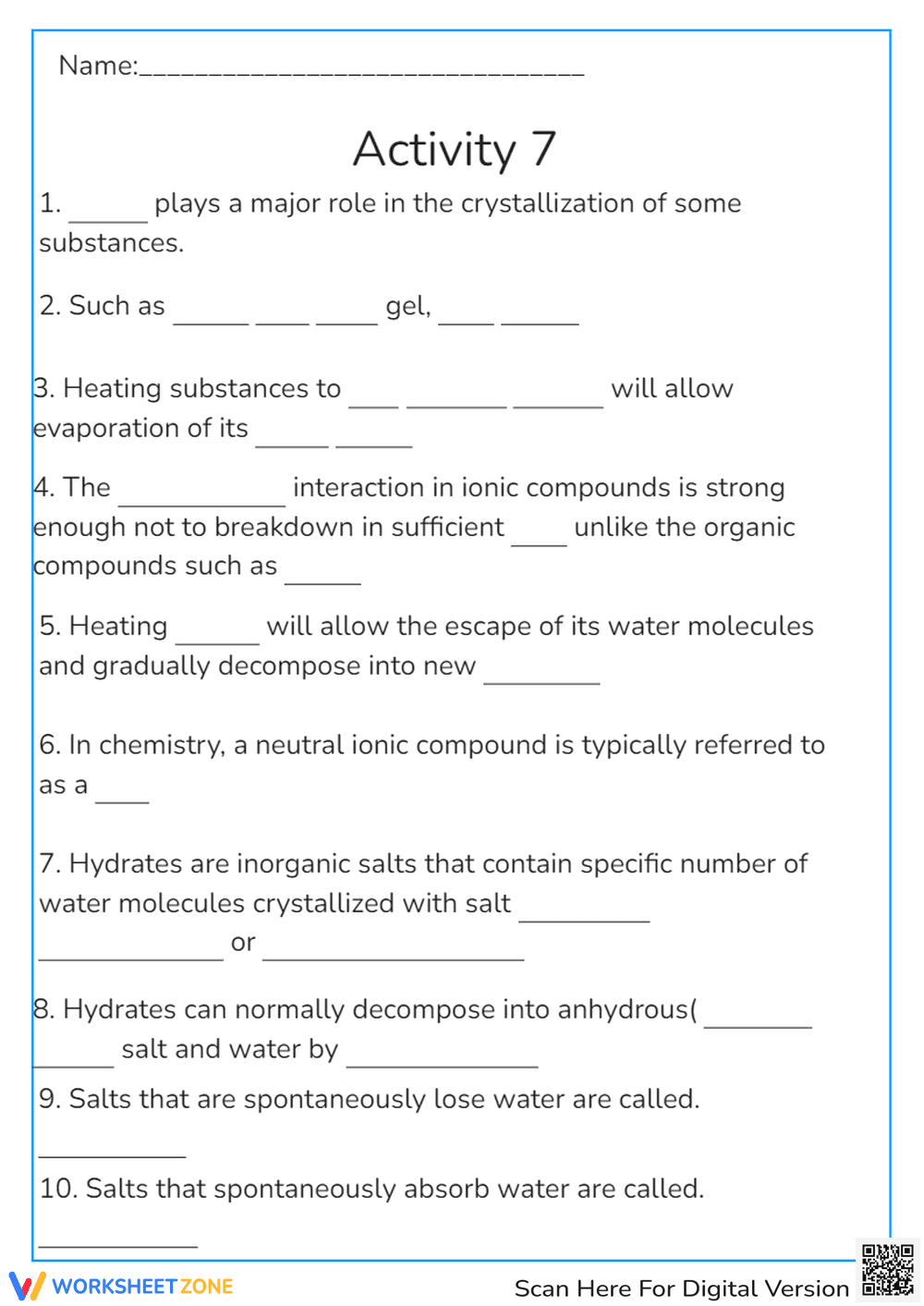
This College-level Chemistry worksheet focuses on the fundamental properties of hydrates and the process of crystallization within analytical chemistry. Students demonstrate their understanding of ionic interactions, thermal decomposition, and the behavior of anhydrous salts through targeted fill-in-the-blank exercises. It provides a clear path for students to articulate complex chemical transitions before laboratory work.
At a Glance
- Grade: College · Subject: Chemistry
- Standard:
HS-PS1-3— Infer strength of electrical forces between particles from bulk scale substance structure- Skill Focus: Hydrates and Crystallization
- Format: 2 pages · 14 problems · PDF
- Best For: Analytical Chemistry Lab Prep or Review
- Time: 20–30 minutes
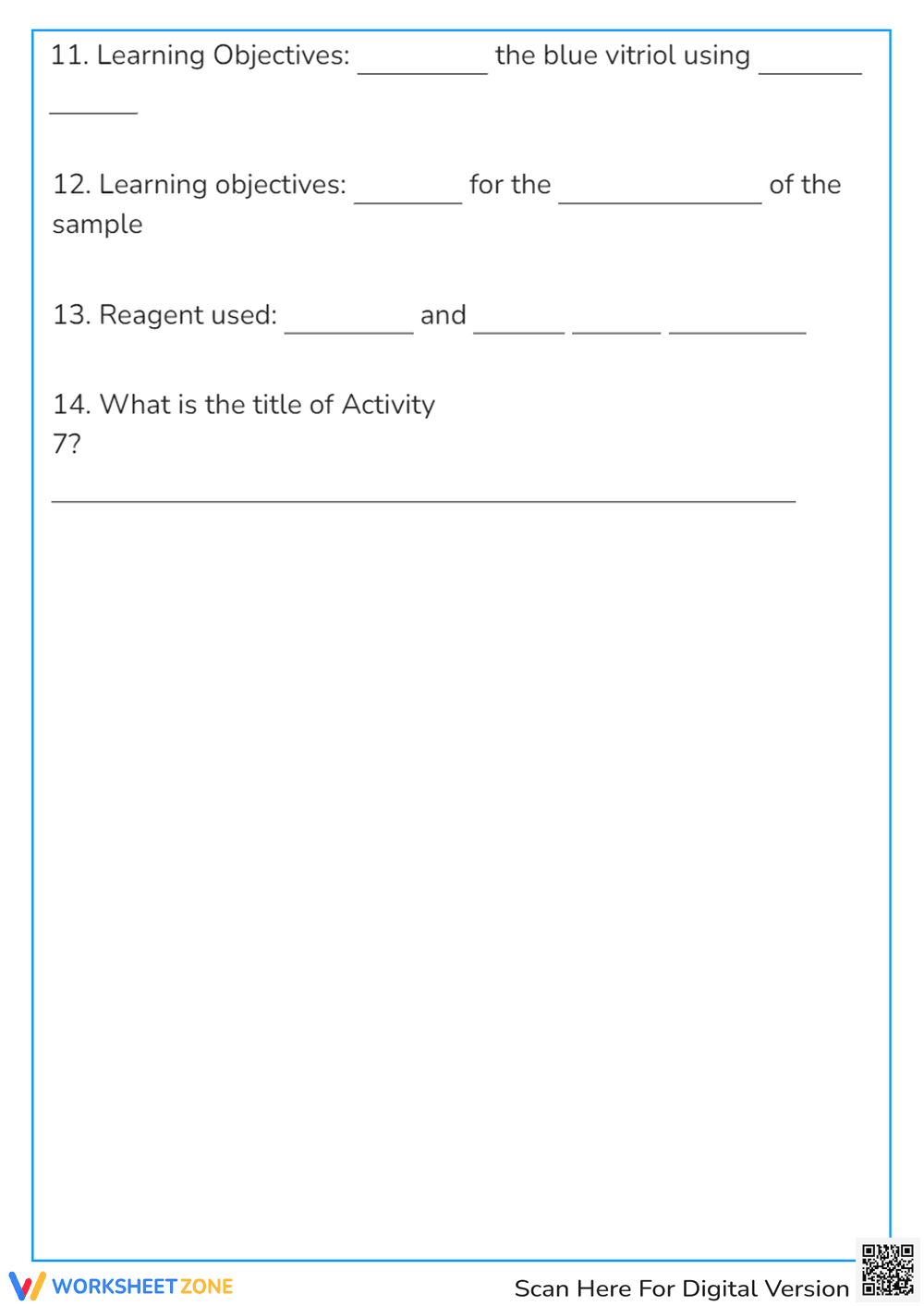
The resource contains 14 structured fill-in-the-blank questions spread across 2 pages. The first page focuses on the theoretical definitions of hydrates, ionic compound stability, and the terminology for water absorption and loss. The second page transitions into specific laboratory learning objectives and reagent identification, specifically referencing "blue vitriol" (copper sulfate pentahydrate) to ground the theory in practical lab application.
This worksheet is designed for a zero-prep classroom workflow. First, print the 2-page PDF (30 seconds). Second, distribute the activity to students as a pre-lab entrance ticket or a post-lecture check for understanding (1 minute). Finally, review the answers collectively to address misconceptions regarding hygroscopic versus efflorescent salts (10 minutes). Total teacher preparation time is under 2 minutes, making it an ideal resource for busy lab instructors.
Primary alignment is `HS-PS1-3`, which requires students to gather evidence to compare the structure of substances at the bulk scale. By identifying how water molecules integrate into crystalline lattices and the energy required to remove them, students engage with the strength of electrical forces in ionic compounds. This standard code can be copied directly into lesson plans, IEP goals, or district curriculum mapping tools.
Use this as a formative assessment during an Analytical Chemistry unit on gravimetric analysis. It is particularly effective as a bridge activity between a lecture on stoichiometry and a physical lab involving the heating of hydrates. Instructors should observe if students can distinguish between the physical escape of water and chemical decomposition into new substances. Expected completion typically takes 25 minutes.
This is designed for undergraduate students in introductory or analytical chemistry courses. It serves as an excellent scaffold for students who need to solidify their vocabulary before performing complex calculations. It pairs naturally with a laboratory manual or an anchor chart detailing the common prefixes for hydrated salts and the properties of anhydrous compounds.
According to the RAND AIRS 2024 report on post-secondary STEM readiness, structured retrieval practice through targeted fill-in-the-blank activities significantly improves the retention of technical nomenclature in laboratory settings. This worksheet aligns with the HS-PS1-3 standard by requiring students to describe the bulk properties of hydrates and the intermolecular forces governing crystallization. By focusing on the specific student action of identifying how inorganic salts contain specific numbers of water molecules, the resource supports the transition from conceptual understanding to quantitative analysis. Research from Fisher & Frey (2014) suggests that such scaffolded vocabulary tasks are essential for mastering the language of chemistry, which is a prerequisite for successful experimental design. This 14-task activity provides the necessary repetition to ensure students can accurately describe chemical reagents like blue vitriol before engaging in high-stakes laboratory procedures.


