


























Views
Downloads

CCSS.ELA-LITERACY.L.6.1 Achievement Test 2: Grade 6 Ready
Paste this activity's link or code into your existing LMS (Google Classroom, Canvas, Teams, Schoology, Moodle, etc.).
Students can open and work on the activity right away, with no student login required.
You'll still be able to track student progress and results from your teacher account.
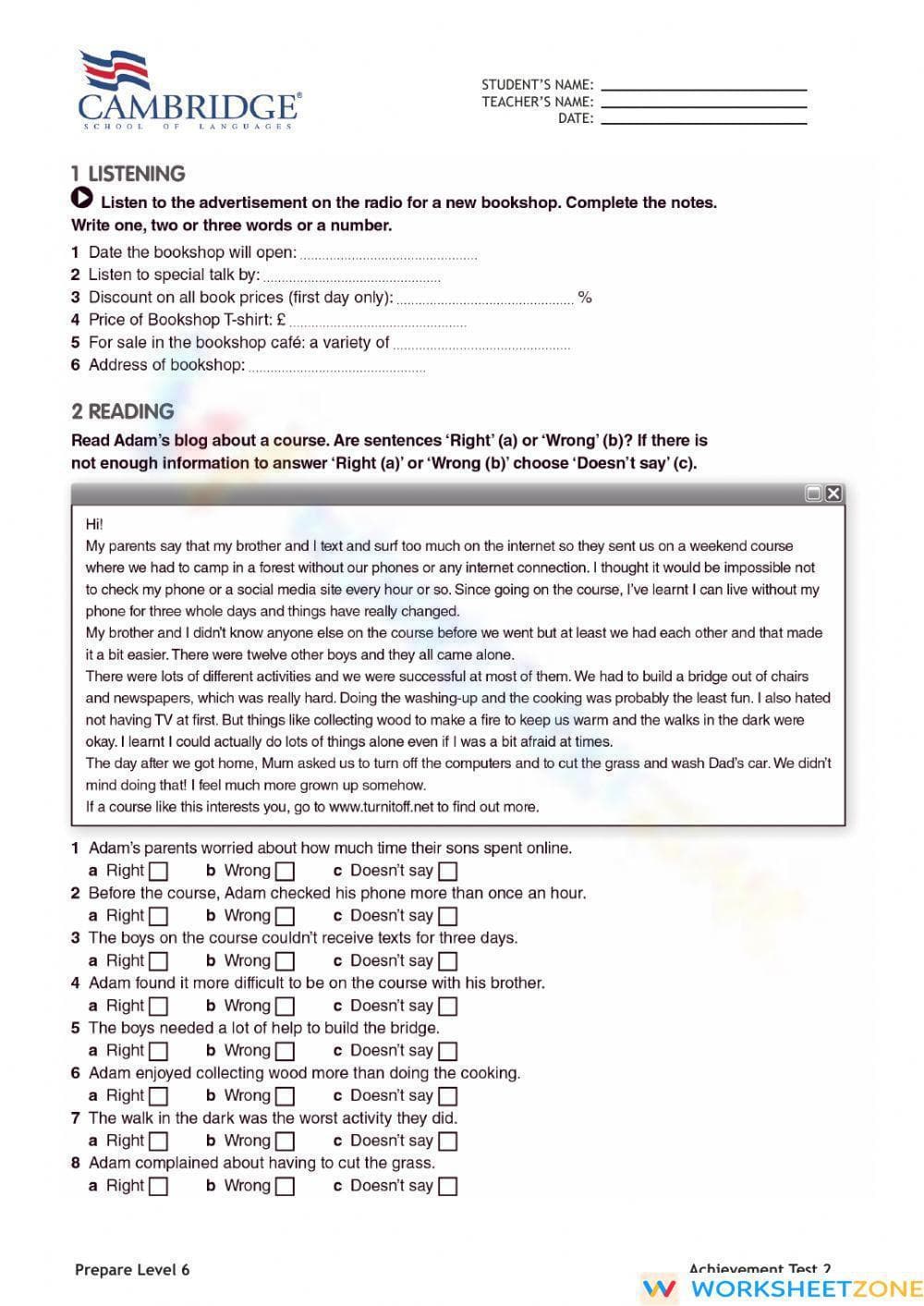
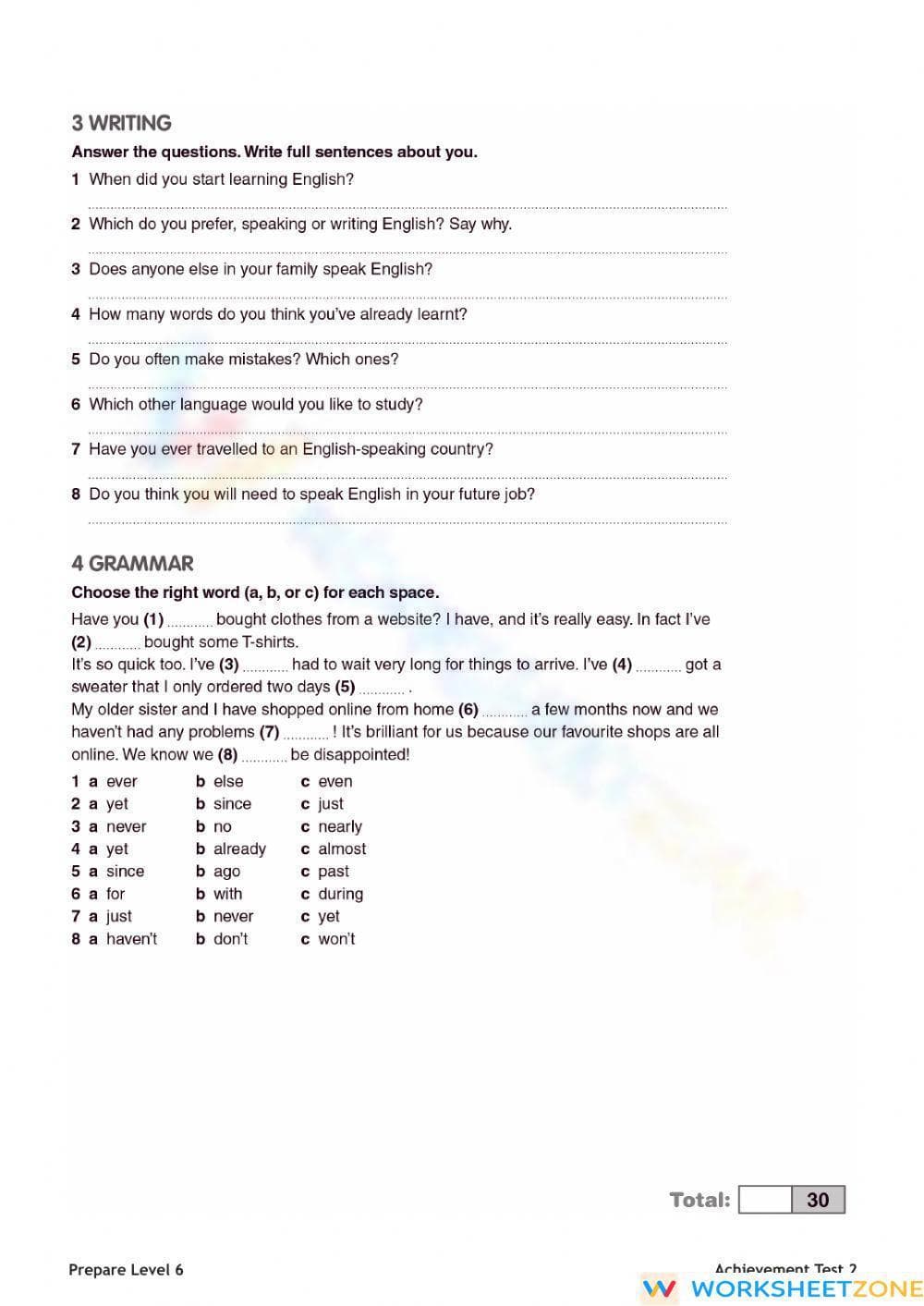
This Grade 6 achievement test provides a comprehensive evaluation of core English Language Arts skills. Students demonstrate mastery through integrated listening, reading, writing, and grammar tasks designed to measure proficiency and identify growth areas. It serves as a rigorous summative assessment tool for mid-year or end-of-unit progress monitoring in any middle school ELA curriculum.
At a Glance
- Grade: 6 · Subject: ELA
- Standard:
CCSS.ELA-LITERACY.L.6.1— Demonstrate command of the conventions of standard English grammar and usage when writing- Skill Focus: Integrated Language Arts Proficiency
- Format: 2 pages · 30 problems · Answer key included · PDF
- Best For: Summative unit assessment or progress monitoring
- Time: 45–60 minutes
The two-page assessment features four distinct sections: a listening comprehension task based on a radio advertisement, an eight-question reading passage about a weekend camp experience, a reflective writing section requiring full-sentence personal responses, and a multiple-choice grammar cloze test. The layout is professionally formatted with clear point distribution for easy grading and immediate feedback.
Each of the 30 tasks is strategically mapped to core proficiency benchmarks, allowing teachers to categorize student performance into Approaching, Meeting, or Exceeding expectations. The variety of question types—ranging from objective multiple-choice to subjective open-response—provides multi-modal evidence of student understanding. Scores can be recorded directly into digital gradebooks or utilized as data points for IEP goal tracking and differentiated instructional planning.
Primary standard CCSS.ELA-LITERACY.L.6.1 focuses on the conventions of standard English grammar and usage. The reading section additionally aligns with CCSS.ELA-LITERACY.RI.6.1, requiring students to cite textual evidence to support analysis of what the text says explicitly. Both standard codes can be copied directly into lesson plans, IEP goals, or district curriculum mapping tools to ensure instructional compliance.
Administer this test as a formal end-of-unit summative assessment to gauge student retention of grammar and reading strategies. Alternatively, use specific sections as timed check-ins during a review week. While students work on the writing section, observe their ability to construct complex sentences and use correct punctuation; this provides immediate formative data on their expressive language development. Completion typically requires 45 to 60 minutes.
This resource is designed for Grade 6 students, ESL/ELL learners at an intermediate level, and homeschool educators seeking structured testing materials. It pairs naturally with grade-level reading passages and grammar anchor charts for a complete instructional cycle.
This Grade 6 ELA achievement test facilitates the systematic evaluation of CCSS.ELA-LITERACY.L.6.1, ensuring students demonstrate a command of standard English conventions. According to RAND AIRS 2024, integrated assessments that combine receptive skills like listening and reading with productive skills like writing provide a more accurate reflection of a learner's true linguistic capacity than isolated skill drills. By requiring students to process information across multiple formats—from radio advertisements to personal reflections—the test mirrors the cognitive demands found in high-stakes state examinations and academic environments. The inclusion of a 30-point scoring system allows for precise data collection, supporting the evidence-based instructional cycles advocated by EdReports 2024. Educators can use these results to identify specific gaps in grammar application or reading comprehension, enabling targeted intervention strategies that align with district-wide literacy goals and individual student growth trajectories.


