




























Views
Downloads

Acceleration Graphs Worksheet | Grade 9 Essential

Paste this activity's link or code into your existing LMS (Google Classroom, Canvas, Teams, Schoology, Moodle, etc.).
Students can open and work on the activity right away, with no student login required.
You'll still be able to track student progress and results from your teacher account.
This Grade 9 physical science worksheet develops students' ability to interpret velocity-time graphs and calculate acceleration using slope formulas. Across 14 scaffolded problems on 4 student pages, learners read coordinates, compute acceleration rates with metric units, and analyze multidirectional motion.
At a Glance
- Grade: 9 · Subject: Physical Science
- Standard:
HS-PS2-1— Analyze velocity-time graphs to calculate acceleration and evaluate motion- Skill Focus: Velocity-time graph interpretation and acceleration calculation
- Format: 4 pages · 14 problems · Answer key included · PDF
- Best For: Kinematics practice and homework
- Time: 25–40 minutes
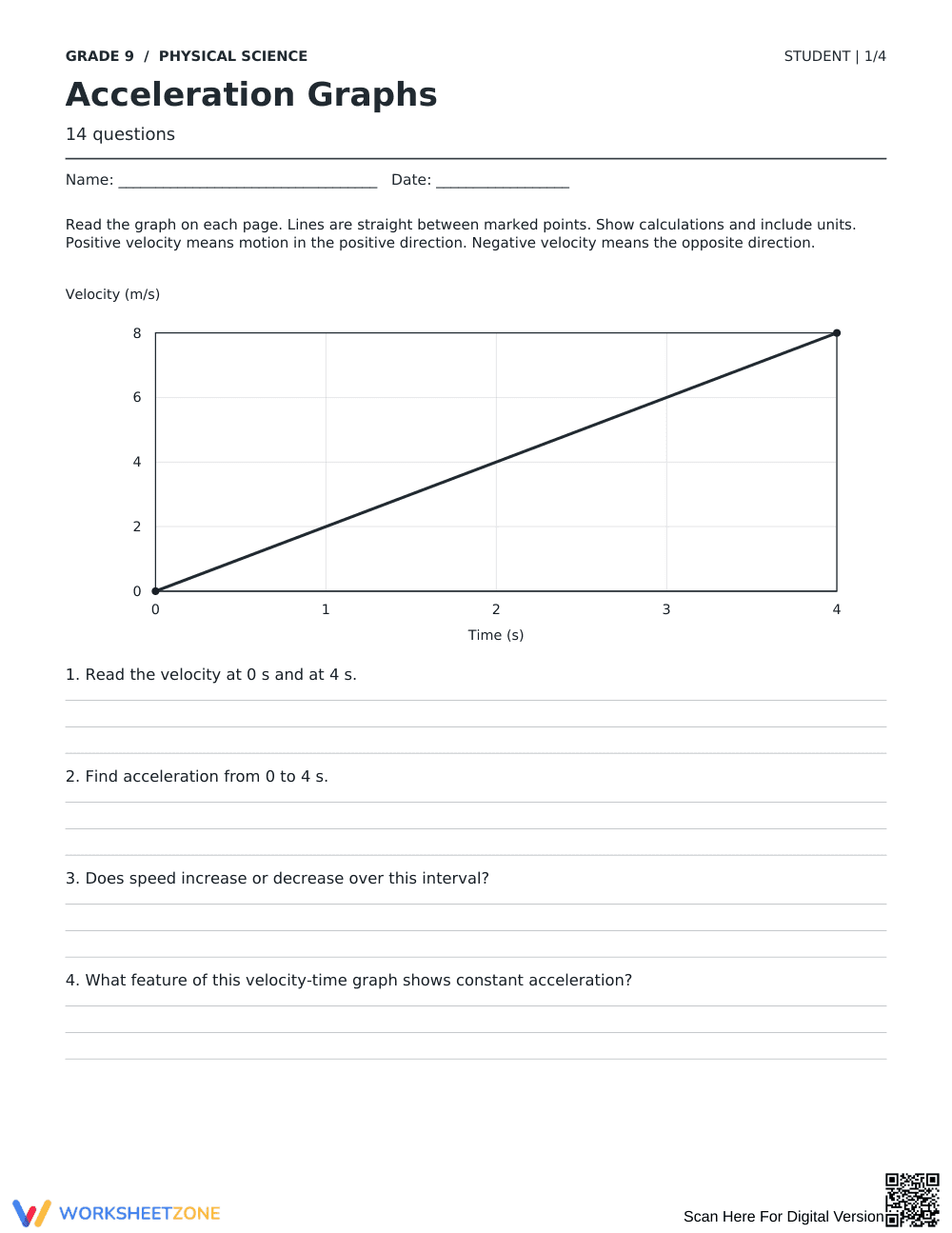
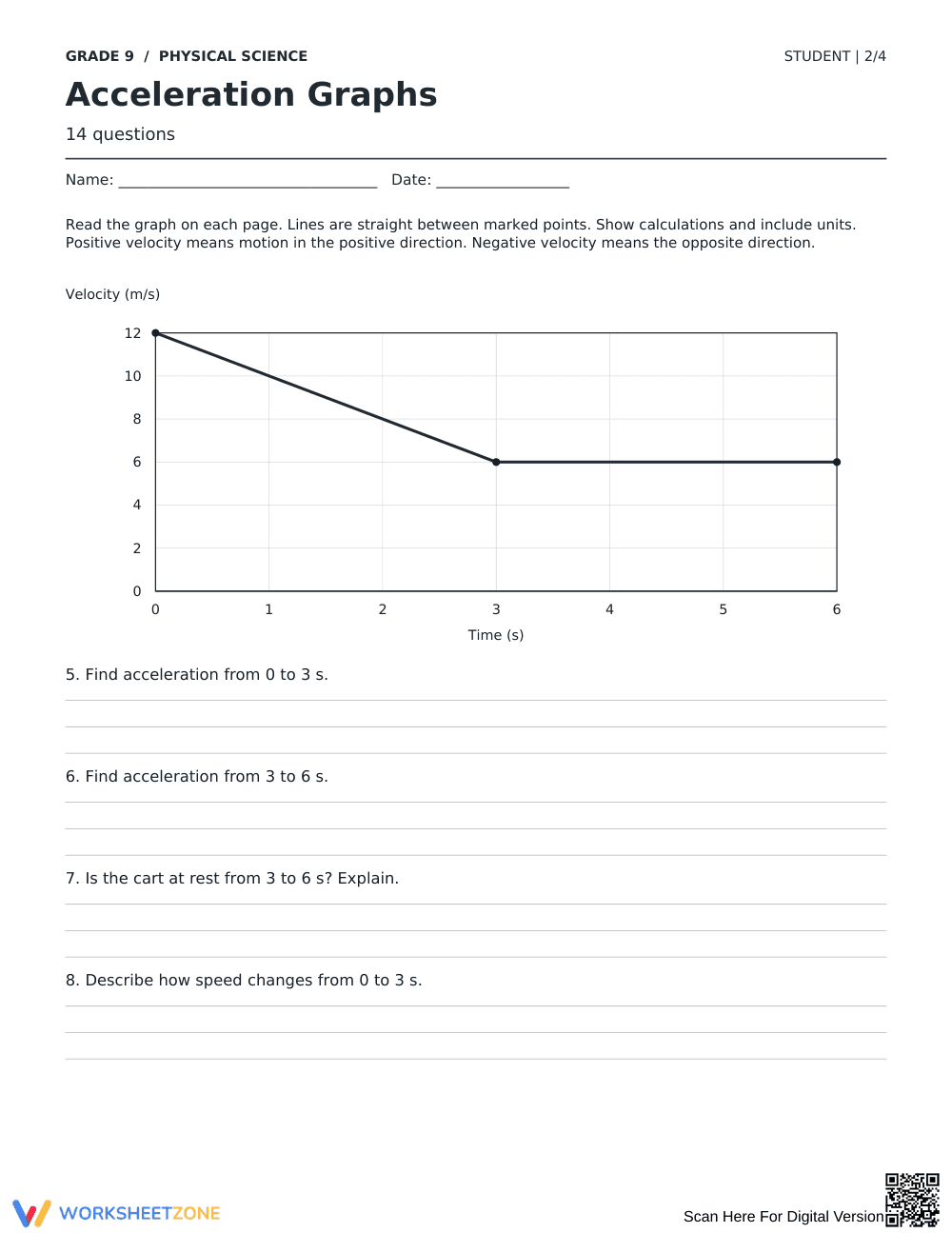
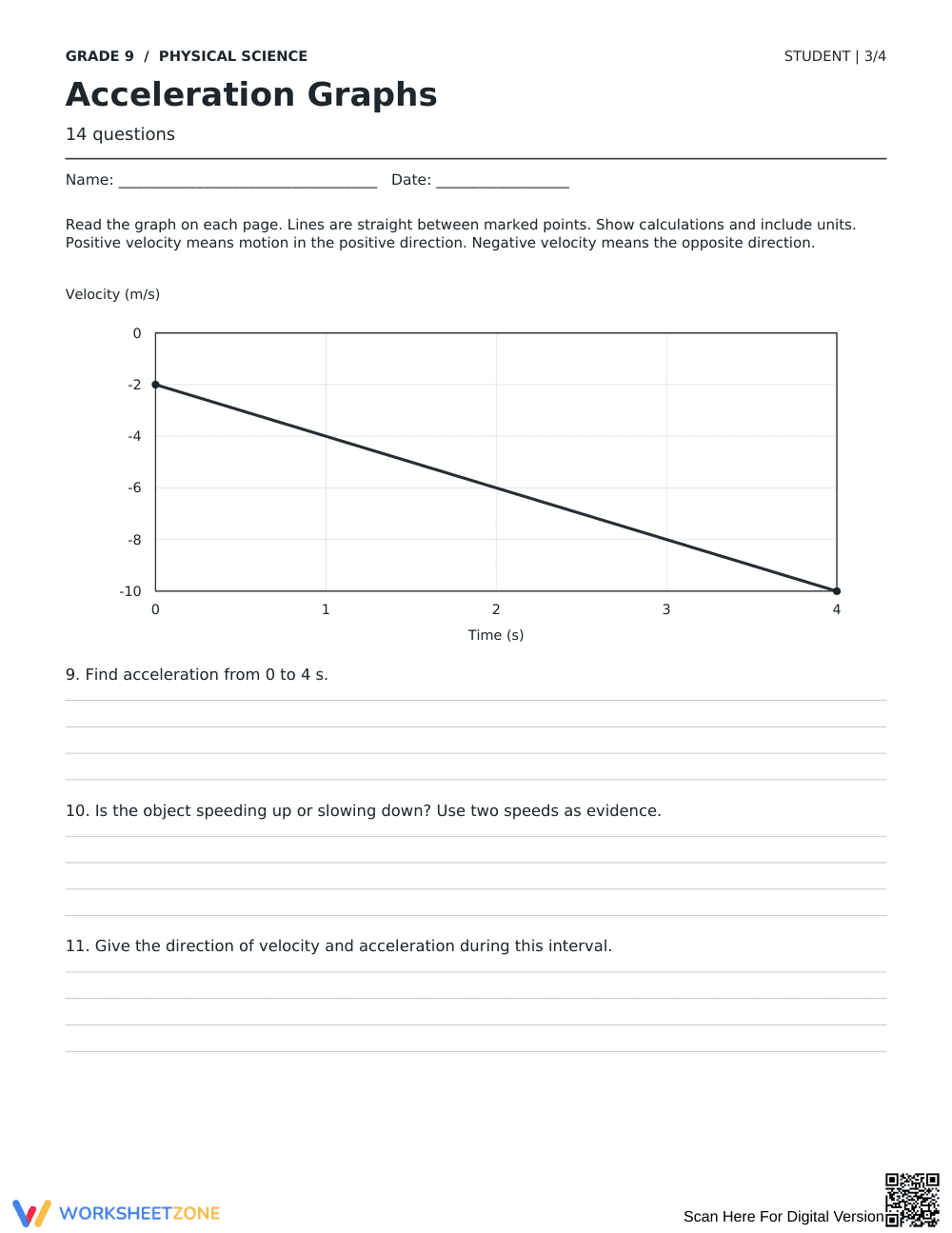
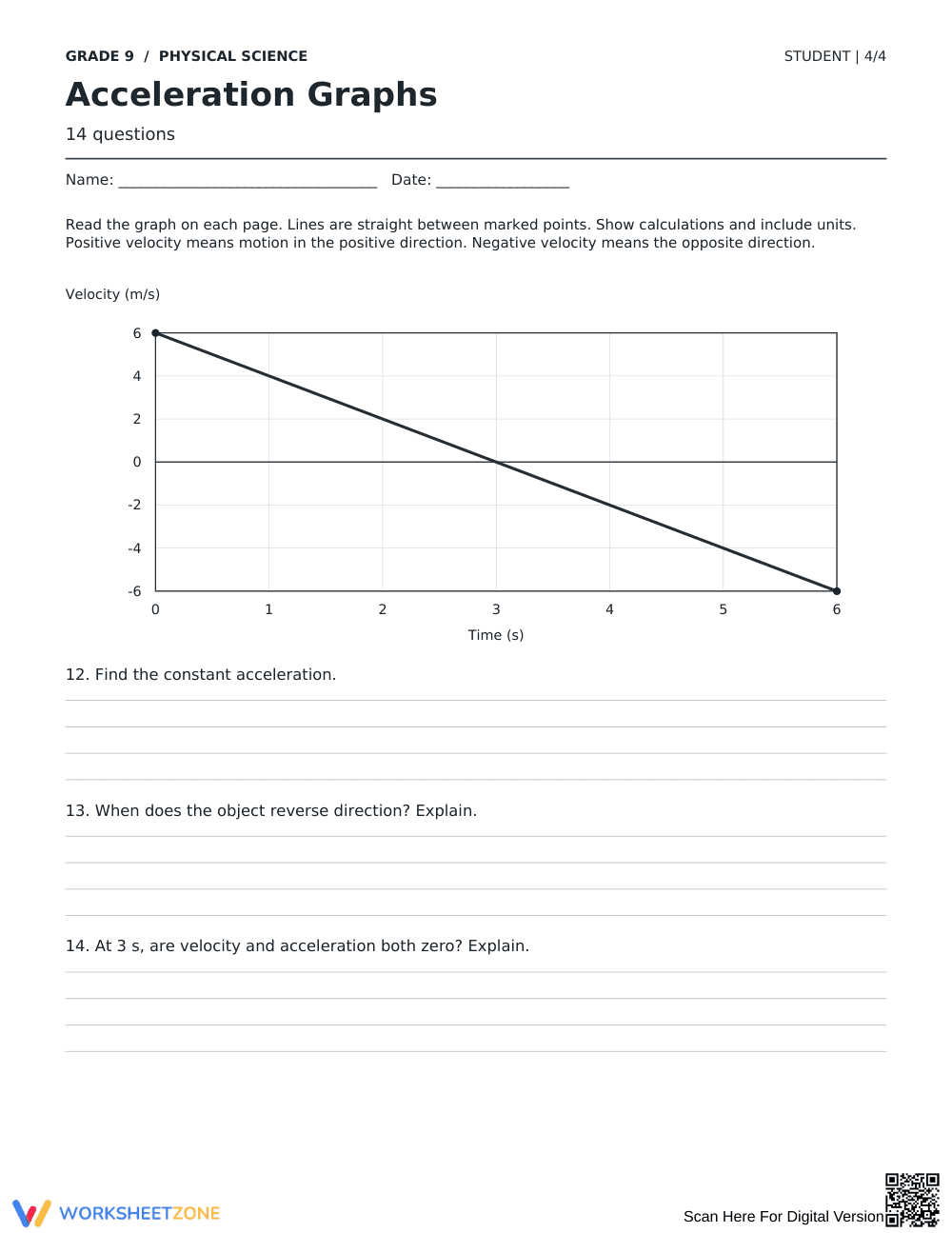
The resource includes 4 distinct graph scenarios across 4 student pages and a 2-page answer key. Students analyze linear acceleration, constant velocity, negative velocity, and directional reversals, solving calculation items with formulas ($a = \frac{\Delta v}{\Delta t}$) and writing conceptual justifications.
Skill Progression
- Guided practice (Questions 1–4): Students read initial and final velocities from a linear positive-slope graph and compute constant acceleration.
- Supported practice (Questions 5–8): Learners analyze a piecewise graph, calculating negative acceleration and zero acceleration while explaining constant speed.
- Independent practice (Questions 9–14): Students evaluate negative-direction motion, identify direction reversals, and explain instantaneous zero velocity versus acceleration.
This progression follows the gradual release of responsibility model from basic coordinate extraction to deep conceptual analysis.
Standards Alignment
This resource aligns with Next Generation Science Standard `HS-PS2-1` by building kinematic graph-analysis skills required to understand acceleration before investigating force and mass relationships. Supporting alignment includes CCSS Math `CCSS.MATH.CONTENT.HSF.IF.B.6` for calculating and interpreting rate of change from graphs. Both standard codes can be copied directly into lesson plans, IEP goals, or district curriculum mapping tools.
How to Use It
Assign this worksheet following direct instruction on kinematics and velocity-time graphs. Use Pages 1 and 2 for guided practice and modeling slope calculations, then assign Pages 3 and 4 for independent practice. For formative assessment, check Question 14 to see whether students confuse zero velocity with zero acceleration at turning points. Expected completion time is 25 to 40 minutes.
Who It's For
This worksheet is designed for Grade 9 physical science and high school introductory physics students. Scaffold for emerging learners by providing a slope formula reminder, and extend for advanced students by having them draw matching position-time graphs. It pairs well with a motion-sensor laboratory investigation.
According to research synthesized by Fisher & Frey (2014) on structured instructional scaffolding, guided visual data analysis combined with clear problem modeling helps high school science students bridge abstract mathematical representations and core physics principles. Next Generation Science Standard `HS-PS2-1` requires learners to analyze one-dimensional motion data and interpret acceleration as a rate of change. This 14-item physical science worksheet provides systematic practice reading velocity-time graphs, applying acceleration equations with appropriate metric units ($m/s^2$), and evaluating directional motion across 4 student pages. By requiring explicit mathematical calculations alongside written conceptual explanations, the resource directly addresses common student misconceptions regarding negative acceleration, constant velocity intervals, and instantaneous rest. The accompanying 2-page answer key facilitates prompt formative evaluation, allowing educators to diagnose comprehension gaps and track individual student mastery efficiently throughout introductory mechanics units.


