


























Views
Downloads

Weathering & Erosion: Essential Grade 2 Science Worksheet
Paste this activity's link or code into your existing LMS (Google Classroom, Canvas, Teams, Schoology, Moodle, etc.).
Students can open and work on the activity right away, with no student login required.
You'll still be able to track student progress and results from your teacher account.
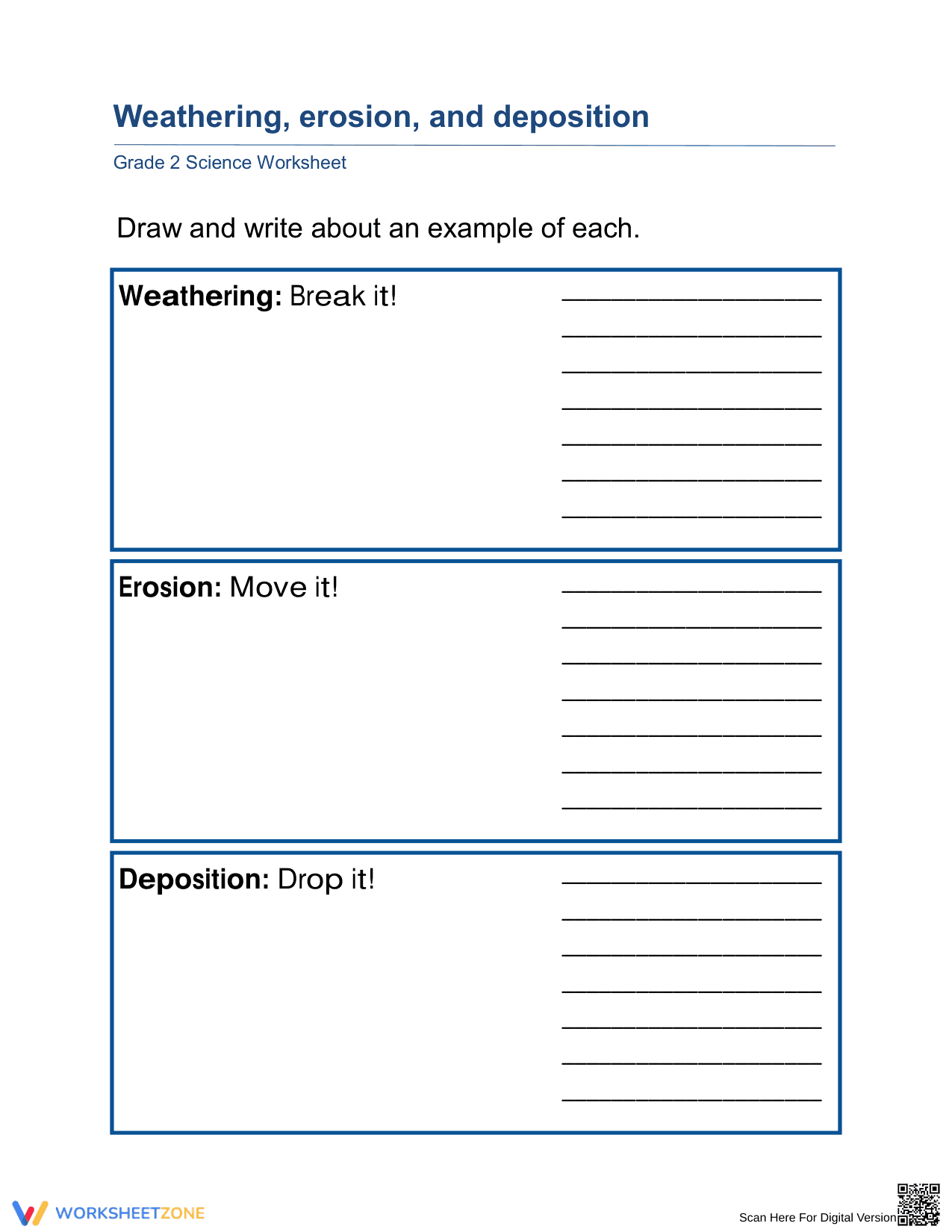
This Grade 2 science worksheet helps students master fundamental earth processes: weathering, erosion, and deposition. By combining visual representation with descriptive writing, students solidify their understanding of how natural materials break down, move, and settle. It is an essential tool for reinforcing core earth science concepts through active student participation and critical thinking.
At a Glance
- Grade: 2 · Subject: Earth Science
- Standard:
2-ESS1-1— Use evidence to show that Earth events can occur quickly or slowly- Skill Focus: Weathering, Erosion, and Deposition
- Format: 1 page · 3 problems · Answer key included · PDF
- Best For: Independent practice or quick formative assessment
- Time: 15–20 minutes
This resource features a cleanly designed one-page worksheet focused on the "Break it, Move it, Drop it" cycle. The page is divided into three sections for weathering, erosion, and deposition. Each section provides space for students to illustrate a real-world example and primary-ruled lines for drafting a corresponding explanation, making complex geological changes manageable.
This worksheet offers a true zero-prep workflow for maximum efficiency. Print the single-page PDF in seconds. Distribute to students; the instructions are self-explanatory, requiring only a one-minute introduction. Review work using the included answer key for immediate feedback. Total teacher preparation is under two minutes, making this an ideal resource for busy mornings or substitute plans.
The worksheet is aligned to NGSS standard 2-ESS1-1, requiring students to provide evidence that Earth events occur quickly or slowly. By describing weathering, erosion, and deposition, students gather evidence of continuous processes altering the Earth’s surface. This standard code can be copied directly into lesson plans, IEP goals, or district curriculum mapping tools.
Assign this worksheet after students observe these processes through experiments or digital simulations. It serves as an excellent formative assessment to check for misconceptions between erosion and deposition. Teachers should circulate during the drawing phase to ask probing questions about the forces involved. Completion usually takes 15 to 20 minutes for most second graders.
This resource is tailored for Grade 2 but works well for Grade 3 review or scaffolded Grade 4 practice. Large drawing boxes accommodate varied fine-motor skills, while the writing lines support simple sentence construction. It pairs perfectly with a "Weathering in a Jar" experiment or anchor charts showing landforms created by wind and water.
According to NAEP data, students engaging in multi-modal learning—combining sketching with writing—demonstrate significantly higher retention of scientific vocabulary like weathering and deposition. This worksheet applies the principles of Fisher & Frey (2014) by using a "Draw and Write" framework to scaffold the transition from observation to abstract conceptualization. By requiring original examples of geological processes, the task aligns with evidence-based practices for science literacy that emphasize the integration of disciplinary core ideas with crosscutting concepts. The 2-ESS1-1 standard focus ensures that students are actively building evidence-based models of how the Earth’s surface evolves over time. This resource provides the rigorous yet accessible practice necessary to meet modern standards for elementary science proficiency while maintaining a classroom-ready format that respects teacher time and instructional focus for various student populations. This approach ensures that core concepts are mastered thoroughly before moving to advanced topics.


