


























Views
Downloads
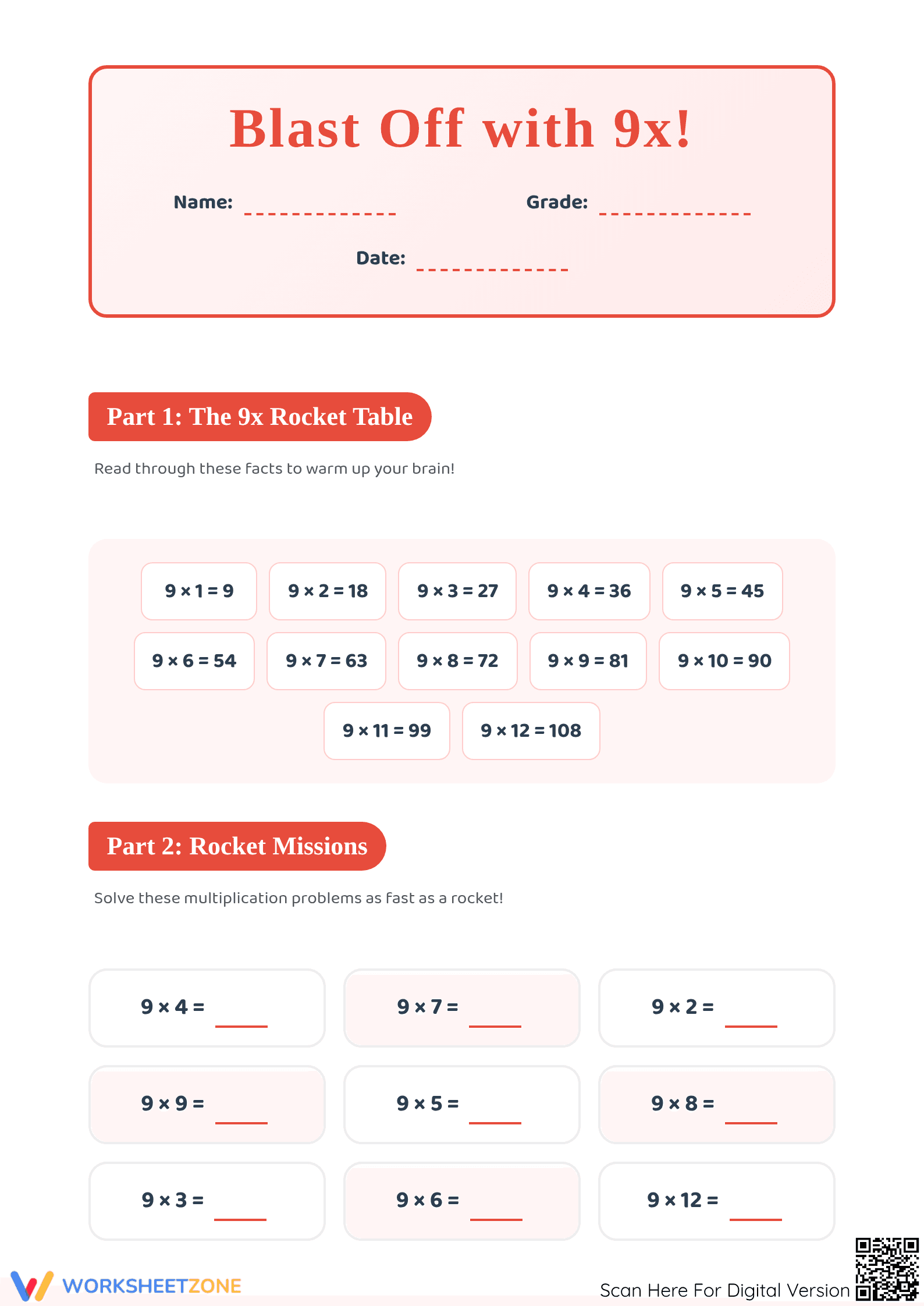


Essential 9x Times Tables Worksheet | Grade 3 Math
Paste this activity's link or code into your existing LMS (Google Classroom, Canvas, Teams, Schoology, Moodle, etc.).
Students can open and work on the activity right away, with no student login required.
You'll still be able to track student progress and results from your teacher account.
This Essential 9x Times Tables worksheet provides 29 multiplication problems designed to build fluency. Students move from basic recall to complex application, ensuring they master the nine-times facts through varied contexts. It is a complete resource for Grade 3 and Grade 4 learners.
At a Glance
- Grade: 3–4 · Subject: Math
- Standard:
CCSS.MATH.CONTENT.3.OA.C.7— Fluently multiply within 100 using strategies such as the relationship between multiplication and division- Skill Focus: 9x Multiplication Fluency
- Format: 3 pages · 29 problems · Answer key included · PDF
- Best For: Homework, independent practice, or small group review
- Time: 20–30 minutes
This multi-page PDF features five distinct sections. It begins with a "Rocket Table" reference guide for mental warm-up, followed by 9 direct multiplication problems. The difficulty increases with 9 missing factor equations and 6 comparison problems using greater than, less than, or equal symbols. Finally, 5 "Space Stories" word problems require students to apply their knowledge to galactic scenarios.
Skill Progression
- Guided practice starts with direct 9x tasks to anchor basic recall through 9 specific problems.
- Supported practice introduces 9 missing factor equations and 6 inequality comparisons to challenge algebraic thinking.
- Independent practice concludes with 5 word problems, requiring learners to translate text into mathematical operations.
This sequence follows the gradual-release model, moving from highly scaffolded reference to independent problem-solving.
Standards Alignment
The primary focus is CCSS.MATH.CONTENT.3.OA.C.7, which requires students to "fluently multiply and divide within 100, using strategies such as the relationship between multiplication and division." By practicing 9x facts in both standard and missing-factor formats, students satisfy this foundational requirement. This standard code can be copied directly into lesson plans, IEP goals, or district curriculum mapping tools.
How to Use It
Assign this worksheet during the "You Do" phase of a lesson on the multiples of nine to solidify memory. It also serves as an effective formative assessment tool; observe how students handle the missing factor section to identify those struggling with the inverse relationship of operations. Expect completion in approximately 25 minutes.
Who It's For
This resource is perfect for third and fourth-grade students developing multiplication automaticity. It provides necessary scaffolding for learners who meet with difficulties while offering extension word problems for those ready for a challenge. Pair this with a multiplication anchor chart or a short timed drill for maximum impact.
RAND AIRS 2024 analysis indicates that systematic practice of 9x multiplication facts is a critical predictor of success in middle-school algebraic reasoning. Research from Fisher & Frey (2014) emphasizes that "purposeful practice" involving varied formats—such as inequalities and word problems—prevents rote memorization from becoming disconnected from conceptual utility. By engaging with 29 unique tasks aligned to CCSS.MATH.CONTENT.3.OA.C.7, students move beyond simple computation into the "Space Stories" application phase, which mirrors the rigor found in NAEP assessments. Educators can cite this resource as a valid tool for building fluency within the Grade 3-4 curriculum, ensuring that standard-aligned outcomes are met through a structured instructional design that prioritizes both speed and deep mathematical comprehension.


