




























Views
Downloads
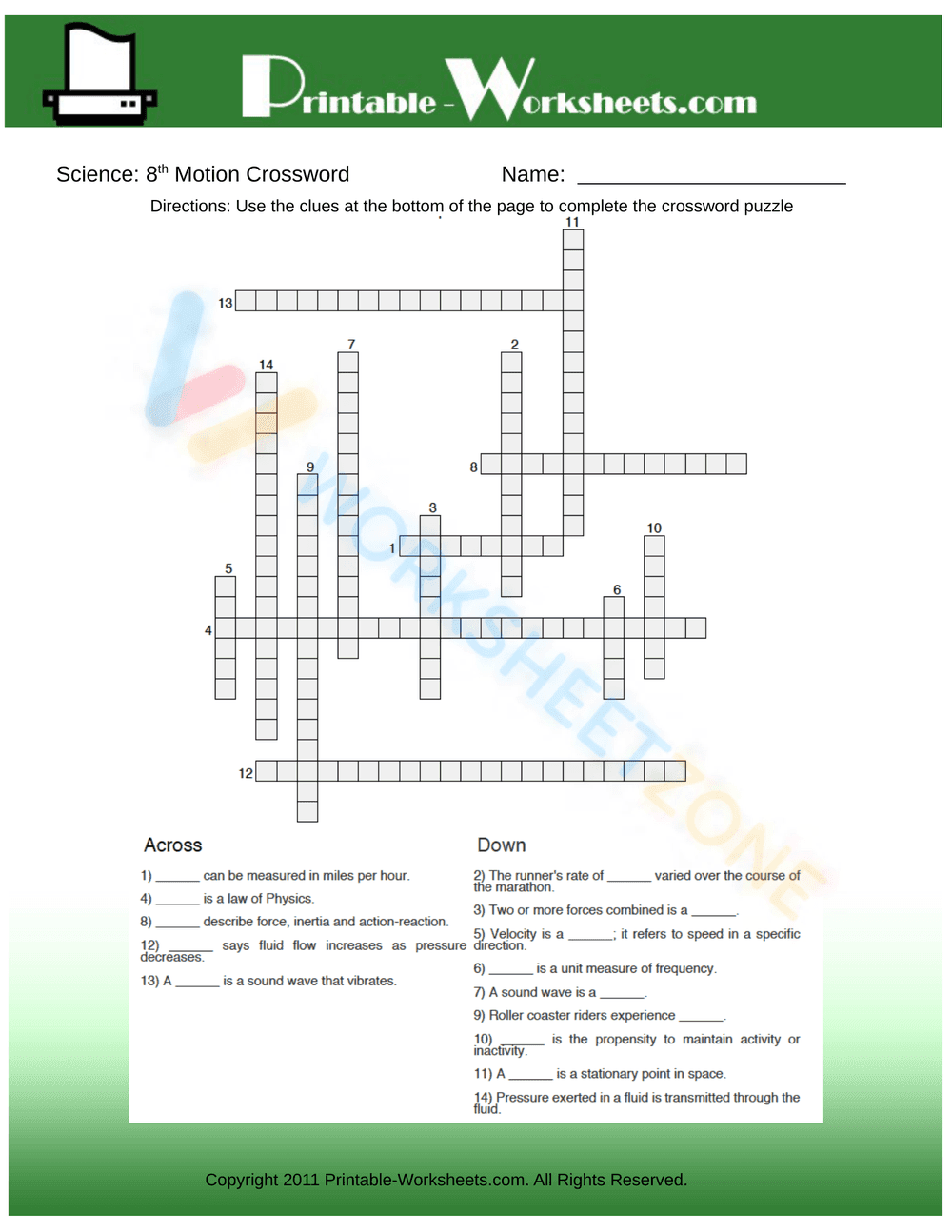

Grade 8 Science Motion — Printable No-Prep Worksheet

Paste this activity's link or code into your existing LMS (Google Classroom, Canvas, Teams, Schoology, Moodle, etc.).
Students can open and work on the activity right away, with no student login required.
You'll still be able to track student progress and results from your teacher account.
This Grade 8 science crossword puzzle reinforces essential physics vocabulary related to motion, forces, and energy. Students recall and apply key terms like inertia, velocity, and frequency to complete the grid, solidifying their grasp of foundational physical science concepts before moving on to complex calculations.
At a Glance
- Grade: 8 · Subject: Science
- Standard:
MS-PS2-2— Understand forces, motion, and physical laws- Skill Focus: Physics Vocabulary
- Format: 1 page · 14 problems · Answer key included · PDF
- Best For: Vocabulary review and sub plans
- Time: 15–20 minutes
Inside this resource, educators will find a single-page crossword puzzle featuring 14 distinct clues divided into Across and Down sections. The prompts cover a range of physical science topics, including Newton's laws of motion, wave properties, fluid dynamics, and speed measurement. A complete answer key is provided to ensure accurate grading and allow for peer-to-peer review sessions.
This worksheet is designed for immediate classroom implementation with a streamlined workflow:
- Print (1 minute): Generate copies of the single-page PDF for the entire class.
- Distribute (1 minute): Hand out the puzzle as a bell-ringer or independent practice activity.
- Review (3 minutes): Display the answer key on the board for quick self-correction.
With under two minutes of total teacher prep time, this activity is highly suitable for emergency sub plans or transitional periods between major science units.
This activity aligns with MS-PS2-2 by supporting the foundational vocabulary needed to plan an investigation to provide evidence that the change in an object's motion depends on the sum of the forces on the object and the mass of the object. Mastery of terms like inertia and velocity is critical for discussing these concepts accurately. Both standard codes can be copied directly into lesson plans, IEP goals, or district curriculum mapping tools.
Deploy this crossword puzzle as a formative assessment during the middle of a physics unit to gauge vocabulary retention. Alternatively, use it as a quiet, independent activity after direct instruction on Newton's laws. While students work, teachers can circulate and observe which specific terms require reteaching. Expected completion time ranges from 15 to 20 minutes, depending on the student's reading comprehension and prior knowledge.
This resource is primarily designed for 8th-grade general science students. It serves as an excellent differentiation tool for visual learners who benefit from the structural hints provided by intersecting crossword letters. Pair this puzzle with a comprehensive anchor chart detailing the laws of physics to support students who may need additional scaffolding.
Effective science instruction requires explicit vocabulary development to ensure students can articulate complex physical phenomena. Aligning with MS-PS2-2, this resource helps learners understand forces, motion, and physical laws through targeted terminology practice. According to a recent ScienceDirect TpT Analysis, integrating structured word puzzles into middle school science curricula significantly improves the retention of domain-specific vocabulary compared to rote memorization alone. By engaging with terms like inertia, velocity, and frequency in a puzzle format, students actively retrieve information, strengthening their cognitive pathways. This active recall process is essential for building the scientific literacy required for high school physics and beyond. Providing consistent, low-stakes opportunities to interact with academic language ensures that all learners can confidently participate in classroom discussions and laboratory investigations.


