




























Views
Downloads

Angle Properties Printable Worksheet | Grade 7 Math

Paste this activity's link or code into your existing LMS (Google Classroom, Canvas, Teams, Schoology, Moodle, etc.).
Students can open and work on the activity right away, with no student login required.
You'll still be able to track student progress and results from your teacher account.
This comprehensive angle properties worksheet equips Grade 7 students with the essential skills to identify and calculate unknown angles. By utilizing a detailed reference guide and step-by-step examples, learners will confidently solve algebraic geometry problems involving supplementary, complementary, and vertical angles.
At a Glance
- Grade: 7 · Subject: Math
- Standard:
CCSS.MATH.CONTENT.7.G.B.5— Use angle facts to write and solve simple equations.- Skill Focus: Angle Properties
- Format: 3 pages · 6 problems · Answer key included · PDF
- Best For: Independent practice and review
- Time: 20–30 minutes
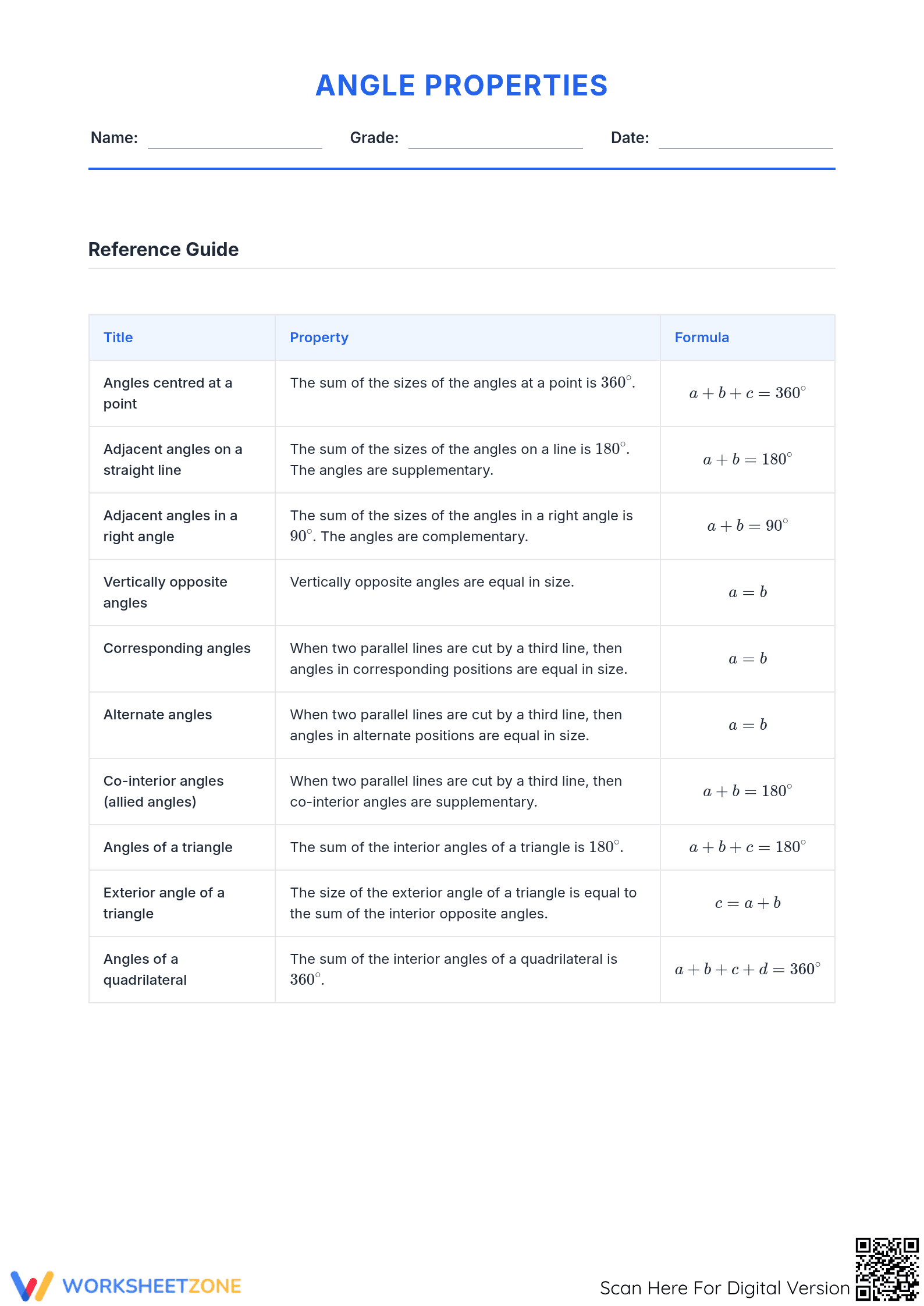
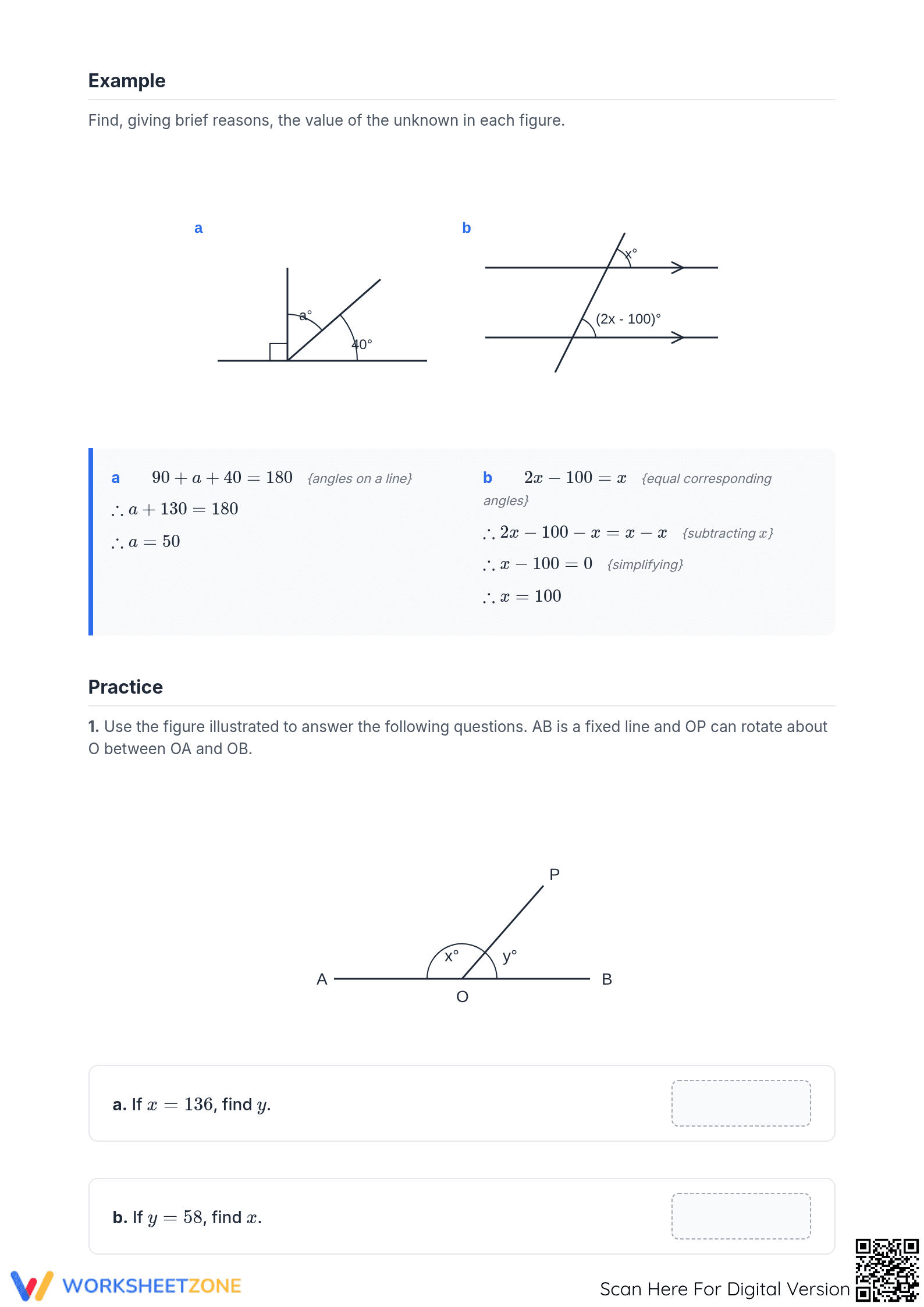
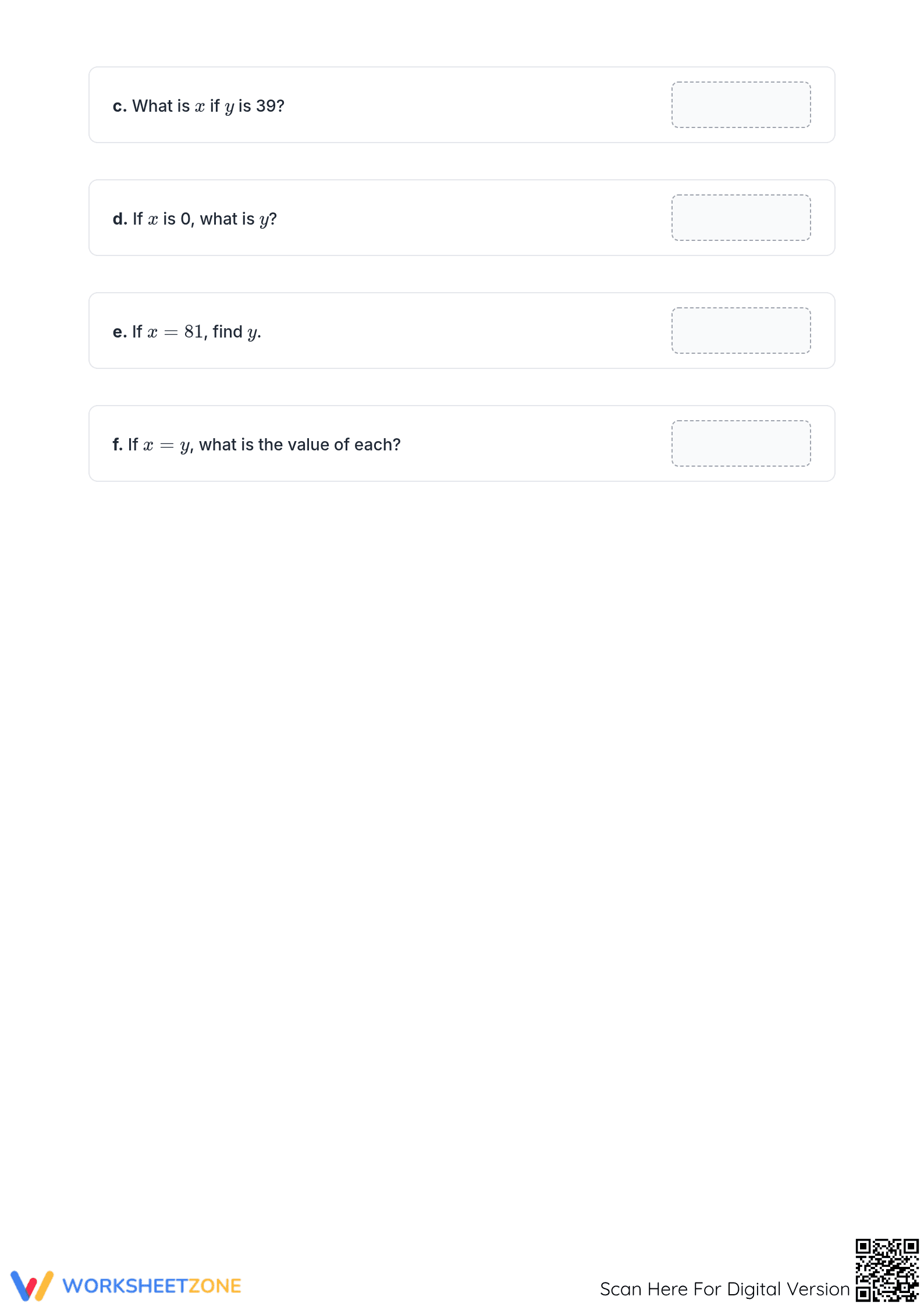
This three-page layout supports student independence. The first page provides a reference guide detailing formulas for angles on a straight line, vertically opposite angles, and more. The second page offers worked examples demonstrating how to set up equations for unknown variables. Finally, students apply these concepts across six practice problems, with a full answer key provided.
- Guided practice: Students begin by reviewing the comprehensive reference table, which pairs visual diagrams with algebraic formulas for nine distinct angle relationships.
- Supported practice: Learners analyze two fully worked examples that model the process of writing equations and providing brief geometric reasons for each step.
- Independent practice: Students tackle six specific scenarios based on a single geometric figure, calculating unknown variables using their knowledge of supplementary angles.
This gradual-release approach ensures students transition smoothly from the "I Do" instructional phase to the "You Do" independent application.
Aligned to primary standard CCSS.MATH.CONTENT.7.G.B.5: Use facts about supplementary, complementary, vertical, and adjacent angles in a multi-step problem to write and solve simple equations for an unknown angle in a figure. This resource also reinforces foundational algebra skills by requiring students to isolate variables. Both standard codes can be copied directly into lesson plans, IEP goals, or district curriculum mapping tools.
Use this versatile worksheet during direct instruction as a guided notes companion, allowing students to reference the formula chart while you introduce new angle relationships. Alternatively, assign the practice section as independent homework. As a formative assessment tip, observe whether students correctly identify the geometric relationship before they attempt to set up their algebraic equations. Expected completion time is 20 to 30 minutes.
This resource is primarily designed for Grade 7 math students mastering introductory geometry and algebra concepts. The built-in reference guide makes it an excellent tool for students who require additional scaffolding or visual aids to recall complex vocabulary like "co-interior" or "alternate" angles. It pairs perfectly with interactive anchor charts or introductory lessons on parallel lines cut by a transversal.
Mastering geometric relationships requires explicit instruction and structured reference materials. According to a RAND AIRS 2024 study, providing students with integrated reference guides during complex problem-solving tasks significantly reduces cognitive overload and improves algebraic accuracy. This resource directly supports that methodology by pairing a comprehensive formula chart with targeted practice. By aligning with CCSS.MATH.CONTENT.7.G.B.5, the worksheet ensures students can effectively use angle facts to write and solve simple equations. The clear progression from visual diagrams to algebraic application helps bridge the gap between concrete geometry and abstract algebra. Educators can rely on this structured format to build mathematical confidence, ensuring learners have the necessary tools to justify their reasoning, set up accurate equations, and successfully calculate unknown variables in multi-step geometric figures across various contexts.


