


























Views
Downloads
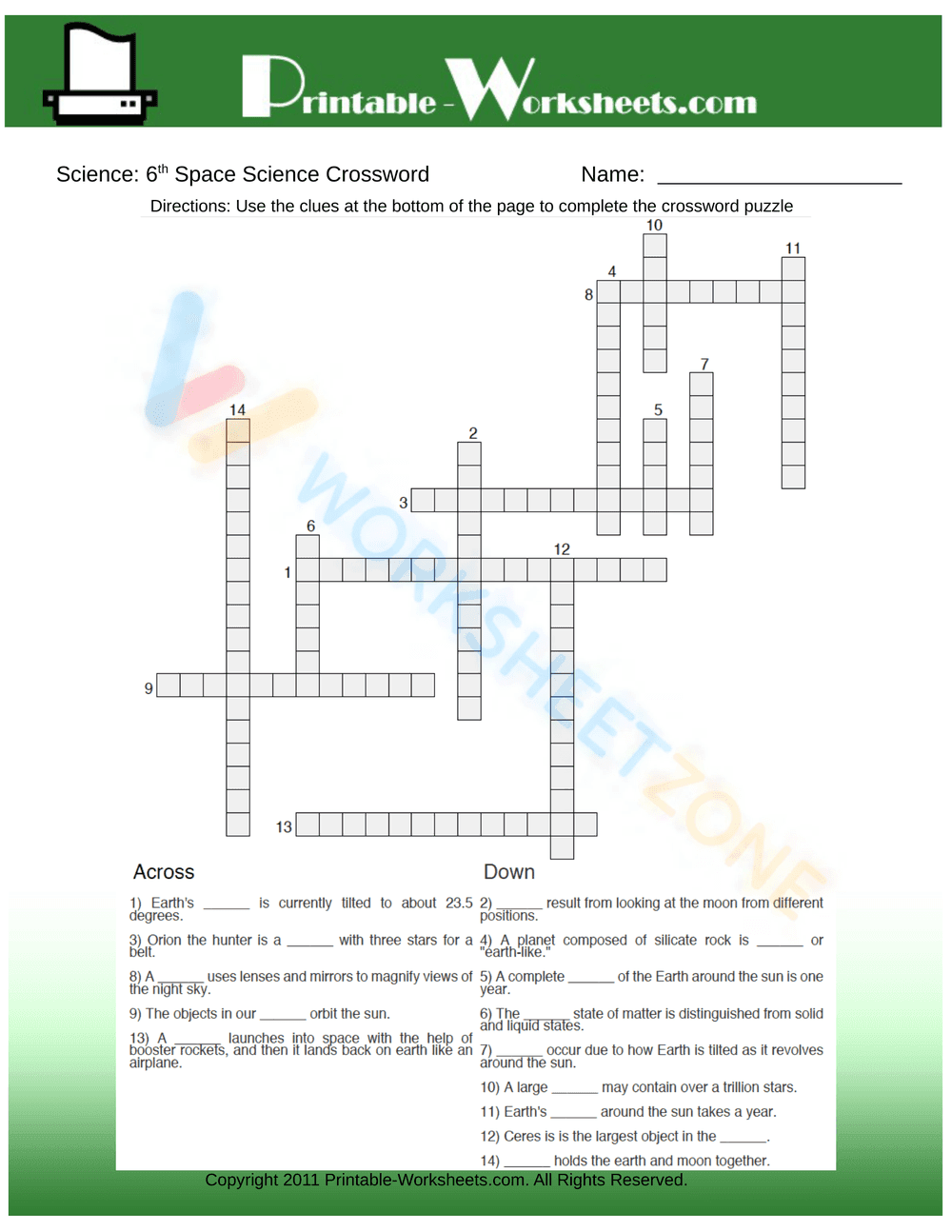

Grade 6 Space Science Crossword — Printable Worksheet
Paste this activity's link or code into your existing LMS (Google Classroom, Canvas, Teams, Schoology, Moodle, etc.).
Students can open and work on the activity right away, with no student login required.
You'll still be able to track student progress and results from your teacher account.
This Grade 6 space science crossword worksheet provides a structured way for students to reinforce their understanding of astronomical concepts. By engaging with 14 specific clues, learners practice identifying key terms related to Earth's tilt, lunar phases, and the mechanics of the solar system. It is designed to solidify vocabulary retention through active recall and definition matching.
At a Glance
- Grade: 6 · Subject: Science
- Standard:
MS-ESS1-1— Develop and use a model of the Earth-sun-moon system- Skill Focus: Space Science Vocabulary
- Format: 1 page · 14 problems · Answer key included · PDF
- Best For: Vocabulary review and formative assessment
- Time: 15–20 minutes
The worksheet features a classic crossword grid accompanied by 14 descriptive clues divided into Across and Down sections. The content covers a broad range of middle school Earth and Space Science topics, including planetary composition, celestial mechanics, and space exploration technology. The single-page layout ensures that students have all the information they need in one view, and a comprehensive answer key is provided for quick grading.
This resource is optimized for a zero-prep classroom environment. Teachers can print the PDF in under 30 seconds, distribute it to the class in less than a minute, and use the included answer key to review results in under 5 minutes. Because the instructions are self-explanatory, it functions perfectly as a last-minute substitute plan or an independent station activity that requires no prior teacher setup.
The primary focus is `MS-ESS1-1`, which requires students to explain the cyclic patterns of lunar phases, eclipses of the sun and moon, and seasons. Additionally, it supports `MS-ESS1-2` by touching upon the role of gravity in the motions within galaxies and the solar system. Both standard codes can be copied directly into lesson plans, IEP goals, or district curriculum mapping tools.
Use this worksheet as a bell ringer at the start of a unit on the solar system to gauge prior knowledge. Alternatively, assign it as a post-instruction review tool to ensure students have mastered the technical language required for more complex modeling tasks. Teachers should observe which clues, such as Earth's tilt or gravity, take students longer to solve to identify areas needing further direct instruction.
This activity is ideal for 6th-grade science students, including those requiring literacy support or English Language Learners (ELL) who benefit from vocabulary-heavy tasks. It pairs naturally with a classroom anchor chart on the solar system or a direct instruction lesson regarding the Earth-sun-moon relationship. The format is accessible for students working at various reading levels.
The use of crossword puzzles in science education serves as a high-utility retrieval practice tool, aligning with the instructional frameworks described by Fisher & Frey (2014). By requiring students to map definitions to specific terminology like MS-ESS1-1 concepts, the worksheet facilitates the transition from surface-level recognition to deeper conceptual fluency. Research indicates that structured vocabulary tasks reduce cognitive load during subsequent complex problem-solving phases. This Grade 6 science resource specifically targets the Earth-sun-moon system and gravitational mechanics, providing 14 distinct opportunities for students to demonstrate their grasp of essential scientific nomenclature. According to Fisher & Frey (2014), such scaffolds are vital for middle school learners who are developing the academic language necessary to describe celestial phenomena. This worksheet ensures that the standard code and its associated skills are reinforced through a low-stakes, high-engagement format suitable for diverse classroom settings.


