


























Views
Downloads
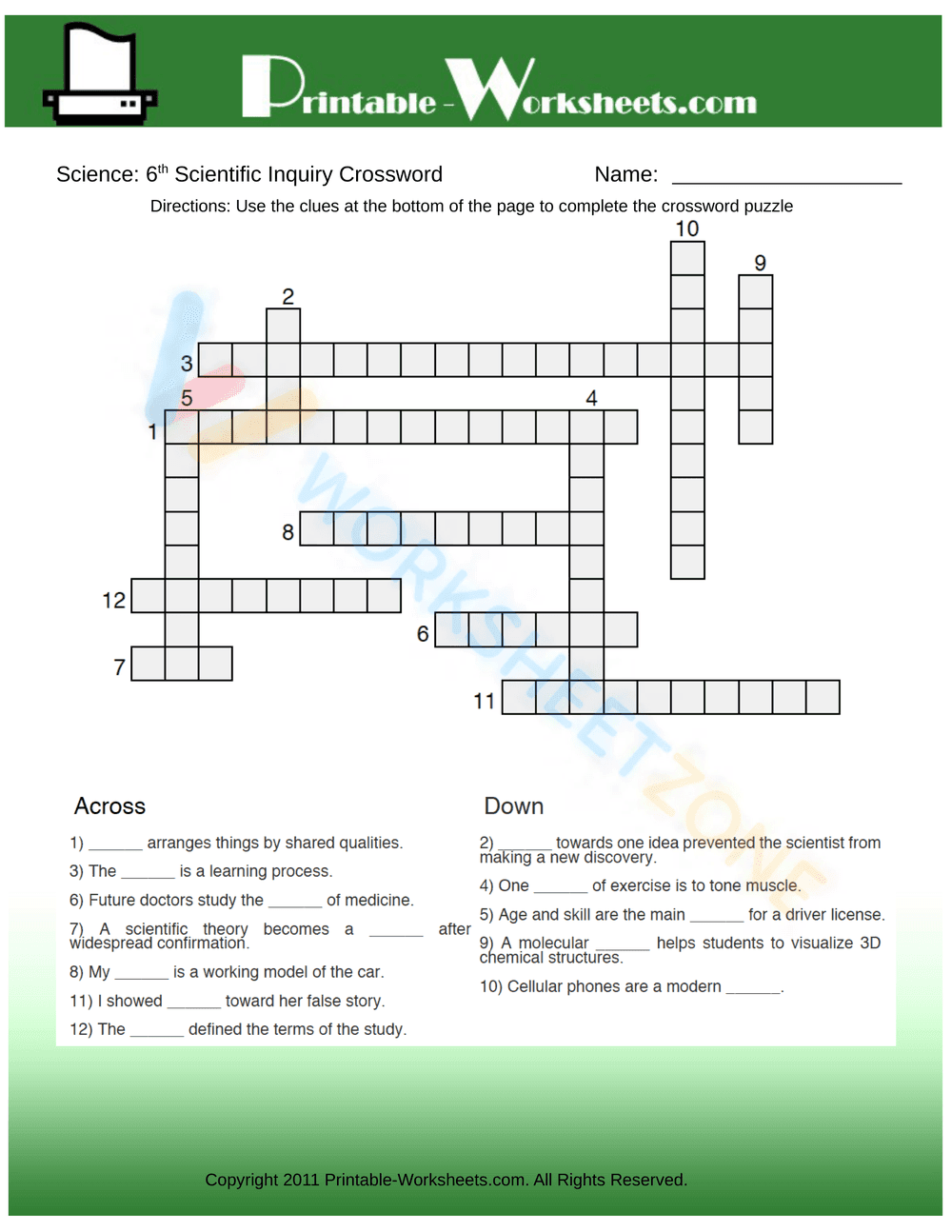

Grade 6 Science Vocabulary — Printable No-Prep Worksheet
Paste this activity's link or code into your existing LMS (Google Classroom, Canvas, Teams, Schoology, Moodle, etc.).
Students can open and work on the activity right away, with no student login required.
You'll still be able to track student progress and results from your teacher account.
This Grade 6 science crossword puzzle helps students master essential scientific inquiry vocabulary through engaging, context-based clues. By completing this activity, learners reinforce their understanding of foundational terms, ensuring they can accurately interpret domain-specific language in future laboratory experiments and informational texts.
At a Glance
- Grade: 6 · Subject: Science
- Standard:
CCSS.ELA-LITERACY.RST.6-8.4— Determine the meaning of domain-specific scientific words- Skill Focus: Scientific Inquiry Vocabulary
- Format: 1 page · 12 problems · Answer key included · PDF
- Best For: Independent practice and review
- Time: 15–20 minutes
This resource features a single-page crossword puzzle containing twelve distinct clues related to scientific methodology and inquiry. Students read fill-in-the-blank sentences to deduce the correct terminology, such as "theory," "model," and "classification." The straightforward layout includes clear across and down sections, while the included answer key allows for rapid grading or peer review without requiring additional teacher materials.
This resource is designed for immediate classroom implementation with a zero-prep workflow:
- Print (1 minute): Generate enough copies of the single-page PDF for your roster.
- Distribute (1 minute): Hand out the puzzle as students enter the room for a focused bell-ringer.
- Review (3 minutes): Display the answer key on the smartboard for quick self-correction.
With a total teacher prep time of under two minutes, this worksheet serves as an ideal emergency sub plan or a reliable sponge activity for early finishers.
This activity aligns directly with CCSS.ELA-LITERACY.RST.6-8.4: Determine the meaning of symbols, key terms, and other domain-specific words and phrases as they are used in a specific scientific or technical context relevant to grades 6-8 texts and topics. It also supports general science literacy by reinforcing the academic language necessary for middle school laboratory reports. Both standard codes can be copied directly into lesson plans, IEP goals, or district curriculum mapping tools.
Deploy this crossword puzzle as a formative assessment after introducing a new scientific inquiry unit. Alternatively, assign it as a quiet, independent homework task to solidify vocabulary retention before a unit exam. While students work, circulate the room and observe which clues cause the most hesitation; this provides immediate formative data on which concepts require reteaching. Most sixth graders will complete the twelve items within a 15 to 20-minute timeframe.
This worksheet is primarily designed for sixth-grade general education science students building their foundational academic vocabulary. To support English Language Learners or students with IEPs, teachers can provide a scrambled word bank on the board to reduce retrieval friction. It pairs perfectly with an introductory direct instruction lesson on the scientific method or a reading passage about famous historical discoveries.
Mastering domain-specific terminology is a critical component of middle school science education. When students practice with CCSS.ELA-LITERACY.RST.6-8.4 to determine the meaning of domain-specific scientific words, they build the cognitive framework necessary for advanced laboratory work. According to Fisher & Frey (2014), explicit vocabulary instruction combined with repeated, varied exposures significantly increases reading comprehension in technical subjects. Crossword puzzles offer a low-stakes, highly structured format for this repeated exposure, requiring learners to actively recall definitions based on contextual clues. This active retrieval strengthens neural pathways, ensuring that terms like "theory" and "model" transition from short-term memory into long-term academic fluency. By integrating these targeted vocabulary exercises into regular instruction, educators provide the linguistic tools students need to articulate their scientific observations accurately and confidently across all STEM disciplines.


