


























Views
Plays
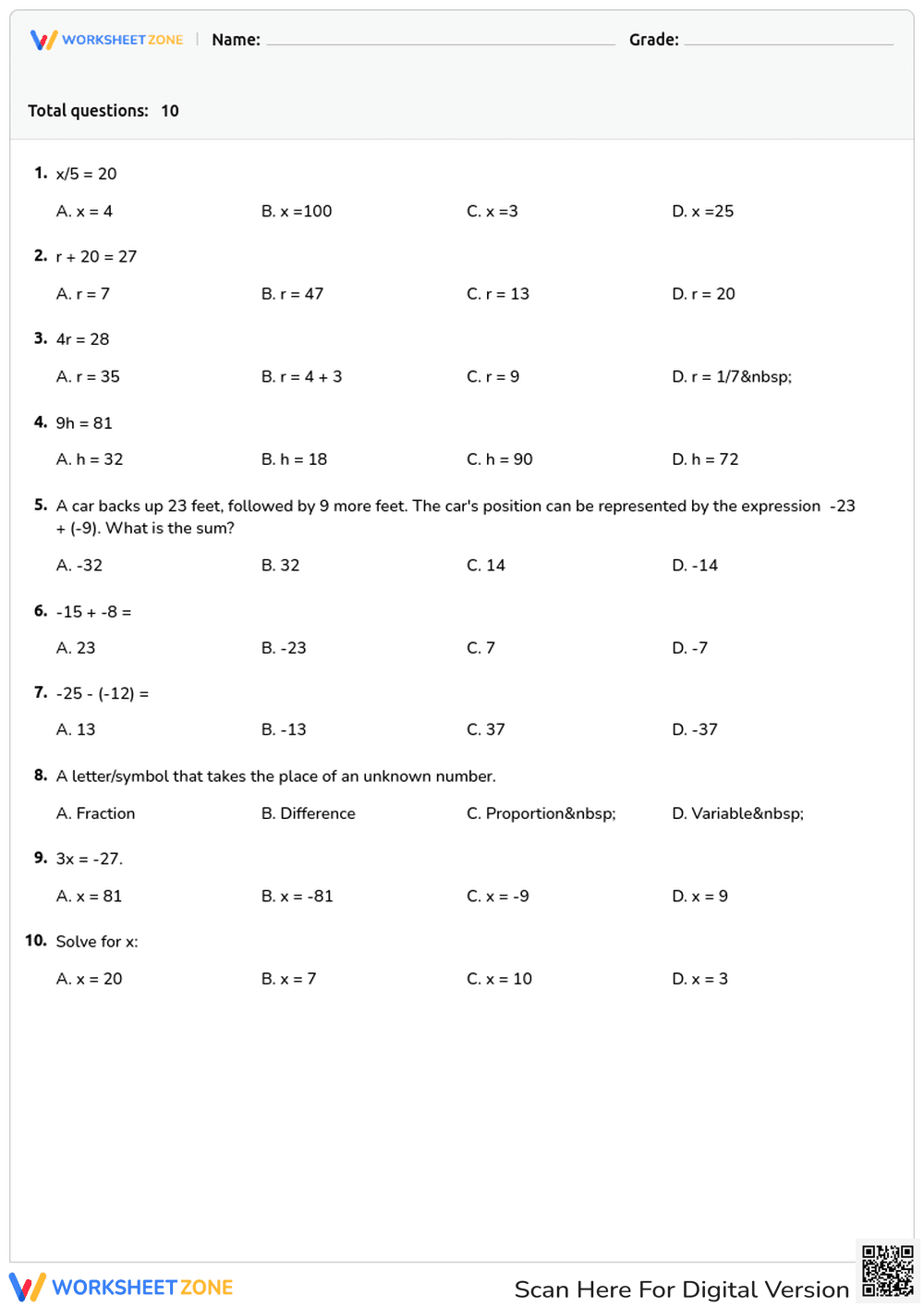

Grade 6 Math Review — Printable No-Prep Worksheet
Paste this activity's link or code into your existing LMS (Google Classroom, Canvas, Teams, Schoology, Moodle, etc.).
Students can open and work on the activity right away, with no student login required.
You'll still be able to track student progress and results from your teacher account.
This Grade 6 math review worksheet provides students with targeted practice on solving one-step equations and performing integer operations. By working through these multiple-choice problems, learners build fluency in isolating variables and applying negative number rules, ensuring they are prepared for more advanced algebraic concepts.
At a Glance
- Grade: 6 · Subject: Math
- Standard:
CCSS.MATH.CONTENT.6.EE.B.7— Solve one-step equations with positive and negative numbers- Skill Focus: One-Step Equations & Integer Operations
- Format: 1 page · 10 problems · Answer key included · PDF
- Best For: End-of-unit review or assessment
- Time: 15–20 minutes
Inside this single-page resource, educators will find a streamlined ten-question multiple-choice assessment. The problem set covers solving basic algebraic equations using addition, subtraction, multiplication, and division. It also includes practical application questions involving integer addition and subtraction, alongside a vocabulary check for algebraic terms. A complete answer key is provided to facilitate rapid grading.
Zero-Prep Workflow
- Print (1 minute): Simply download the PDF and print a class set. The clean layout requires no special formatting.
- Distribute (1 minute): Hand out the single-page quiz as a warm-up, exit ticket, or independent practice activity.
- Review (3 minutes): Use the included answer key to quickly score student responses or project it for whole-class self-grading.
Total teacher preparation time is under two minutes, making this an ideal resource for emergency sub plans or last-minute schedule changes.
Standards Alignment
This resource is closely aligned with CCSS.MATH.CONTENT.6.EE.B.7: "Solve real-world and mathematical problems by writing and solving equations of the form x + p = q and px = q for cases in which p, q and x are all nonnegative rational numbers." It also supports foundational integer operation skills. Both standard codes can be copied directly into lesson plans, IEP goals, or district curriculum mapping tools.
How to Use It
Deploy this worksheet during the review phase of an algebra unit, just before a summative assessment. It serves perfectly as an independent practice assignment where students can demonstrate their mastery of isolating variables. Alternatively, use it as a formative assessment tool; observe whether students struggle more with the algebraic steps or the underlying integer arithmetic. Expected completion time ranges from 15 to 20 minutes, depending on student fluency.
Who It's For
This worksheet is designed for sixth-grade math students, though it serves as an excellent remediation tool for seventh and eighth graders needing a refresher on basic equations. For differentiation, teachers can allow students who are struggling with integer rules to use a physical number line while completing the assignment. It pairs naturally with direct instruction lessons on inverse operations and algebraic vocabulary.
Mastering foundational algebra requires consistent, targeted practice with immediate feedback. According to EdReports 2024, instructional materials that provide clear, focused problem sets significantly improve student retention of core mathematical procedures. This worksheet directly addresses CCSS.MATH.CONTENT.6.EE.B.7, helping students solve one-step equations with positive and negative numbers. By integrating integer operations with algebraic reasoning, learners develop the procedural fluency necessary for higher-level mathematics. The multiple-choice format not only familiarizes students with standardized testing structures but also allows educators to quickly identify common misconceptions, such as sign errors during addition or subtraction. Regular exposure to these specific problem types ensures that students build confidence and accuracy, reducing cognitive load when they eventually transition to multi-step equations and complex functions in subsequent grade levels. This targeted approach solidifies essential skills for long-term academic success.


