


























Views
Downloads

Essential Perimeter Practice Worksheet | Grade 3 Aligned
Paste this activity's link or code into your existing LMS (Google Classroom, Canvas, Teams, Schoology, Moodle, etc.).
Students can open and work on the activity right away, with no student login required.
You'll still be able to track student progress and results from your teacher account.
This comprehensive math worksheet helps students master the concept of perimeter through engaging, real-world scenarios. By calculating the boundaries of various geometric shapes and determining material requirements for edges, learners develop a practical understanding of measurement and spatial reasoning. This resource bridges the gap between abstract geometry and functional application in daily life.
At a Glance
- Grade: 3 · Subject: Math
- Standard:
CCSS.MATH.CONTENT.3.MD.D.8— Solve real-world and mathematical problems involving perimeters of polygons- Skill Focus: Perimeter and measurement application
- Format: 4 pages · 8 problems · Answer key included · PDF
- Best For: Independent practice or small group review
- Time: 25–35 minutes
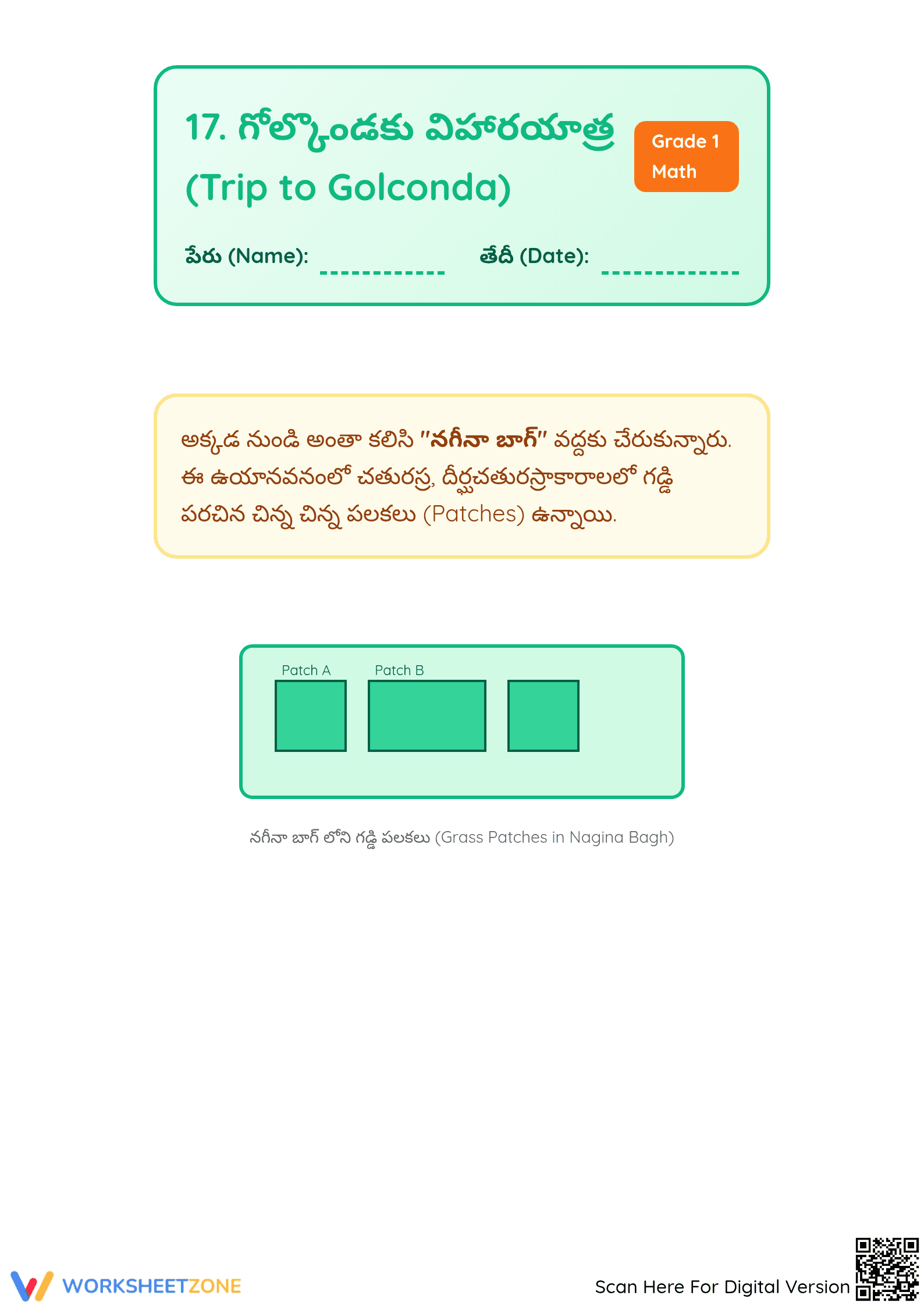
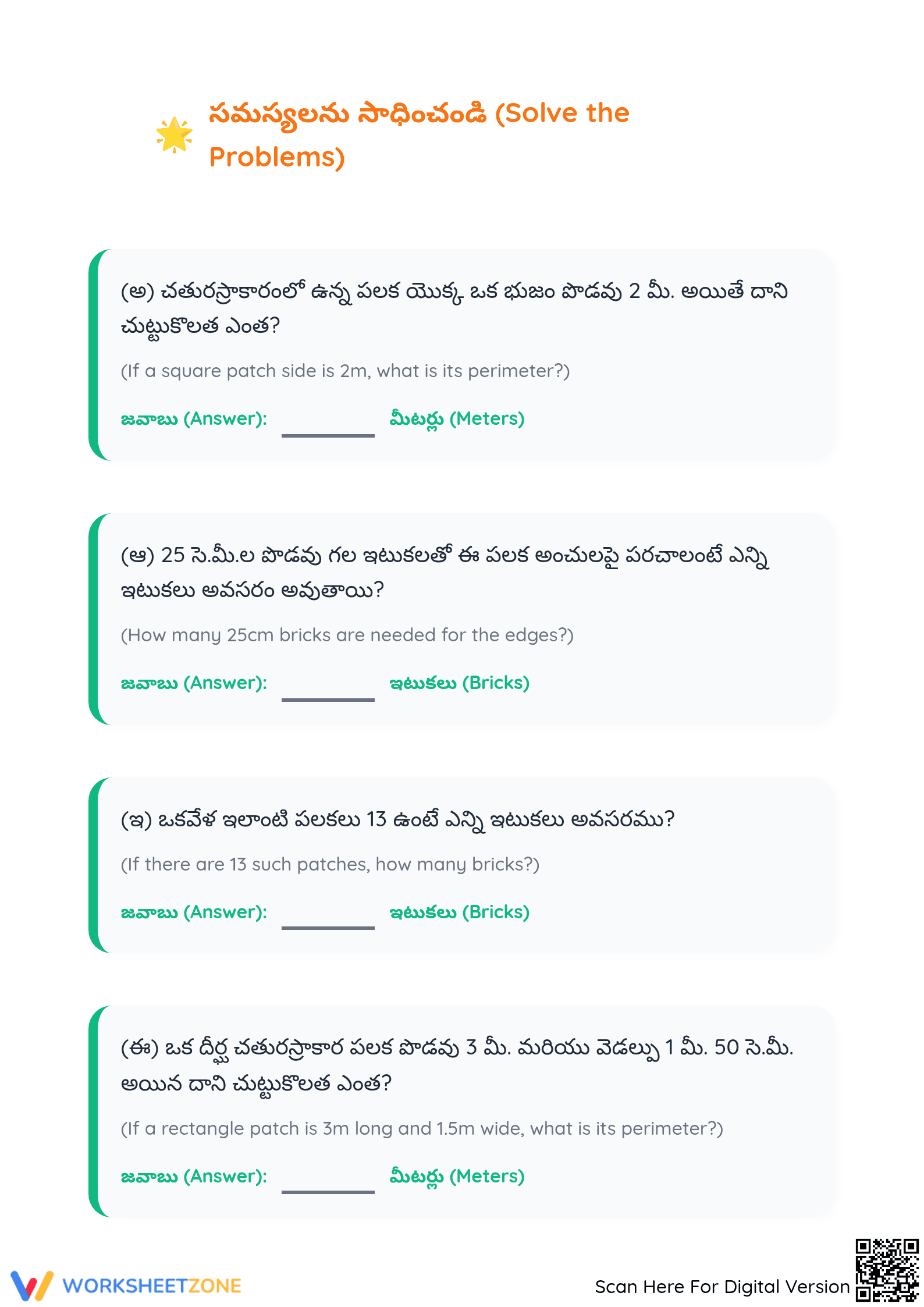
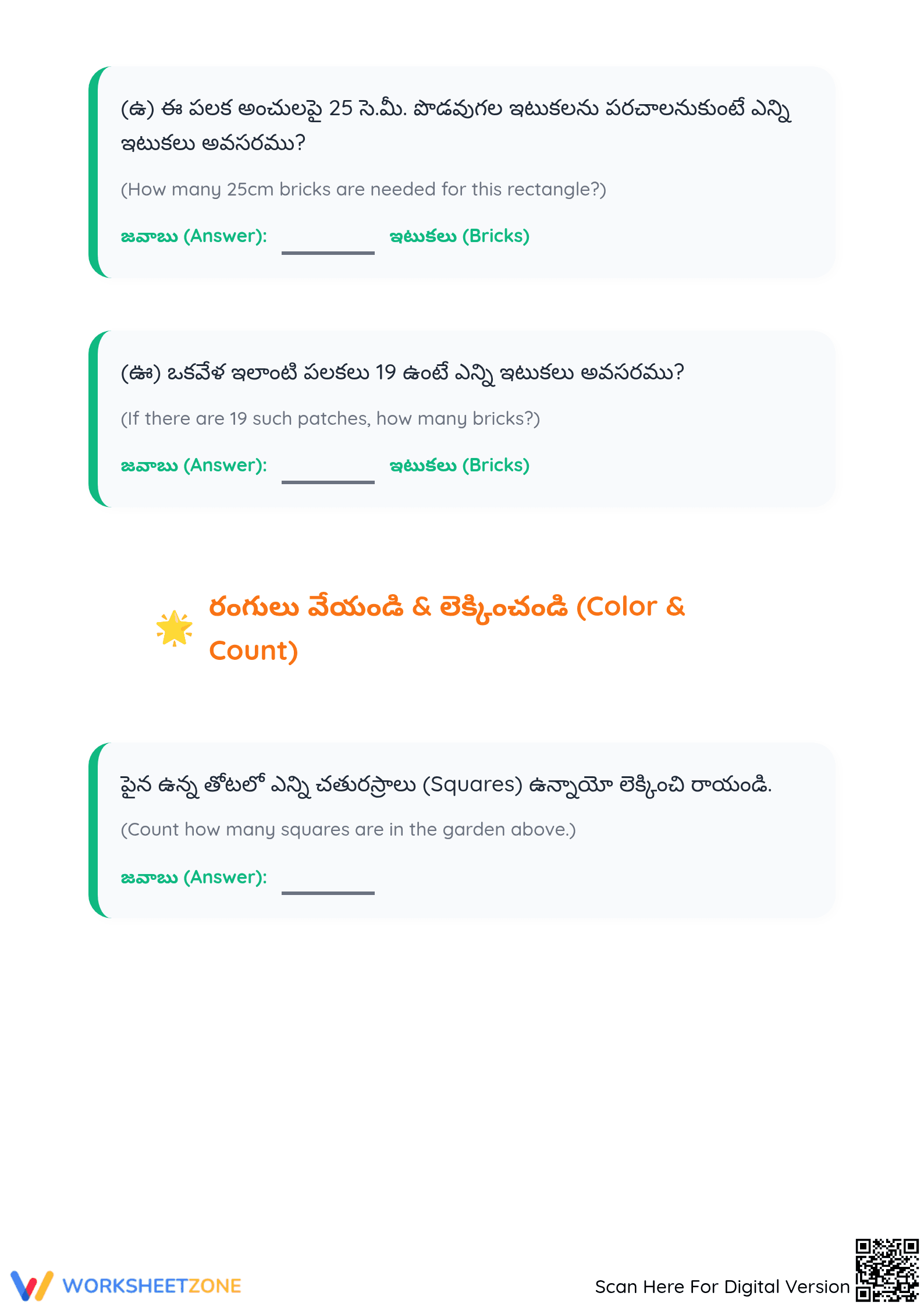
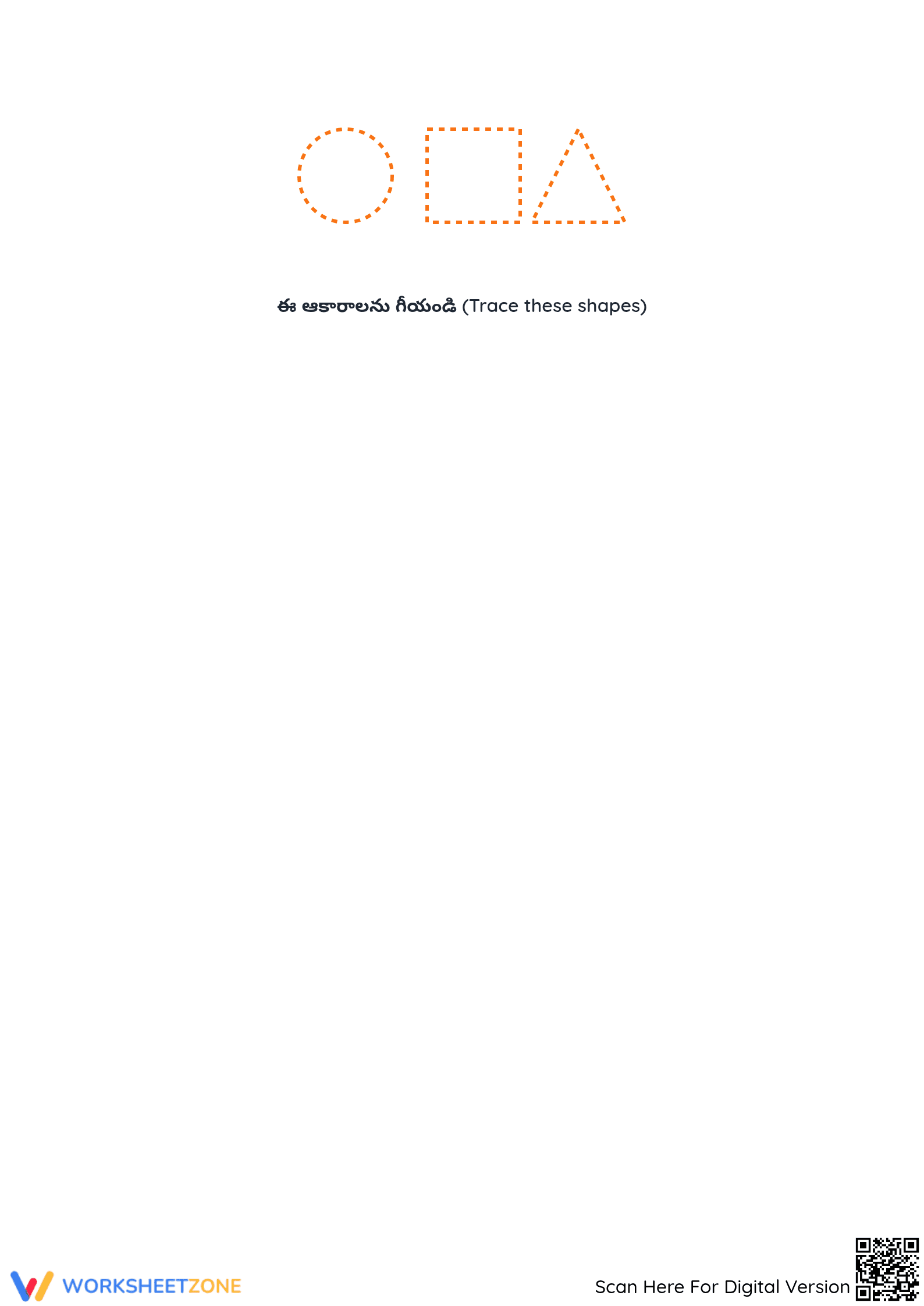
Inside this four-page PDF, students will find eight structured tasks that progress from basic shape identification to complex perimeter calculations. The worksheet includes problems involving squares and rectangles, unit conversions between meters and centimeters, and a creative "Color & Count" section. Visual aids representing "Grass Patches" in Nagina Bagh provide concrete context, while a tracing activity on the final page reinforces basic geometric recognition for circles, squares, and triangles.
The zero-prep workflow for this resource is designed for maximum teacher efficiency. First, print the four-page packet in less than one minute. Next, distribute the worksheets to students for a focused 30-minute individual session. Finally, use the included answer key for a five-minute whole-class review. This streamlined process requires less than two minutes of total teacher preparation, making it an ideal choice for substitute plans or last-minute enrichment.
This resource is specifically aligned to `CCSS.MATH.CONTENT.3.MD.D.8`, which requires students to solve real-world and mathematical problems involving perimeters of polygons, including finding the perimeter given side lengths. Both standard codes can be copied directly into lesson plans, IEP goals, or district curriculum mapping tools to ensure instructional compliance and accurate student progress tracking across the measurement domain.
Use this worksheet during the "Independent Practice" phase of a lesson on measurement or as a summative assessment after a unit on geometry. For a formative check, observe students during the brick-calculation tasks to see if they accurately convert units before calculating the total count for the rectangular patches. The expected completion time is 30 minutes, allowing it to fit perfectly into a standard math block or serve as a comprehensive homework assignment for weekend practice.
This resource is designed for Grade 3 students, though it provides excellent reinforcement for Grade 4 learners who need measurement review. The inclusion of bilingual labels in both Telugu and English makes it a valuable tool for English Language Learners or international classrooms. It pairs naturally with a reading passage about historical sites like Golconda or an anchor chart on perimeter formulas to provide a cross-curricular instructional experience.
According to the RAND AIRS 2024 report, integrating real-world contexts into mathematical problem-solving significantly increases student engagement and retention of spatial concepts. This worksheet employs a "Trip to Golconda" theme, using grass patches and bricks to ground abstract perimeter formulas in tangible scenarios. By asking students to determine how many 25cm bricks are needed for a square patch with 2m sides, the resource demands higher-order thinking and unit-conversion skills. Research by Fisher & Frey (2014) emphasizes that such scaffolded, context-rich practice is essential for moving students from procedural fluency to conceptual mastery. Providing clear visual representations of shape boundaries allows learners to visualize the perimeters they are measuring, reducing cognitive load while maintaining rigorous academic standards. This 4-page Essential Printable ensures that students meet the requirements of `CCSS.MATH.CONTENT.3.MD.D.8` through proven, ready-to-use instructional design that is classroom-tested for effectiveness.


