


























Views
Downloads

Navigate Vocabulary Worksheet | Essential Grade 5 ELA
Paste this activity's link or code into your existing LMS (Google Classroom, Canvas, Teams, Schoology, Moodle, etc.).
Students can open and work on the activity right away, with no student login required.
You'll still be able to track student progress and results from your teacher account.
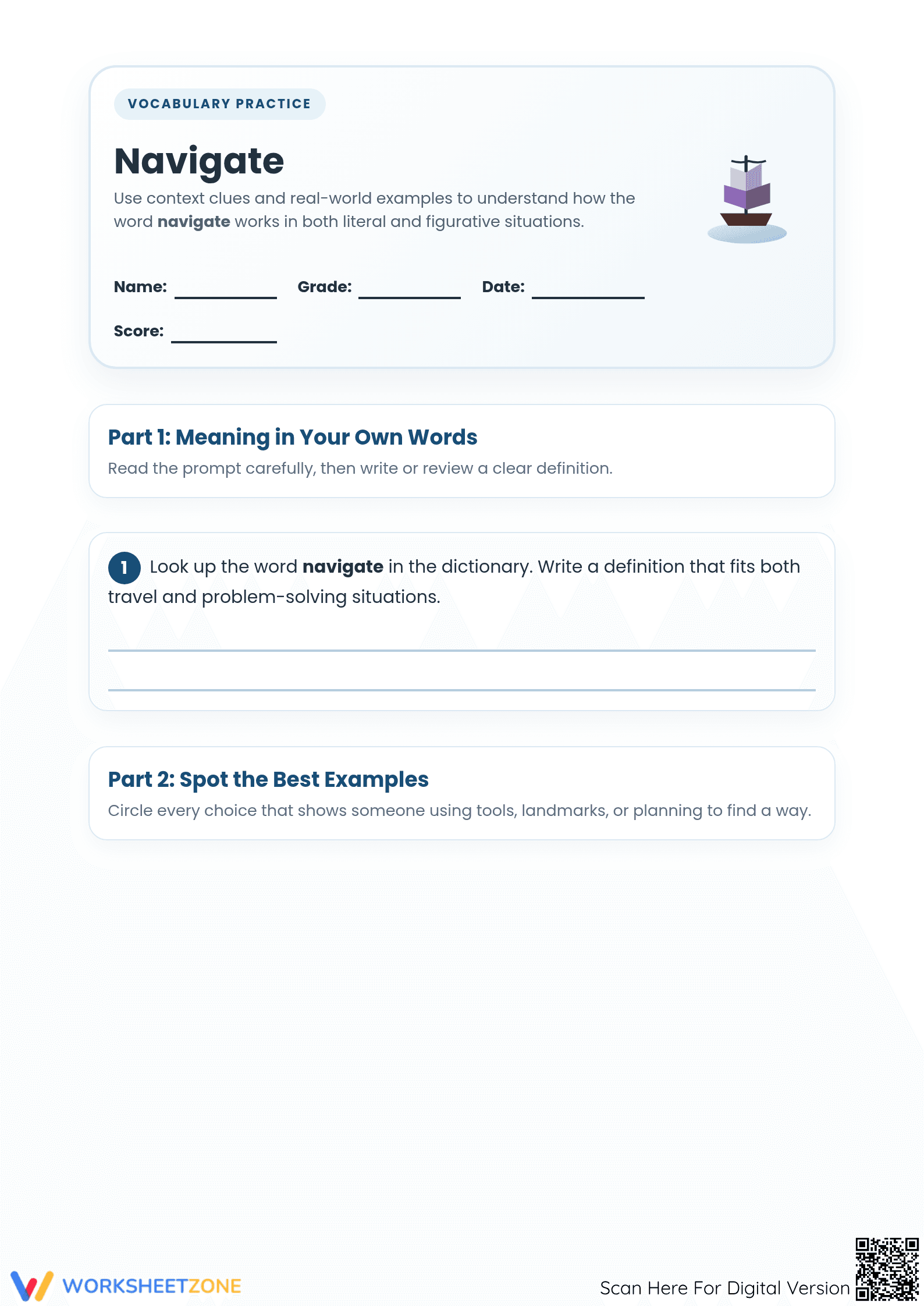
This Grade 5 vocabulary worksheet provides a comprehensive exploration of the word "navigate," helping students move beyond simple definitions to true conceptual mastery. By exploring both the literal and figurative applications of the term, learners develop the linguistic flexibility required for complex middle-school texts. Students will define, identify, and analyze the word in multiple contexts to ensure lasting retention.
At a Glance
- Grade: 5 · Subject: English
- Standard:
CCSS.ELA-LITERACY.L.5.4— Determine or clarify the meaning of unknown and multiple-meaning words and phrases- Skill Focus: Vocabulary Acquisition & Metaphor
- Format: 2 pages · 8 tasks · Answer key included · PDF
- Best For: Vocabulary expansion and figurative language practice
- Time: 15–20 minutes
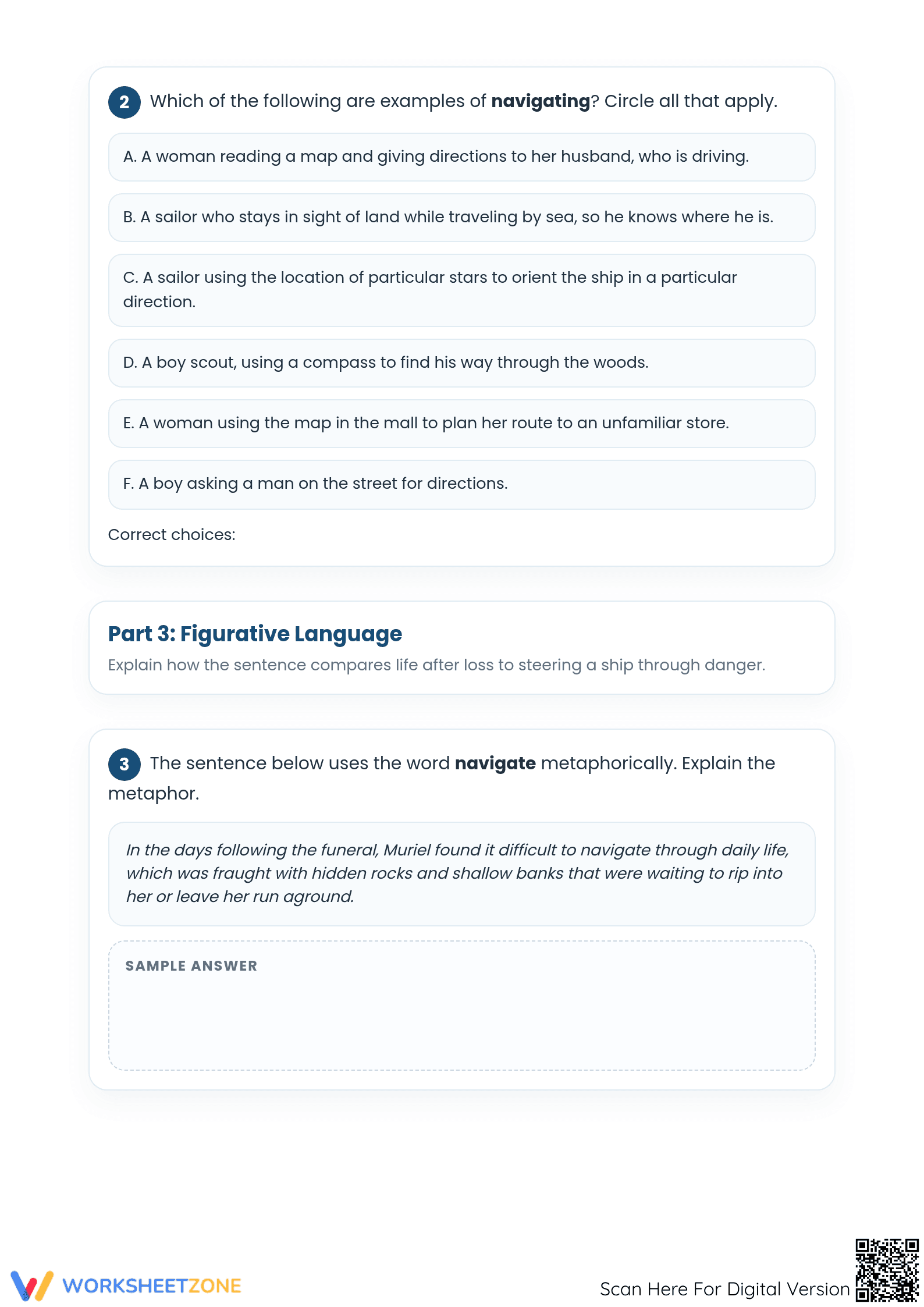
What's Inside: This comprehensive 2-page PDF features three distinct sections designed to build word depth. It includes a dictionary-based definition task, a multi-select identification exercise with 6 real-world scenarios, and a sophisticated metaphor analysis prompt. The layout is clean and focused, providing ample writing space and a sample answer section for the figurative language component to guide student responses.
- Guided Practice: Students begin by consulting a dictionary to synthesize a definition that bridges the gap between physical travel and abstract problem-solving, establishing a firm semantic foundation.
- Supported Practice: Learners evaluate 6 specific examples of navigation, ranging from reading maps to planning mall routes, to distinguish between active navigation and passive observation.
- Independent Practice: The final task requires students to deconstruct a complex metaphor involving life's challenges and nautical dangers, demonstrating high-level comprehension of figurative language.
This resource follows the gradual release of responsibility model, moving from teacher-supported dictionary work to independent literary analysis. Standards Alignment: This worksheet is primarily aligned with `CCSS.ELA-LITERACY.L.5.4`, focusing on word acquisition and usage. It also supports `CCSS.ELA-LITERACY.L.5.5` by requiring students to interpret figurative language within a specific context. Both standard codes can be copied directly into lesson plans, IEP goals, or district curriculum mapping tools.
How to Use It: This worksheet is ideal as a mid-week vocabulary reinforcement or a focused bell-ringer activity. For best results, assign this after a direct instruction session on context clues or nautical terminology. Teachers can use the metaphor section as a formative assessment to observe how well students transition from literal to abstract thinking. Expect completion within 15 to 20 minutes depending on dictionary access.
Who It's For: While designed for Grade 5 students, this resource is highly effective for ESL/ELL learners who need to understand the nuances of English polysemy. It pairs naturally with adventure literature, historical texts about exploration, or anchor charts focused on figurative language devices. The structured format provides necessary scaffolding for students who struggle with abstract word meanings.
According to research by Fisher & Frey (2014), vocabulary instruction is most effective when students are asked to use words in multiple contexts, including figurative ones. This worksheet implements that evidence-based strategy by requiring students to apply the word "navigate" to both physical maps and emotional landscapes. By engaging with 8 distinct tasks across 2 pages, students build the cognitive pathways necessary to move a word from short-term recognition to long-term expressive use. The inclusion of `CCSS.ELA-LITERACY.L.5.4` ensures that the practice is not just busywork but a targeted step toward meeting national literacy benchmarks. This resource provides the structured repetition and high-level analysis needed to bridge the gap between basic decoding and sophisticated reading comprehension in the upper elementary years.


