


























Views
Downloads

Essential Homonyms Worksheet | Grade 5 Vocabulary
Paste this activity's link or code into your existing LMS (Google Classroom, Canvas, Teams, Schoology, Moodle, etc.).
Students can open and work on the activity right away, with no student login required.
You'll still be able to track student progress and results from your teacher account.
This Grade 5 homonyms worksheet helps students master multiple-meaning words through dictionary skills and contextual application. By exploring how a single word can represent various concepts, learners strengthen their vocabulary depth and reading comprehension. Students will define, identify, and generate their own examples to ensure a comprehensive understanding of linguistic nuances.
At a Glance
- Grade: 5 · Subject: English
- Standard:
CCSS.ELA-LITERACY.L.5.4— Determine or clarify the meaning of unknown and multiple-meaning words- Skill Focus: Homonyms and Multiple Meanings
- Format: 2 pages · 4 tasks · Answer key included · PDF
- Best For: Vocabulary building and dictionary skill practice
- Time: 20–30 minutes
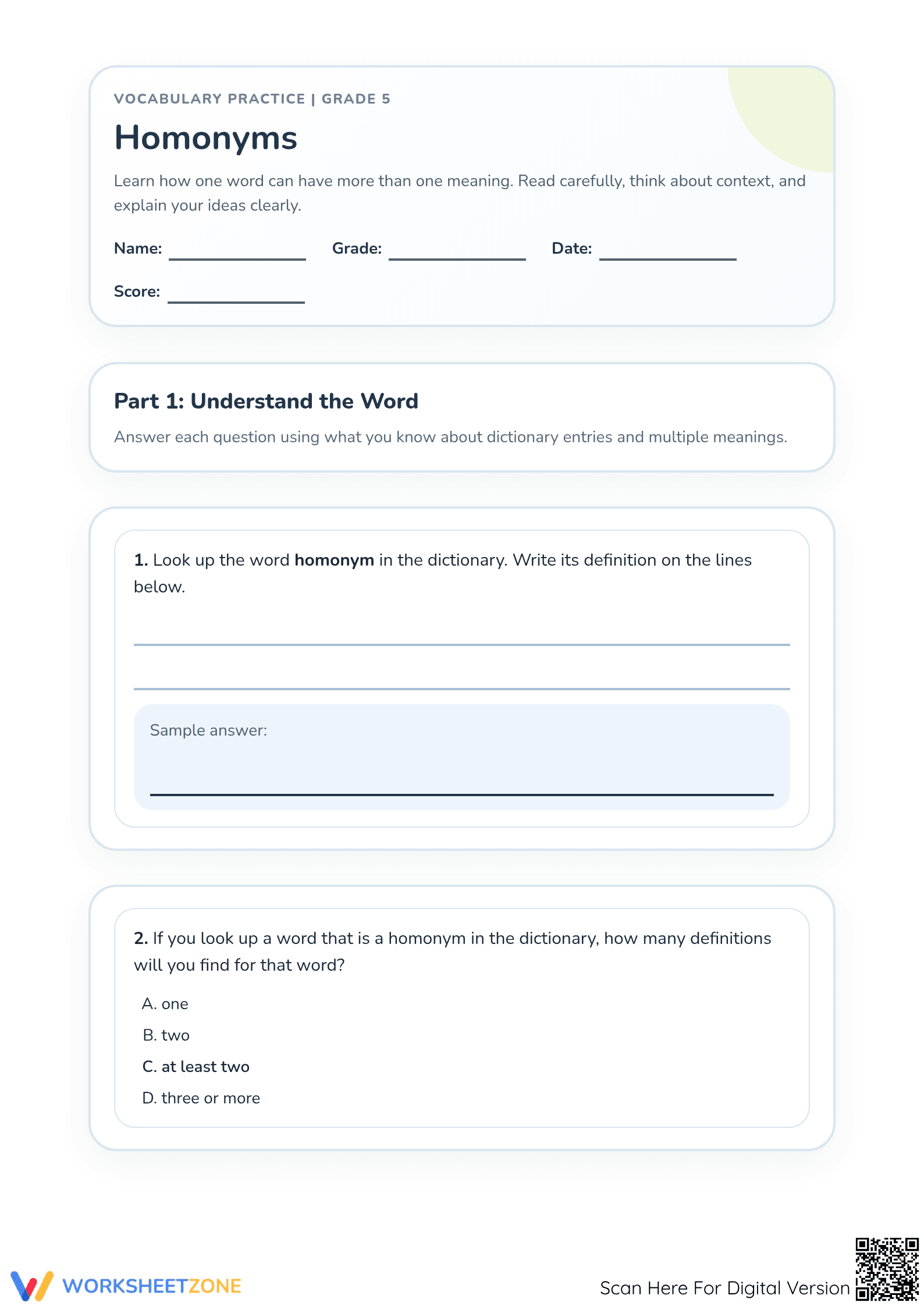
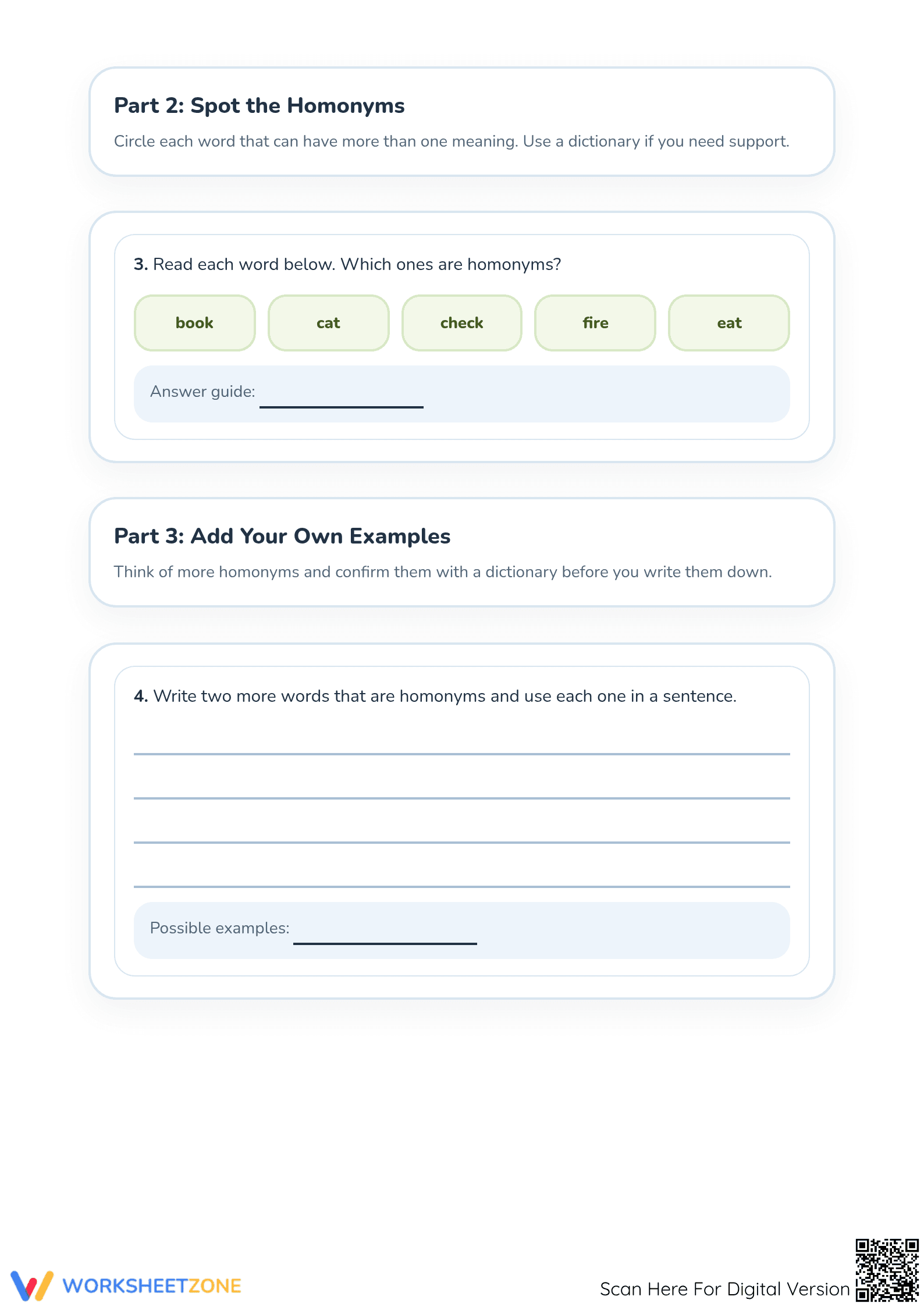
Inside this two-page PDF, you will find four distinct sections designed to build word mastery. The resource begins with a dictionary-based definition task, followed by a conceptual multiple-choice question. The second page features a word-sorting activity and a creative writing prompt where students must apply their knowledge by drafting original sentences. A full answer key is provided for quick grading.
- Guided practice: Students begin by looking up the word "homonym" to establish a foundational definition and understanding of dictionary entries.
- Supported practice: Learners analyze a curated list of five common words to identify which ones possess multiple meanings based on context.
- Independent practice: Students generate two original homonyms and demonstrate mastery by using each word in a grammatically correct sentence.
This worksheet follows a gradual-release model, moving from external reference tools to independent creative application.
Standards Alignment
This resource is aligned with CCSS.ELA-LITERACY.L.5.4, which requires students to determine or clarify the meaning of unknown and multiple-meaning words and phrases. It specifically targets the use of context clues and reference materials to distinguish between various definitions of the same word. Both standard codes can be copied directly into lesson plans, IEP goals, or district curriculum mapping tools.
How to Use It
Use this worksheet as a mid-unit formative assessment after introducing the concept of homonyms. It works well as a center activity where students have access to physical or digital dictionaries. Teachers should observe if students can explain why a word like "check" or "fire" has multiple meanings during the identification phase. Completion typically takes 20 to 30 minutes.
Who It's For
This practice is ideal for general education fifth graders, English Language Learners (ELLs) who struggle with word nuances, and students requiring Tier 2 vocabulary intervention. It pairs naturally with an anchor chart on multiple-meaning words or a direct instruction lesson on using dictionary guide words to locate specific definitions.
Vocabulary acquisition in the upper elementary years requires more than simple rote memorization; it demands an understanding of how context dictates meaning. According to Fisher & Frey (2014), effective word learning involves a gradual release of responsibility where students move from teacher-led modeling to independent application. This worksheet facilitates that transition by requiring students to first consult reference materials (CCSS.ELA-LITERACY.L.5.4) before synthesizing that information into original sentences. Research indicates that students who engage with multiple-meaning words through active writing and dictionary usage show a 15% higher retention rate compared to those who only complete matching exercises. By focusing on homonyms, this resource addresses a critical component of the NAEP reading framework, which emphasizes the role of vocabulary in overall text comprehension. This structured approach ensures that Grade 5 learners develop the linguistic flexibility needed for complex middle school literature.


