




























Views
Downloads
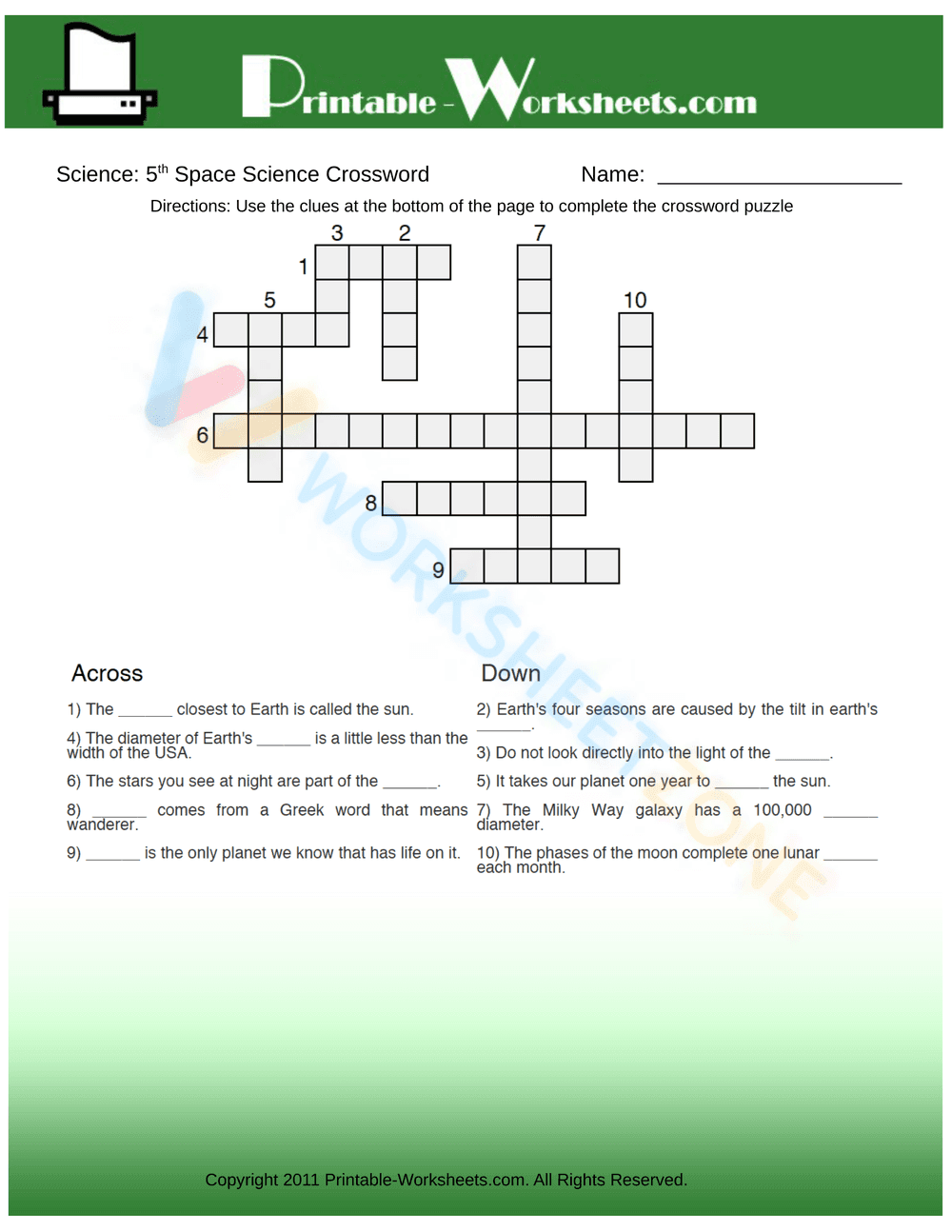

Grade 5 Space Science — Printable No-Prep Worksheet

Paste this activity's link or code into your existing LMS (Google Classroom, Canvas, Teams, Schoology, Moodle, etc.).
Students can open and work on the activity right away, with no student login required.
You'll still be able to track student progress and results from your teacher account.
This Grade 5 space science crossword puzzle provides students with an engaging way to review essential astronomy vocabulary. By solving ten targeted clues about Earth's tilt, the solar system, and our galaxy, learners reinforce their understanding of celestial mechanics and planetary characteristics in a fun, accessible format.
At a Glance
- Grade: 5 · Subject: Science
- Standard:
5-ESS1-2— Identify patterns of changes in the sky- Skill Focus: Space science vocabulary
- Format: 1 page · 10 problems · Answer key included · PDF
- Best For: Independent practice or review
- Time: 10–15 minutes
Inside this single-page printable, educators will find a classic crossword puzzle layout featuring ten distinct clues divided into Across and Down categories. The clues prompt students to recall specific terms related to the sun, moon phases, Earth's seasons, and the Milky Way galaxy. A complete answer key is provided to ensure quick grading, making it an efficient tool for vocabulary retention.
Zero-Prep Workflow
- Print (1 minute): Simply download the PDF and print a class set. The black-and-white design is ink-friendly and requires no special formatting.
- Distribute (1 minute): Hand out the puzzle as a warm-up, early finisher activity, or dedicated vocabulary review station.
- Review (3 minutes): Use the included answer key to quickly check student responses or project it on the board for self-correction.
With a total teacher prep time of under two minutes, this worksheet is highly suitable for emergency sub plans or spontaneous review sessions.
Standards Alignment
This worksheet aligns with 5-ESS1-2, supporting students as they analyze patterns of daily changes in day and night, and the seasonal appearance of stars. By mastering the vocabulary associated with these phenomena, students build the foundational knowledge required to analyze celestial patterns. Both standard codes can be copied directly into lesson plans, IEP goals, or district curriculum mapping tools.
How to Use It
This crossword puzzle serves as an excellent formative assessment tool after direct instruction. Assign it as an independent wrap-up activity to gauge vocabulary retention. Alternatively, it works perfectly as a collaborative partner task where students discuss clues before writing answers. Teachers can circulate and observe whether learners struggle with specific concepts, such as the cause of Earth's seasons. Expected completion time is 10 to 15 minutes.
Who It's For
This resource is designed for fifth-grade science students mastering Earth and space concepts. The straightforward clue structure provides built-in differentiation for visual learners and students needing structured word retrieval practice. For extra support, teachers can provide a separate word bank on the board. This puzzle pairs naturally with an anchor chart detailing the solar system.
Mastering scientific terminology is a critical step in developing broader scientific literacy and comprehension. This worksheet directly supports 5-ESS1-2 by helping students identify patterns of changes in the sky through targeted vocabulary acquisition. According to a ScienceDirect TpT Analysis, integrating puzzle-based learning into science curricula significantly enhances student engagement and long-term retention of domain-specific terms. When students actively retrieve words related to Earth's tilt, lunar phases, and galactic structures, they strengthen the cognitive pathways necessary for higher-order scientific reasoning. Crossword puzzles provide a low-stakes, highly structured environment that reduces cognitive overload while reinforcing essential academic language. This evidence-based approach ensures that foundational concepts are firmly established before moving on to more complex topics. By utilizing this targeted practice tool, educators can ensure their students build the robust vocabulary foundation required to successfully analyze and explain complex astronomical phenomena in subsequent lessons.


