


























Views
Downloads

5th Grade Energy Science Crossword | Printable Guide
Paste this activity's link or code into your existing LMS (Google Classroom, Canvas, Teams, Schoology, Moodle, etc.).
Students can open and work on the activity right away, with no student login required.
You'll still be able to track student progress and results from your teacher account.
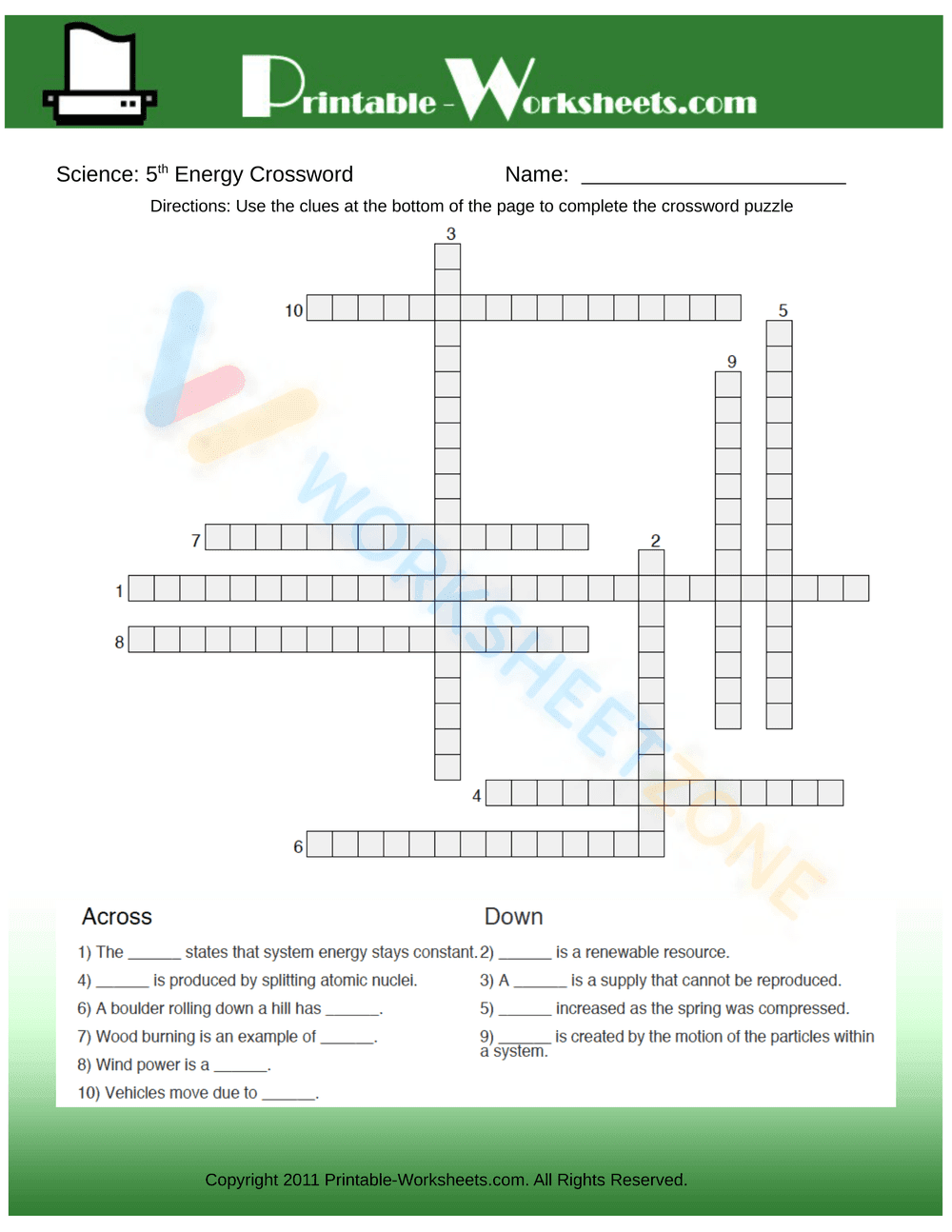
This Grade 5 science energy crossword provides students with 10 vocabulary-rich clues to reinforce fundamental physical science concepts. By identifying terms like kinetic, potential, and renewable energy, learners solidify their understanding of how energy functions within systems. This activity serves as an effective review tool for unit assessments or as a quick formative check.
At a Glance
- Grade: 5 · Subject: Science
- Standard:
5-PS3-1— Use models to describe that energy in animals’ food was once energy from the sun- Skill Focus: Energy Vocabulary & Concepts
- Format: 1 page · 10 problems · Answer key included · PDF
- Best For: Vocabulary review and early finishers
- Time: 15–20 minutes
This single-page PDF features a professionally designed crossword grid paired with 10 descriptive clues. The clues cover essential topics including the law of conservation of energy, nuclear fission, mechanical motion, and thermal energy. A clear name line and organized layout ensure student work remains legible, while the included answer key allows for rapid grading or self-correction.
Zero-Prep Workflow
The workflow for this resource is designed for maximum efficiency in busy classrooms. First, print the single-page PDF (30 seconds). Next, distribute the sheets to students as a warm-up or transition activity (1 minute). Finally, review the answers as a whole group to clarify misconceptions about energy types (5 minutes). Total teacher preparation time is under 2 minutes, making it an ideal sub-plan component.
Standards Alignment
This worksheet aligns with `5-PS3-1`, which requires students to use models to describe energy flow. While the standard focuses on food chains, the underlying vocabulary of energy forms—chemical, thermal, and mechanical—is foundational to this mastery. Both standard codes can be copied directly into lesson plans, IEP goals, or district curriculum mapping tools.
How to Use It
Assign this crossword during the "elaborate" phase of a 5E lesson cycle to help students internalize technical terminology. It works exceptionally well as a quiet-work option for students who finish lab experiments early. For a formative assessment, observe which students struggle with the distinction between renewable and nonrenewable resources to guide your next small-group instruction session. Completion typically takes 15 to 20 minutes.
Who It's For
This resource is tailored for fifth-grade students beginning their physical science units. It is particularly helpful for English Language Learners (ELLs) who benefit from the structural support of a crossword puzzle when learning academic vocabulary. Pair this worksheet with a visual anchor chart displaying energy transformations to provide additional scaffolding for diverse learners.
According to the RAND AIRS 2024 report, structured vocabulary practice in science significantly improves long-term retention of complex physical concepts. This worksheet targets the 5-PS3-1 standard by requiring students to recall and apply precise terminology related to energy systems, such as the law of conservation and the mechanics of renewable resources. By engaging with 10 specific clues, learners move beyond rote memorization toward a conceptual framework of how energy is stored and transferred. Research from Fisher & Frey (2014) emphasizes that crossword puzzles provide a low-stakes environment for students to test their knowledge of domain-specific language before high-stakes testing. This resource bridges the gap between initial exposure and mastery, ensuring that Grade 5 students possess the linguistic tools necessary for advanced scientific inquiry and evidence-based explanations in later middle school grades.


