


























Views
Downloads



Printable Math Assessment: Grades 6-9 Comprehensive Unit 1
Paste this activity's link or code into your existing LMS (Google Classroom, Canvas, Teams, Schoology, Moodle, etc.).
Students can open and work on the activity right away, with no student login required.
You'll still be able to track student progress and results from your teacher account.
Comprehensive Middle School Math Assessment
This comprehensive Grade 6-9 Mathematics Assessment provides a rigorous evaluation of essential middle school math concepts across five distinct domains. Students demonstrate mastery of arithmetic, algebraic expressions, geometry, and real-world problem-solving. This three-page resource is designed to identify learning gaps and confirm readiness for advanced mathematical topics within a single instructional period.
At a Glance
- Grade: 6-9 · Subject: Math
- Standard:
CCSS.MATH.CONTENT.7.EE.B.3— Solve multi-step real-life and mathematical problems using positive and negative rational numbers.- Skill Focus: Comprehensive Middle School Math Review
- Format: 3 pages · 14 problems · Answer key included · PDF
- Best For: End-of-unit assessment or comprehensive semester review.
- Time: 45–60 minutes
What's Inside
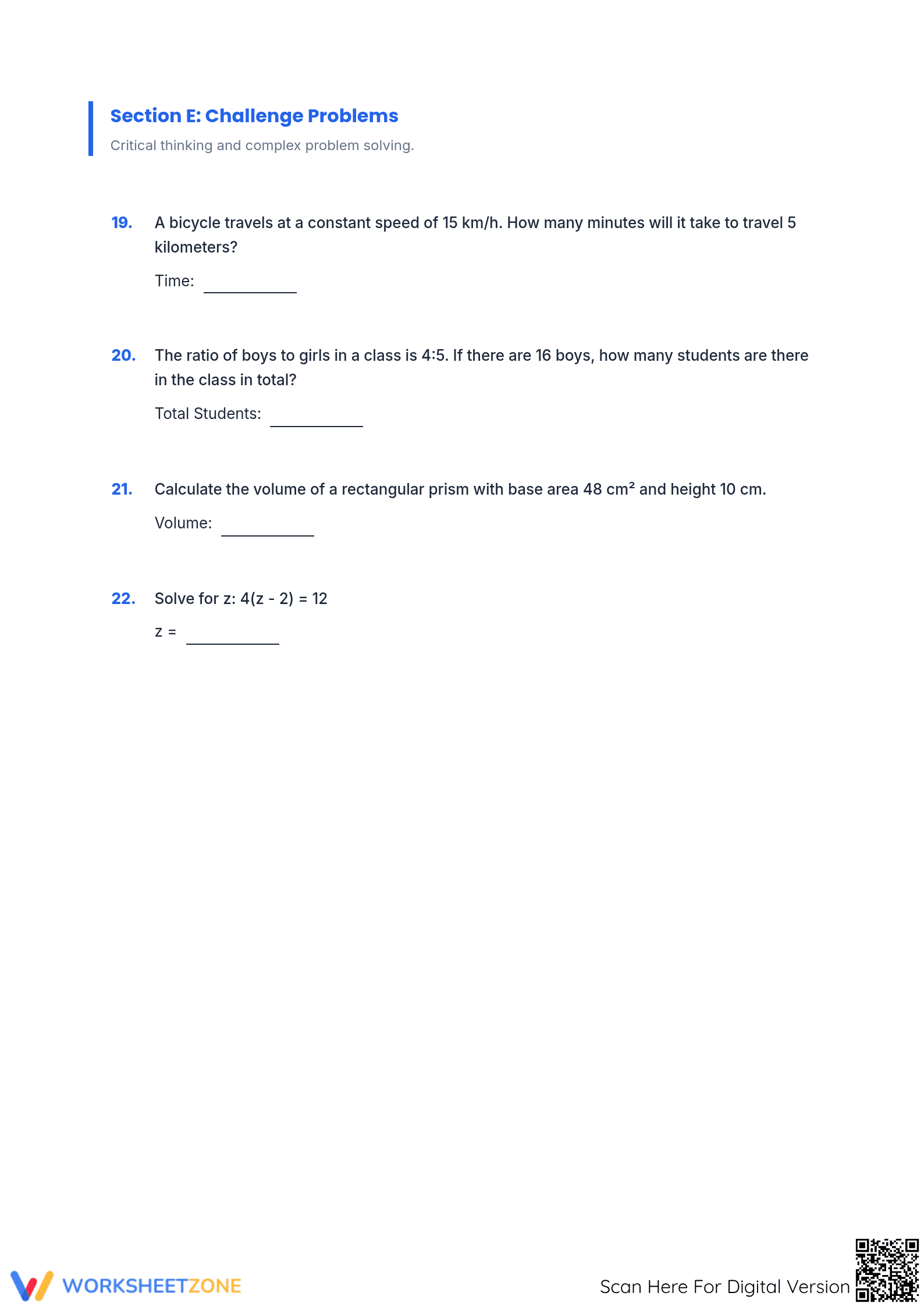
The assessment is divided into five logical sections: Arithmetic & Number Sense, Algebra & Equations, Geometry & Measurement, Practical Applications, and Challenge Problems. It includes 14 multi-part tasks ranging from decimal ordering to solving complex word problems. The resource features clear headings, dedicated workspace for student calculations, and a complete answer key for rapid grading.
Zero-Prep Workflow
The zero-prep workflow is optimized for busy educators. First, print the three-page PDF (less than 1 minute). Next, distribute the assessment to students with minimal instructions required due to the self-explanatory section headers (approx. 2 minutes). Finally, use the included answer key to review student work (10 minutes). This resource is perfectly suited as an emergency sub plan or a scheduled exam.
Standards Alignment
This worksheet is primarily aligned with `CCSS.MATH.CONTENT.7.EE.B.3`, which focuses on solving multi-step mathematical and real-life problems. Additionally, it supports `CCSS.MATH.CONTENT.6.NS.B.3` through multi-digit decimal operations and `CCSS.MATH.CONTENT.6.G.A.1` for area and perimeter calculations. Both standard codes can be copied directly into lesson plans, IEP goals, or district curriculum mapping tools.
How to Use It
Use this assessment as a summative tool after completing a unit on middle school math foundations. During the session, observe student progress through Section C (Geometry) to identify visual-spatial reasoning strengths. For formative use, assign Sections A and B as a "warm-up" check. Expected completion time is 50 minutes for most learners, allowing for a full class period execution.
Who It's For
Designed for Grade 6 through Grade 9 students, this resource is ideal for general education classrooms, tutoring centers, and homeschool settings. It provides excellent practice for students preparing for state-level standardized testing. Pair this worksheet with a coordinate plane anchor chart or a "cheat sheet" of geometric formulas to support students who require instructional accommodations.
The RAND AIRS 2024 report highlights that high-quality mathematics assessments integrating multi-domain problem-solving are critical for developing cognitive flexibility in secondary education. This resource aligns with the CCSS.MATH.CONTENT.7.EE.B.3 standard by requiring students to apply mathematical concepts to real-world scenarios, such as budget management and recipe scaling. Research by Fisher & Frey (2014) emphasizes that "checking for understanding" through comprehensive reviews allows teachers to adjust instructional pacing effectively. By providing 14 structured tasks across five sections, this assessment facilitates a data-driven approach to instruction. Educators can use the variety of problem types—ranging from simple arithmetic to multi-step challenge problems—to gauge if students have achieved functional mathematical literacy. The dedicated challenge section supports higher-order thinking, ensuring the needs of advanced learners are met while maintaining standard-aligned practice for all. This balance is essential for preparing students for high school success.


