


























Views
Downloads
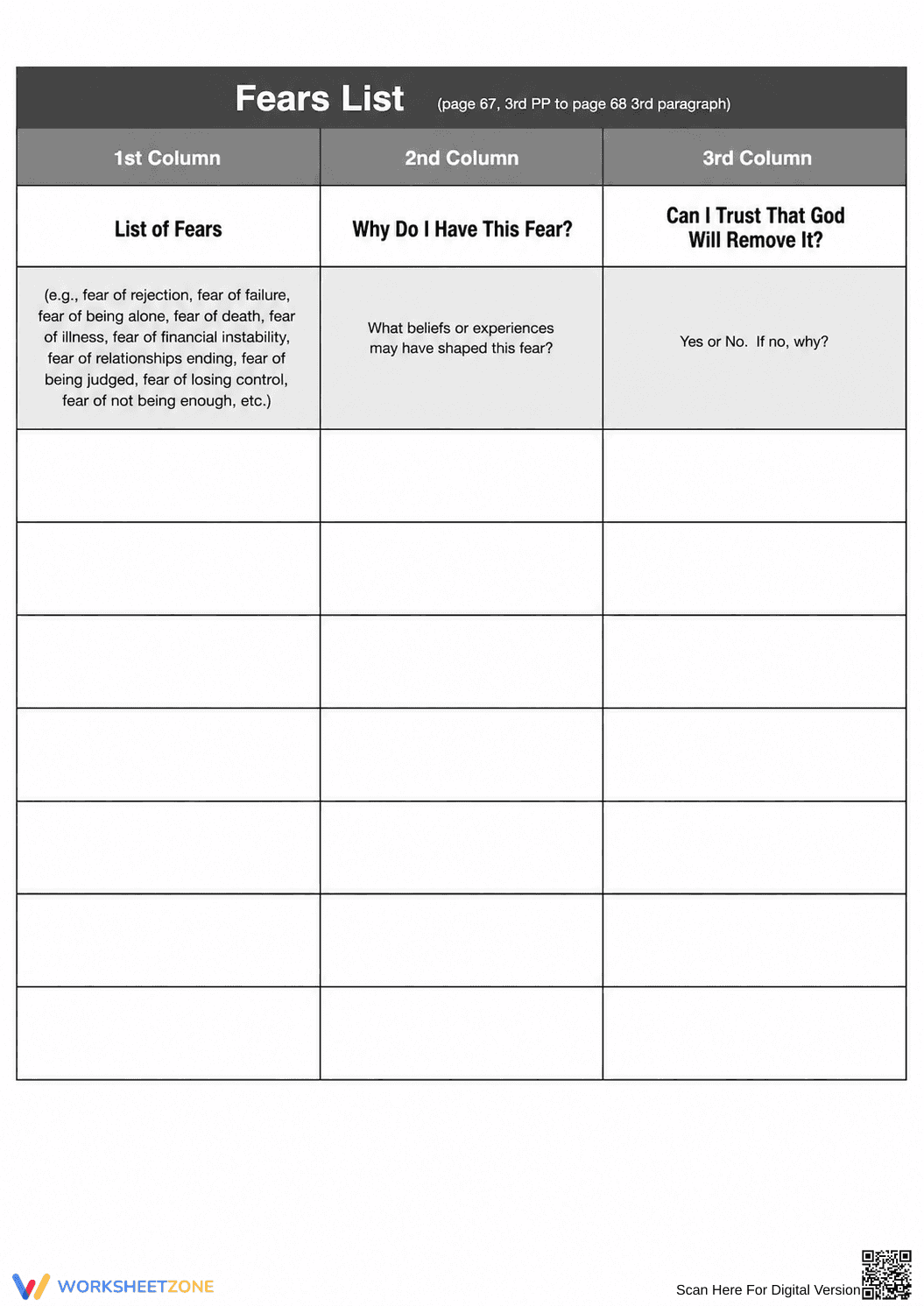

Printable 4th Step Fear List Worksheet | Grade 8
Paste this activity's link or code into your existing LMS (Google Classroom, Canvas, Teams, Schoology, Moodle, etc.).
Students can open and work on the activity right away, with no student login required.
You'll still be able to track student progress and results from your teacher account.
This Grade 8 social skills worksheet guides students through a structured self-reflection exercise to identify and analyze their personal fears. By completing this inventory, individuals develop greater emotional awareness and explore the underlying beliefs or experiences that shape their anxieties, fostering healthier coping mechanisms.
At a Glance
- Grade: 8 · Subject: Social Skills
- Standard:
CCSS.ELA-LITERACY.W.8.10— Write routinely for reflective and discipline-specific tasks- Skill Focus: Self-reflection and emotional awareness
- Format: 1 page · 8 problems · No answer key · PDF
- Best For: Independent reflection and counseling
- Time: 20–30 minutes
This single-page resource features a clear, three-column table designed for deep personal inventory. Students are provided with common examples of fears, such as rejection or failure, to prompt their thinking. They then fill in up to eight specific fears, articulate the root causes or past experiences that shaped them, and reflect on faith-based or personal trust strategies for overcoming these obstacles.
- Print (1 minute): Simply download the PDF and print copies for your group or individual counseling session.
- Distribute (1 minute): Hand out the inventory and briefly review the examples provided in the first column.
- Review (Ongoing): Allow students private time to complete the reflection, requiring zero additional teacher setup.
Total prep time is under two minutes, making this an ideal, ready-to-use resource for advisory periods, counseling sessions, or substitute teacher plans.
Aligned to CCSS.ELA-LITERACY.W.8.10, this activity requires students to write routinely over shorter time frames for a range of discipline-specific tasks, purposes, and audiences. It encourages clear, coherent reflective writing. Both standard codes can be copied directly into lesson plans, IEP goals, or district curriculum mapping tools.
Use this worksheet during a dedicated social-emotional learning (SEL) block or as part of a structured recovery program. It works well as an independent journaling activity before a group discussion on coping strategies. As a formative assessment, observe the depth of reflection in the second column to gauge a student's self-awareness and emotional vocabulary. Expected completion time is 20 to 30 minutes.
This resource is primarily designed for middle and high school students, as well as adults in counseling or recovery settings. The open-ended format naturally differentiates for varying levels of emotional maturity. It pairs excellently with direct instruction on emotional regulation or a lesson on identifying cognitive distortions.
Integrating structured emotional reflection tools like this inventory supports broader social-emotional learning objectives across middle and high school settings. Aligned with CCSS.ELA-LITERACY.W.8.10, the activity asks students to write routinely for reflective and discipline-specific tasks, building critical self-awareness and emotional vocabulary. According to a RAND AIRS 2024 report, consistent implementation of self-reflection and emotional identification exercises significantly improves students' ability to manage anxiety, regulate behavior, and navigate complex interpersonal challenges. By explicitly mapping out personal fears and their historical origins, learners transition from passive emotional responses to active cognitive processing. This specific framework encourages individuals to isolate their anxieties, examine the underlying life experiences that shaped them, and consider actionable or faith-based steps toward resolution. Ultimately, utilizing targeted reflection worksheets fosters long-term resilience, psychological flexibility, and emotional stability in both academic and personal environments.


