


























Views
Downloads



Essential Grade 4 Vocabulary Mastery Worksheet
Paste this activity's link or code into your existing LMS (Google Classroom, Canvas, Teams, Schoology, Moodle, etc.).
Students can open and work on the activity right away, with no student login required.
You'll still be able to track student progress and results from your teacher account.
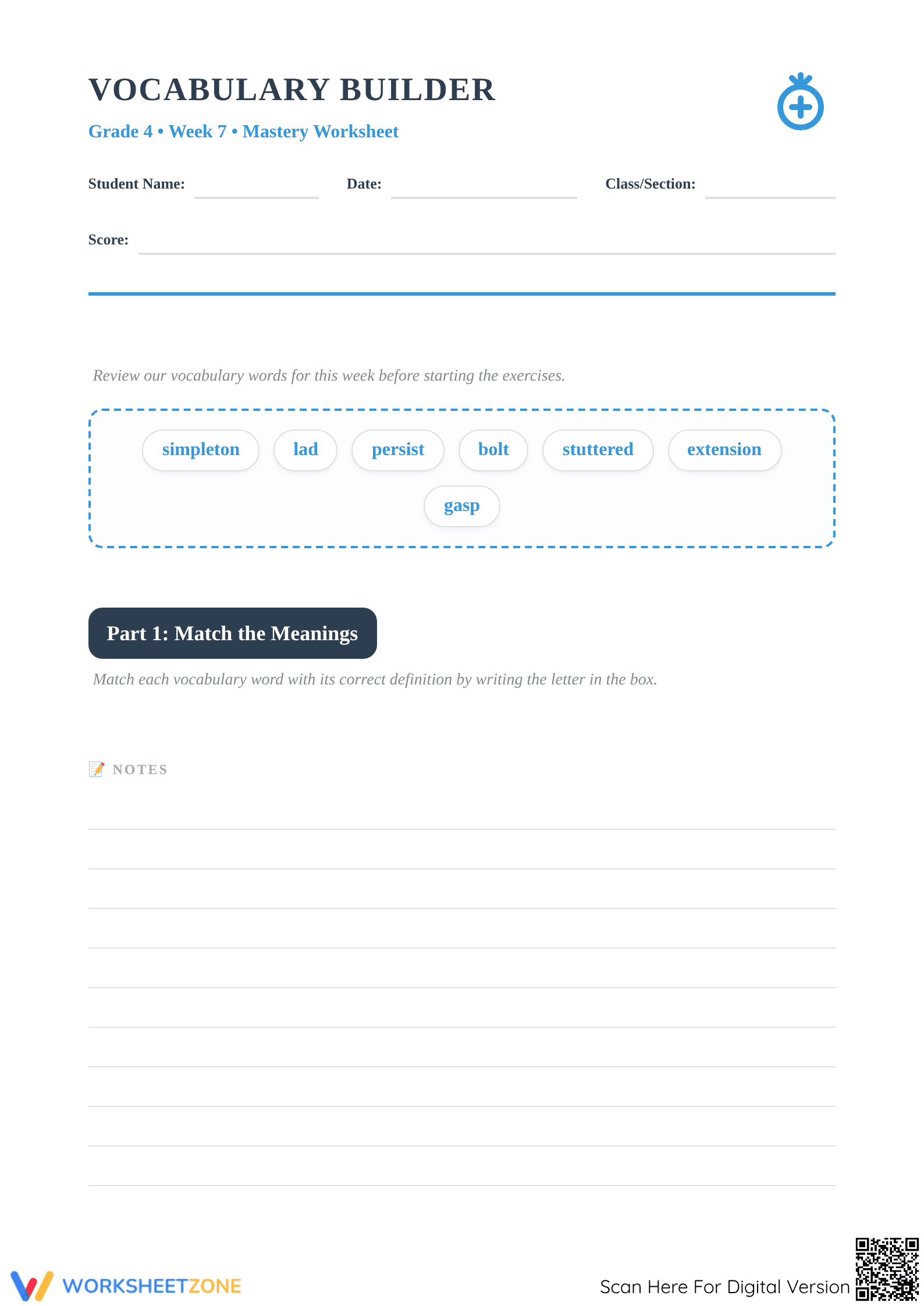
This Grade 4 vocabulary mastery worksheet provides students with a comprehensive framework to acquire and apply seven high-frequency academic words. By moving from simple definition matching to complex sentence construction, learners build the linguistic confidence necessary for reading comprehension and expressive writing. It ensures students do not just memorize words but internalize their nuances for practical use.
At a Glance
- Grade: 4 · Subject: English Language Arts
- Standard:
CCSS.ELA-LITERACY.L.4.6— Acquire and use accurately grade-appropriate general academic and domain-specific words- Skill Focus: Contextual Vocabulary Application
- Format: 4 pages · 20 problems · Answer key included · PDF
- Best For: Weekly vocabulary assessment or independent practice
- Time: 20–30 minutes
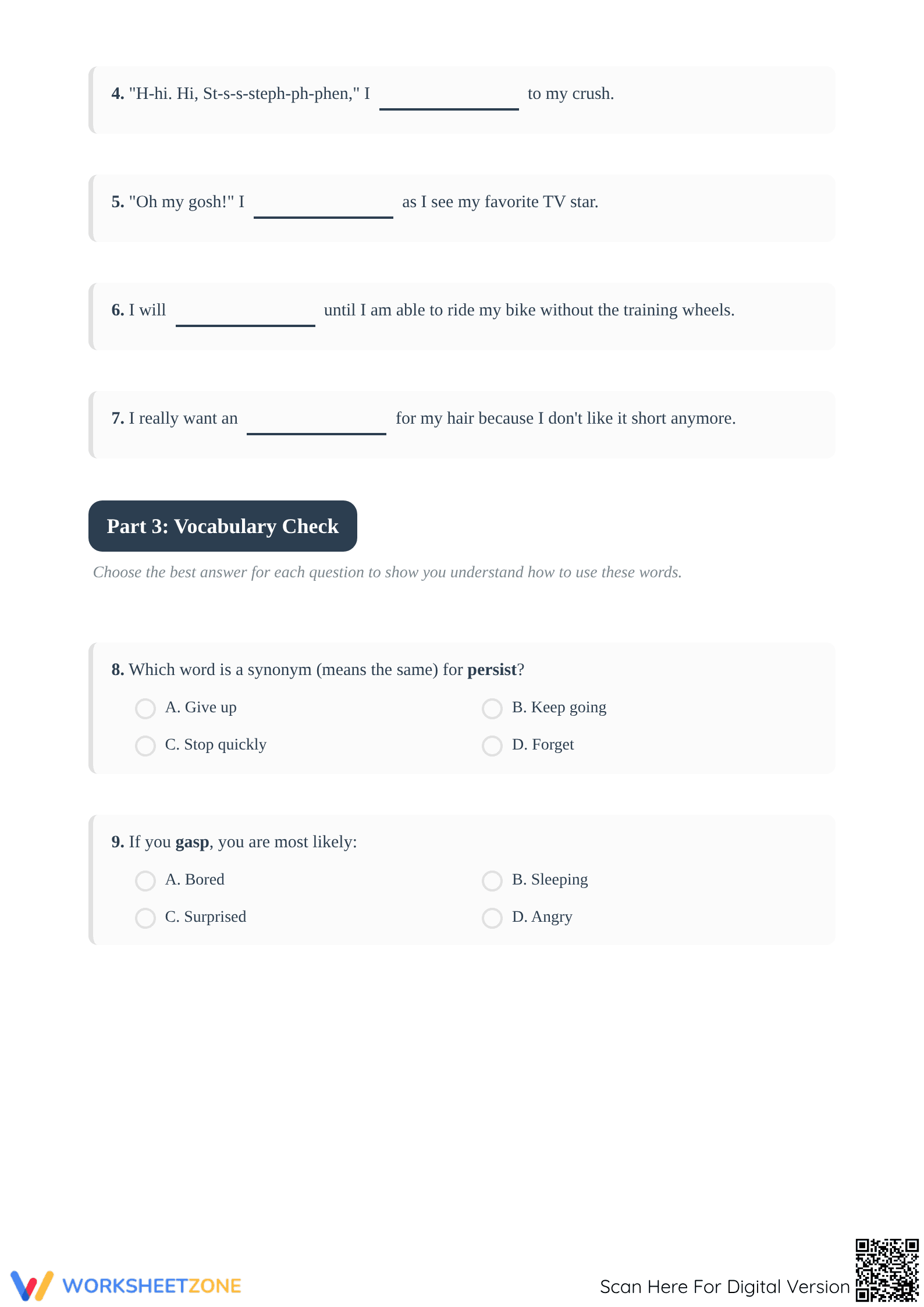
Inside this four-page PDF, you will find 20 distinct tasks organized into four logical tiers. The first page introduces the word bank and a matching exercise to establish baseline definitions for words like persist, simpleton, and extension. Subsequent pages challenge students with contextual fill-in-the-blank sentences, multiple-choice comprehension checks, and a creative writing section. A full answer key is provided for rapid grading or student self-correction.
The zero-prep workflow is designed for the busy educator. Print the four-page packet in less than 30 seconds. Distribute to students for a 25-minute independent work block or a weekly homework assignment. Finally, use the included answer key to review results in under two minutes. This resource is an ideal solution for emergency sub plans or Friday mastery checks where teacher time is limited.
Aligned to CCSS.ELA-LITERACY.L.4.6, this resource focuses on helping students acquire and use accurately grade-appropriate general academic and domain-specific words and phrases. It specifically targets words that appear frequently in informational texts and literary narratives. This standard code can be copied directly into lesson plans, IEP goals, or district curriculum mapping tools to ensure compliance with state frameworks.
Use this worksheet as a summative assessment at the end of a vocabulary unit or as a formative tool during mid-week instruction. Teachers should observe students during the Creative Sentences portion to identify if they can apply the words in original contexts. Completion typically ranges from 20 to 30 minutes depending on the student's writing speed and familiarity with the word bank.
This resource is designed for fourth-grade students but serves as an excellent scaffold for fifth-grade English Language Learners (ELL) or students requiring Tier 2 vocabulary intervention. It pairs naturally with a weekly reading passage or a classroom anchor chart displaying the target word bank for visual reinforcement. The clear layout ensures that students stay focused on the linguistic tasks without distraction.
According to the RAND AIRS 2024 report on literacy instruction, structured vocabulary practice that transitions from receptive tasks like matching to productive tasks like sentence generation is critical for long-term lexical retention. This worksheet follows that evidence-based trajectory by providing 20 opportunities for students to interact with the target words across different cognitive levels. By aligning with CCSS.ELA-LITERACY.L.4.6, the resource ensures that Grade 4 students are building the specific academic language required for success in upper elementary grades. Research from Fisher & Frey (2014) supports this gradual release of responsibility, moving from the supported word bank to independent creative application. This systematic approach reduces cognitive load while maximizing the student's ability to use new terms in diverse communicative contexts, making it a reliable tool for any standard-aligned ELA curriculum.


