


























Views
Downloads



Grade 4 Ancient World Vocabulary — Printable Worksheet
Paste this activity's link or code into your existing LMS (Google Classroom, Canvas, Teams, Schoology, Moodle, etc.).
Students can open and work on the activity right away, with no student login required.
You'll still be able to track student progress and results from your teacher account.
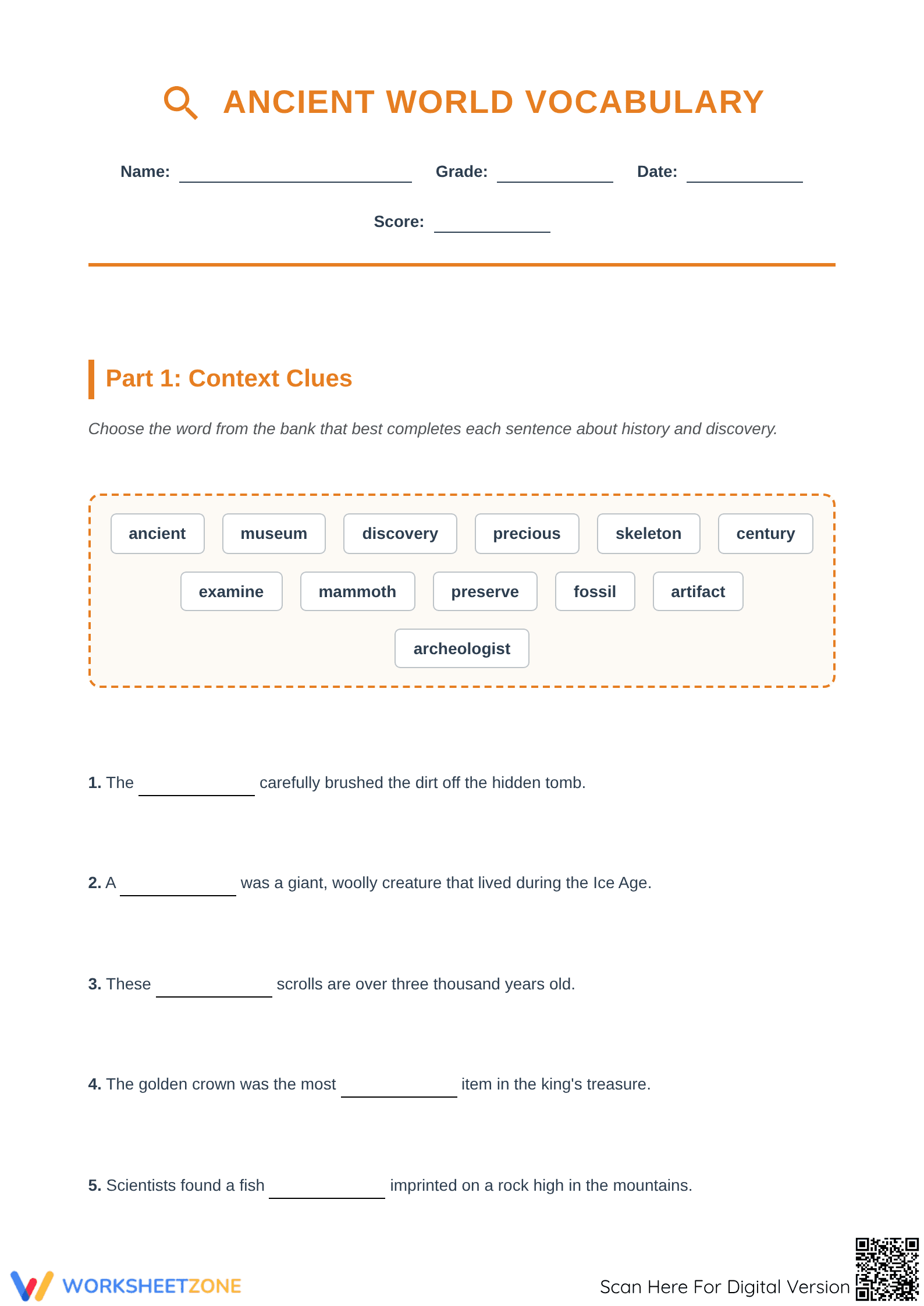
Strengthen your students' academic language with this comprehensive Ancient World vocabulary packet. This resource helps Grade 4 learners master domain-specific terminology through context clues, synonym matching, and conceptual relationship analysis. By the end of these exercises, students will accurately use words related to history and archeology in their own writing and discussions.
At a Glance
- Grade: 4 · Subject: English
- Standard:
CCSS.ELA-LITERACY.L.4.6— Acquire and use grade-appropriate domain-specific words and phrases accurately- Skill Focus: Ancient History Vocabulary
- Format: 4 pages · 29 problems · Answer key included · PDF
- Best For: Independent practice or social studies integration
- Time: 30–45 minutes
What's Inside
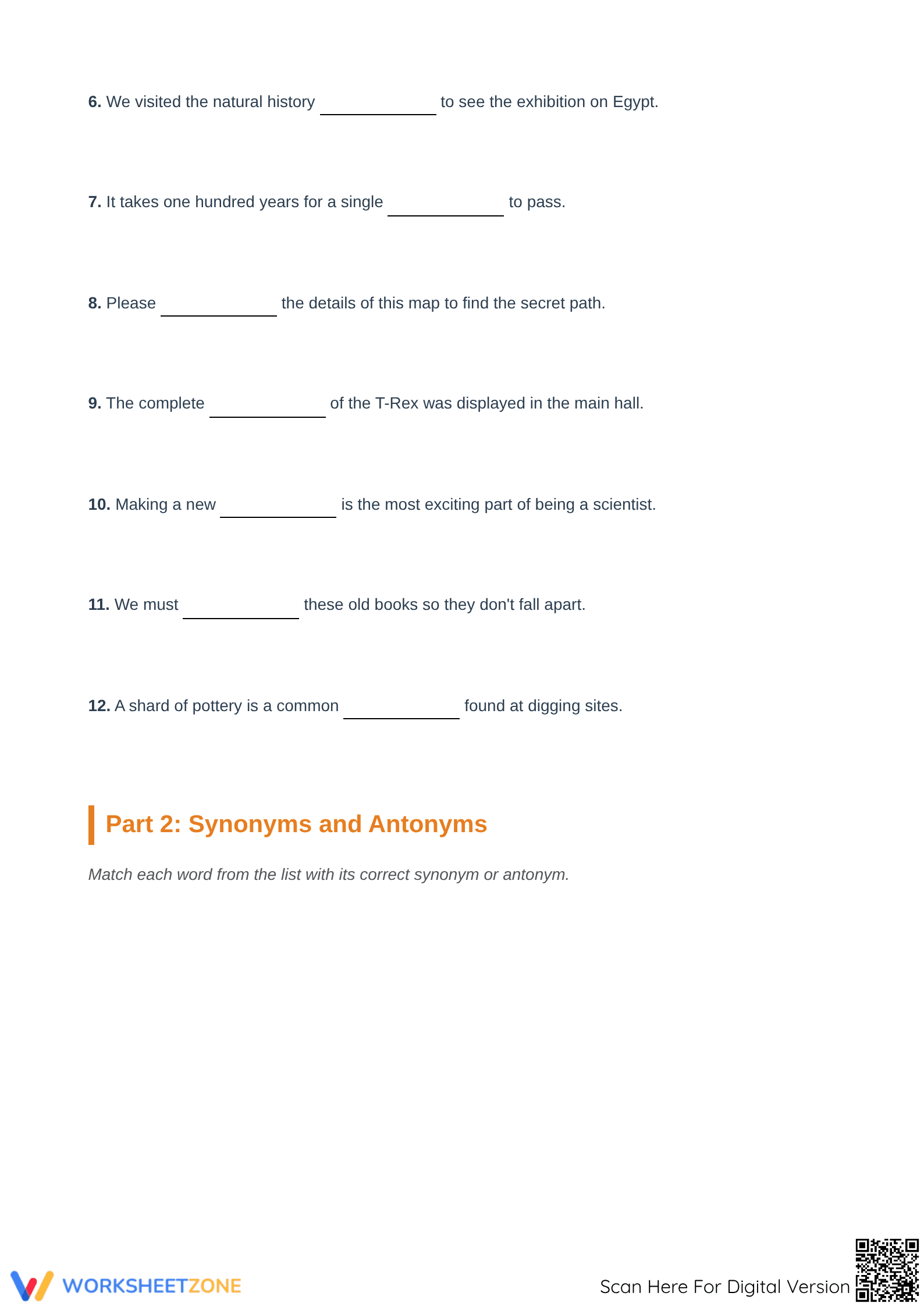
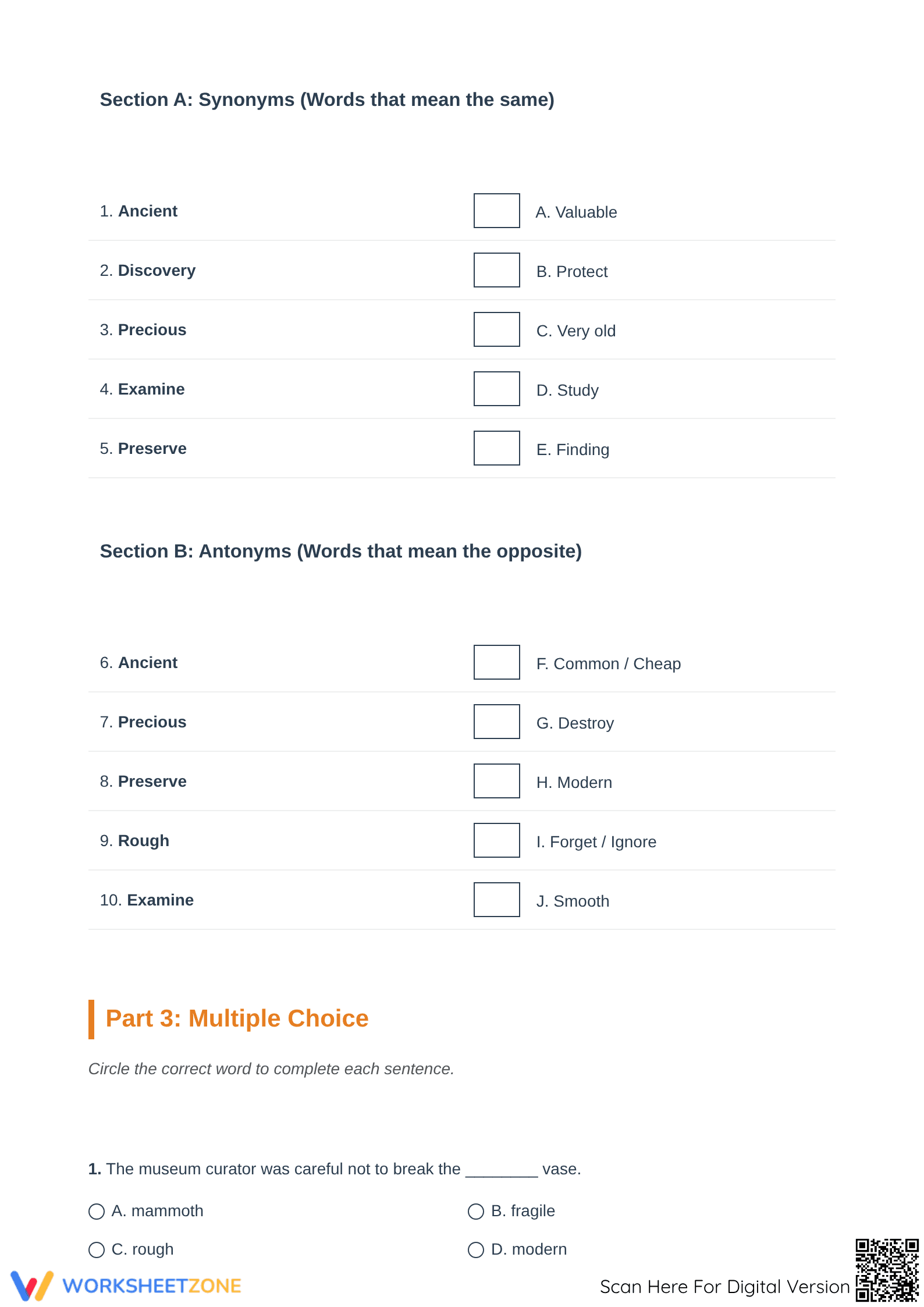
This four-page PDF contains 29 structured tasks divided into four distinct sections. Students work with a word bank of 12 high-frequency terms, including "archeologist," "artifact," and "mammoth." The packet includes fill-in-the-blank sentences, synonym and antonym matching, multiple-choice usage questions, and a short-answer section for explaining word relationships. A full answer key is provided for quick grading.
Zero-Prep Workflow
- Print: Select the 4-page PDF and print enough copies for your class in under 30 seconds.
- Distribute: Hand out the packets as a standalone vocabulary unit or a reliable sub plan.
- Review: Use the included answer key for rapid grading or student-led peer review. Total teacher prep time is under 2 minutes.
Standards Alignment
This worksheet aligns primarily with `CCSS.ELA-LITERACY.L.4.6`, focusing on the acquisition of domain-specific words. It also supports `CCSS.ELA-LITERACY.L.4.4.A` by requiring students to use context clues to determine the meaning of unknown words. Both standard codes can be copied directly into lesson plans, IEP goals, or district curriculum mapping tools.
How to Use It
Assign this packet during a social studies unit on ancient civilizations to bridge the gap between literacy and history. It works well as a formative assessment after direct instruction on context clues. Expect students to spend 30 to 45 minutes completing all four parts. Observe how students handle the "Word Relationships" section to gauge deep conceptual understanding.
Who It's For
This resource is designed for general education Grade 4 students, but it serves as excellent vocabulary support for English Language Learners (ELLs). Pair this worksheet with an informational text about archeology or an anchor chart featuring the 12 target words to provide additional visual scaffolding.
According to Fisher & Frey (2014), the acquisition of domain-specific vocabulary is a critical component of literacy development in the upper elementary grades. This worksheet targets CCSS.ELA-LITERACY.L.4.6 by providing students with multiple exposures to academic terms like "archeologist," "artifact," and "preserve" across four distinct cognitive tasks. Research indicates that students require varied interactions with new words—including identifying synonyms, analyzing context clues, and explaining conceptual relationships—to move from receptive recognition to expressive mastery. By isolating 12 high-frequency social studies terms, this resource reduces cognitive load while maximizing retention through structured repetition. The inclusion of a word bank and multiple-choice options provides necessary scaffolding for diverse learners, ensuring that the focus remains on semantic understanding rather than spelling. This systematic approach to vocabulary instruction aligns with evidence-based practices for improving reading comprehension and content-area literacy in Grade 4 classrooms, making it a reliable tool for daily instruction.


