


























Views
Downloads




Essential Grade 4 Vocabulary Worksheet: Synonyms & Antonyms
Paste this activity's link or code into your existing LMS (Google Classroom, Canvas, Teams, Schoology, Moodle, etc.).
Students can open and work on the activity right away, with no student login required.
You'll still be able to track student progress and results from your teacher account.
This Grade 4 vocabulary worksheet helps students master word relationships and context clues through 21 targeted exercises. Students practice identifying synonyms and antonyms while using surrounding text to define complex terms. By completing these structured tasks, learners build the linguistic precision necessary for reading comprehension and effective writing across all subject areas.
At a Glance
- Grade: 4 · Subject: English Language Arts
- Standard:
CCSS.ELA-LITERACY.L.4.4— Determine the meaning of unknown and multiple-meaning words using context clues- Skill Focus: Synonyms, Antonyms, and Contextual Definition
- Format: 5 pages · 21 problems · Answer key included · PDF
- Best For: Independent practice and formative assessment
- Time: 30–45 minutes
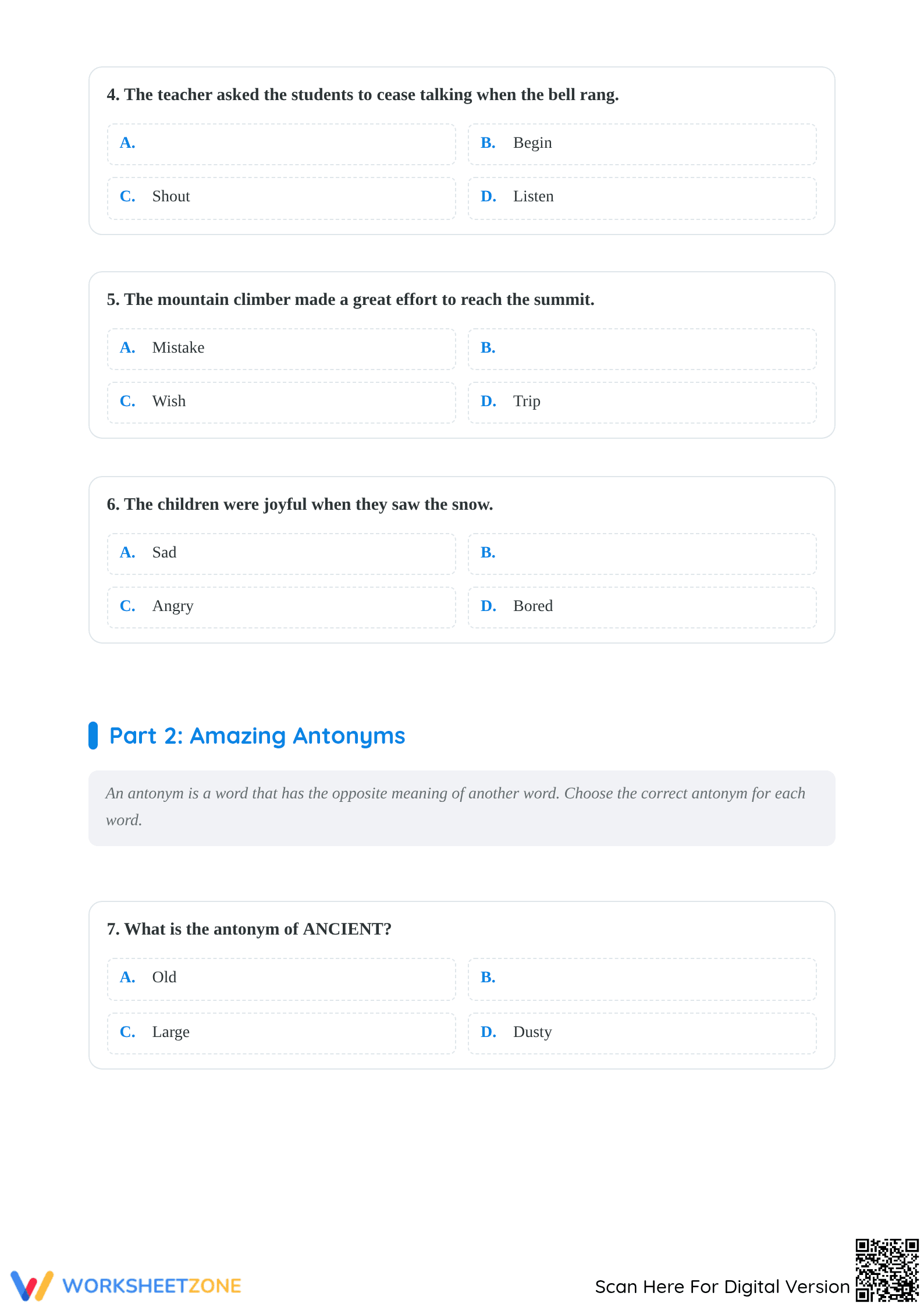
What's Inside: This comprehensive 5-page PDF contains four distinct sections designed to scaffold vocabulary acquisition. It features 6 multiple-choice synonym questions, 6 antonym challenges, 6 context clue detective tasks, and a final vocabulary mastery section with 3 fill-in-the-blank sentences using a word bank. A full answer key is provided for rapid grading and student self-correction.
Zero-Prep Workflow: This resource is designed for immediate implementation. First, print the 5-page packet (1 minute). Next, distribute the worksheets to students for independent or guided work (30 seconds). Finally, use the included answer key to review responses as a whole group or for individual grading (5 minutes). Total teacher preparation time is under 2 minutes, making it an ideal choice for sub plans or morning work.
Standards Alignment: The primary focus is `CCSS.ELA-LITERACY.L.4.4`: "Determine or clarify the meaning of unknown and multiple-meaning words and phrases based on grade 4 reading and content." It also supports `CCSS.ELA-LITERACY.L.4.5.C` by requiring students to demonstrate understanding of words by relating them to their opposites and synonyms. Both standard codes can be copied directly into lesson plans, IEP goals, or district curriculum mapping tools.
How to Use It: Assign this packet as a summative review after a unit on word relationships to gauge student mastery. Alternatively, use individual pages as "bell-ringers" or warm-up activities over the course of a week. During instruction, observe if students can explain why a specific context clue led them to a definition to assess their metalinguistic awareness. Completion typically takes 30 to 45 minutes depending on student reading speed.
Who It's For: This resource is ideal for general education fourth-grade students, English Language Learners (ELLs) needing explicit vocabulary support, and students with IEP goals focused on language processing. It pairs naturally with grade-level reading passages or anchor charts detailing common prefixes and suffixes to further enhance word-solving strategies during literacy blocks.
According to the RAND AIRS 2024 report, explicit instruction in word relationships and context clues is a fundamental component of literacy development that directly correlates with improved reading comprehension scores. This worksheet aligns with those findings by providing 21 structured opportunities for students to engage with CCSS.ELA-LITERACY.L.4.4. By isolating synonyms, antonyms, and contextual definitions, the resource ensures that students develop a robust mental lexicon. Research from Fisher & Frey (2014) emphasizes the importance of the gradual release of responsibility, which is mirrored here through the transition from multiple-choice recognition to fill-in-the-blank application. Educators can utilize this tool to provide the high-frequency practice necessary for students to move from surface-level word recognition to deep semantic understanding. This evidence-based approach supports diverse learners in achieving mastery of fourth-grade language standards through clear, repeatable, and measurable tasks that build confidence in decoding unfamiliar text.


